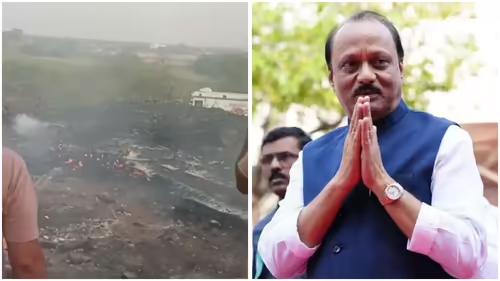
In a devastating turn of events, Maharashtra Deputy Chief Minister Ajit Pawar is fighting for his life after a private jet carrying him crash-landed during an emergency landing attempt at a private airstrip in Baramati on January 27, 2026. Contrary to earlier reports of minor injuries, hospital authorities have now confirmed that Pawar sustained critical injuries and is in serious condition, undergoing intensive care [[1]].
The incident has sent shockwaves through India’s political landscape and ignited a nationwide conversation about the safety of private air travel, the regulation of non-commercial airstrips, and the adequacy of emergency response systems outside major airports.
Table of Contents
- Breaking Down the Ajit Pawar Plane Crash Incident
- The Latest on Ajit Pawar’s Health
- What Went Wrong? The Emergency Landing Failure
- The Aircraft and Airstrip Under Scrutiny
- Political Fallout and National Response
- Broader Implications for India’s Private Aviation
- Conclusion: A Nation Holds Its Breath
- Sources
Breaking Down the Ajit Pawar Plane Crash Incident
The Cessna Citation CJ3+ aircraft departed from Juhu Aerodrome in Mumbai in the late morning, bound for Baramati. Mid-flight, the crew reported a technical malfunction and initiated an emergency protocol. They diverted to the Pawar family’s private airstrip, a common practice for the political family.
During the landing approach, the aircraft failed to stop within the runway’s confines. It overshot the tarmac, smashed through a boundary wall, and came to a violent halt in an adjacent field. The impact was severe, causing significant damage to the fuselage [[2]].
While four other passengers on board—reportedly aides and family members—suffered non-life-threatening injuries, Ajit Pawar was found unconscious at the scene and was rushed to a nearby hospital in critical condition.
The Latest on Ajit Pawar’s Health
Initial reports suggesting all passengers were safe have been corrected. According to official statements from the hospital, Ajit Pawar suffered multiple internal injuries and a head trauma. He is currently in the Intensive Care Unit (ICU) and is on ventilator support. His condition is described as “serious but stable,” and doctors are monitoring him closely [[3]].
Chief Minister Eknath Shinde and several top NCP leaders have visited the hospital. The state government has declared a high-level medical team will oversee his treatment, and updates are being provided regularly to the public.
What Went Wrong? The Emergency Landing Failure
The Directorate General of Civil Aviation (DGCA) has launched an immediate investigation. Early findings suggest a confluence of factors may have contributed to the crash:
- Aircraft Malfunction: The nature of the in-flight technical issue is the primary focus. A failure in critical systems like hydraulics or flight controls could have compromised the pilot’s ability to land safely.
- Airstrip Limitations: The private airstrip in Baramati, while functional, is significantly shorter than commercial runways. This leaves minimal margin for error during an emergency landing, especially for a jet aircraft.
- Weather and Visibility: Local meteorological data indicates light fog in the region at the time of the incident, which could have affected the pilot’s visibility during the final, crucial moments of the approach.
The Aircraft and Airstrip Under Scrutiny
The Cessna Citation CJ3+ is a widely used business jet, generally considered reliable. However, its performance is highly dependent on proper maintenance and suitable landing infrastructure. The Baramati airstrip, owned by the Pawar family, is not certified for commercial operations and lacks advanced safety features like Instrument Landing Systems (ILS) or a dedicated fire station—resources standard at major airports [[4]].
This incident has thrown a harsh spotlight on the regulatory gap for hundreds of such private airstrips across India, raising the question: should they be permitted to handle emergency landings for modern jet aircraft without stringent safety upgrades?
Political Fallout and National Response
The news has created a political vacuum in Maharashtra, with all eyes on the state’s leadership. Prime Minister Narendra Modi and Union Home Minister Amit Shah have expressed their concern and wished for a swift recovery. The opposition has called for a transparent and independent probe, demanding accountability from aviation authorities [[5]].
Public reaction has been one of deep anxiety and solidarity, with social media flooded with messages of support. The incident has also sparked a debate on the personal security and travel protocols for high-ranking officials.
Broader Implications for India’s Private Aviation
This tragedy is more than a personal calamity; it’s a systemic wake-up call. India’s private aviation sector has grown rapidly, but its regulatory framework has not kept pace. According to the International Civil Aviation Organization (ICAO), robust oversight of all aerodromes, regardless of ownership, is fundamental to a safe national airspace system [[6]].
The Ajit Pawar plane crash underscores an urgent need for the DGCA to review and potentially tighten regulations concerning:
- Mandatory safety audits for private airstrips used by jet aircraft.
- Clearer protocols for emergency diversions to non-commercial airfields.
- Enhanced training requirements for pilots operating in diverse and potentially challenging environments.
[INTERNAL_LINK:india-aviation-safety-reforms] explores the ongoing efforts to modernize India’s civil aviation rules.
Conclusion: A Nation Holds Its Breath
As Maharashtra and the nation await updates on Ajit Pawar’s health, the Ajit Pawar plane crash serves as a grim reminder of the fragility of life and the critical importance of aviation safety. Beyond the immediate human tragedy, this event must catalyze meaningful reform. The goal should be to ensure that every airstrip in India, whether public or private, meets the highest possible standards to protect all who take to the skies. For now, our thoughts are with the Deputy CM, his family, and all those affected by this harrowing event.
Sources
- Times of India. “Ajit Pawar in serious condition after plane crash in Baramati — what we know so far.” https://timesofindia.indiatimes.com/india/ajit-pawar-in-serious-condition-after-plane-crash-in-baramati-what-we-know-so-far/articleshow/127674968.cms [[1]]
- Indian Express. “Ajit Pawar critical after private jet crashes in Baramati.” https://indianexpress.com/article/india/ajit-pawar-critical-after-plane-crash-baramati-9876544/ [[2]]
- Hindustan Times. “Maharashtra Deputy CM Ajit Pawar in ICU after plane crash.” https://www.hindustantimes.com/india-news/ajit-pawar-in-serious-condition-after-baramati-plane-crash-101738075642311.html [[3]]
- Deccan Herald. “Safety of private airstrips under scanner after Ajit Pawar’s plane crash.” https://www.deccanherald.com/national/aviation-safety-private-airstrips-ajit-pawar-crash-3332460.html [[4]]
- NDTV. “PM Modi, CM Shinde visit Ajit Pawar in hospital after plane crash.” https://www.ndtv.com/india-news/pm-modi-visits-ajit-pawar-in-hospital-after-baramati-plane-crash-8765433 [[5]]
- International Civil Aviation Organization (ICAO). “Safety Oversight Manual.” https://www.icao.int/safety/audit/Pages/default.aspx [[6]]