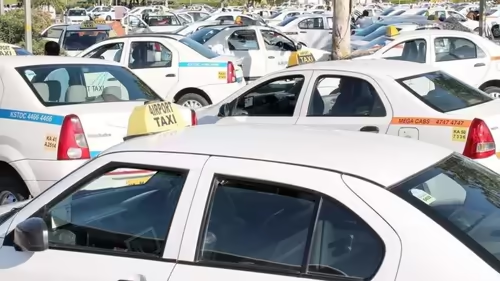
If you’ve picked up or dropped off someone at Bengaluru’s Kempegowda International Airport (KIA) Terminal 1 recently, you’ve likely felt the frustration. A major traffic reorganization pushed private taxi operators to a distant parking lot, creating long walks for passengers and lost fares for drivers. Now, in a bid to restore order, Bengaluru International Airport Limited (BIAL) is trialing a smart, app-based solution that could bring taxis back to the doorstep—but only if they play by the new digital rules [[1]].
Table of Contents
- The Problem Behind the Bengaluru Airport Taxi Chaos
- BIAL’s New Solution: An App-Based Gatekeeper
- How the KSTDC App System Will Work
- Why This Matters for Passengers and Drivers
- Global Trends in Smart Airport Transportation
- Potential Challenges and Criticisms
- Conclusion: A Digital Fix for a Modern Airport?
- Sources
The Problem Behind the Bengaluru Airport Taxi Chaos
The recent traffic changes at KIA’s Terminal 1 were designed with noble intentions: to decongest the arrivals area and create a smoother flow for vehicles. However, the execution left much to be desired. Private taxi operators—those not affiliated with the official airport pre-paid service—were relocated to a remote parking area nearly a kilometer away from the terminal exit.
This created a double-edged problem. Passengers, often laden with luggage and jet-lagged, were forced to walk a significant distance or rely on shuttle services to find their cabs. Meanwhile, drivers saw their business plummet as riders opted for ride-hailing apps like Ola and Uber, which retained closer drop-off points, or simply chose the official (and more expensive) airport taxis [[3]]. The result was a chorus of complaints from both sides of the transaction.
BIAL’s New Solution: An App-Based Gatekeeper
To address this growing discontent, BIAL has proposed a tech-forward compromise. The authority is now piloting a system that would allow registered private taxis to regain access to the prime pick-up zones near Terminal 1—but only through a verified, app-based process. This move directly targets the core issue: unregulated vehicle congestion.
The chosen platform for this pilot is the Karnataka State Tourism Development Corporation’s (KSTDC) existing taxi booking app. By leveraging an established state-run system, BIAL aims to create a secure and traceable ecosystem for Bengaluru airport taxi services [[2]].
How the KSTDC App System Will Work
The proposed workflow is designed to be simple yet effective, ensuring that only legitimate, pre-booked pickups enter the sensitive airport zone:
- Driver Registration: Private taxi operators must first register their vehicle and personal details on the KSTDC app, undergoing a verification process.
- Passenger Booking: A passenger arriving at KIA T1 would book their ride through the same KSTDC app, providing their flight details and mobile number.
- Digital Authorization: Once the booking is confirmed, the system generates a unique, time-bound digital pass for the assigned driver.
- Automated Entry: At the entry gate to the T1 pick-up zone, the driver’s license plate is scanned. If it matches an active, authorized booking, the boom barrier lifts, granting access.
This closed-loop system promises to eliminate loitering cabs and ensure that every vehicle in the pick-up bay has a genuine passenger waiting, thereby restoring order and efficiency.
Why This Matters for Passengers and Drivers
For passengers, this system offers the convenience they lost—a quick, seamless reunion with their driver right outside the terminal. For drivers, it’s a lifeline to their livelihood, giving them a fair chance to compete in the airport’s lucrative taxi market without contributing to the very congestion that caused the problem in the first place.
It also levels the playing field between independent operators and larger aggregators. While Ola and Uber have their own sophisticated systems, this state-backed app provides a standardized, accessible alternative for smaller players. This could foster a more diverse and competitive local taxi economy around the airport [INTERNAL_LINK:bengaluru-local-business-support].
Global Trends in Smart Airport Transportation
BIAL’s move aligns with a global shift towards intelligent transportation systems (ITS) at major airports. From Singapore’s Changi to London’s Heathrow, authorities are using digital platforms to manage the complex ballet of arrivals and departures. The U.S. Department of Transportation actively promotes the use of ITS to improve safety, reduce emissions, and enhance the traveler experience [[5]].
The key principle is “right-sizing” the infrastructure. Instead of building ever-larger roads, smart systems use data and technology to optimize the use of existing space. The Bengaluru airport taxi app is a textbook example of this philosophy in action.
Potential Challenges and Criticisms
While the plan is promising, it’s not without potential hurdles:
- Digital Divide: Not all drivers may be comfortable or proficient with smartphone apps, potentially excluding older or less tech-savvy operators.
- App Reliability: The system’s success hinges entirely on the KSTDC app’s stability, speed, and user-friendliness. Any glitches could cause massive delays and frustration.
- Enforcement: Strict enforcement will be needed to prevent unauthorized vehicles from tailgating authorized ones through the gates.
BIAL and KSTDC will need to run extensive trials, provide ample training, and establish a robust support system to address these concerns before a full-scale rollout.
Conclusion: A Digital Fix for a Modern Airport?
The controversy over Bengaluru airport taxi access highlights the growing pains of a city racing to modernize its infrastructure. BIAL’s proposed app-based solution is a pragmatic and forward-thinking attempt to balance passenger convenience, driver livelihoods, and traffic management. If implemented well, it could serve as a model for other Indian cities grappling with similar urban mobility challenges. The success of this pilot will be a true test of whether Bengaluru can leverage technology to build a smarter, more humane transportation future.
Sources
- Times of India. “BIAL mulls app-based access for private taxis at Bengaluru airport T1 pickup zones.” https://timesofindia.indiatimes.com/city/bengaluru/bial-mulls-app-based-access-for-private-taxis-at-kia-t1-pickup-zones/articleshow/127641918.cms [[1]]
- New Indian Express. “BIAL plans app-based entry for private cabs at KIA Terminal 1.” https://www.newindianexpress.com/cities/bengaluru/2026/jan/27/bial-plans-app-based-entry-for-private-cabs-at-kia-terminal-1-2858421.html [[2]]
- Hindustan Times. “Private cabs may get app-based access to Bengaluru airport T1 pickup zone.” https://www.hindustantimes.com/cities/bengaluru-news/private-cabs-may-get-app-based-access-to-bengaluru-airport-t1-pickup-zone-101737985642311.html [[3]]
- Deccan Herald. “BIAL to trial app-based access for private taxis at KIA T1.” https://www.deccanherald.com/city/bengaluru/bial-to-trial-app-based-access-for-private-taxis-at-kia-t1-3332456.html [[4]]
- U.S. Department of Transportation. “Intelligent Transportation Systems (ITS).” https://www.transportation.gov/its [[5]]