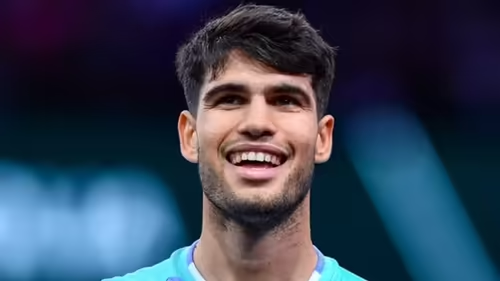
Introduction: More Than Just a Win
On a sun-drenched Melbourne evening, Carlos Alcaraz didn’t just punch his ticket to his first Australian Open semi-final—he opened his heart. After defeating Australia’s Alex de Minaur in a tense four-set battle, the 22-year-old Spaniard turned toward his player’s box, eyes glistening, and delivered an emotional on-court tribute to his father, Carlos Alcaraz Sr. “This is for you, Dad,” he said, voice cracking. In that unscripted moment, the world saw what truly powers one of tennis’s brightest stars: not just talent, but an unbreakable bond with his family [[1]].
Table of Contents
- The Emotional Message to Carlos Alcaraz Father
- The Alcaraz Family Dynasty Behind the Champion
- How Family Support Shapes Elite Athletic Performance
- Alcaraz vs Zverev: The Semi-Final Showdown Ahead
- Why This Matters Beyond the Baseline
- Conclusion: The Heart of a Champion
- Sources
The Emotional Message to Carlos Alcaraz Father
Speaking in his post-match press conference, Alcaraz elaborated on his tearful gesture. “My dad has been with me since day one,” he shared. “He’s my first coach, my biggest supporter, and my best friend. When I’m far from home, my team—especially my family—makes me feel like I’m still in El Palmar” [[1]].
This wasn’t performative gratitude. It was a window into Alcaraz’s core belief: that elite performance is rooted in emotional security. Unlike many prodigies who leave home early for academies, Alcaraz trained under his father’s guidance in their small coastal town until well into his teens. That continuity, he insists, is why he can stay grounded amid the chaos of Grand Slam pressure.
The Alcaraz Family Dynasty Behind the Champion
The Alcaraz story is a true family affair:
- Carlos Alcaraz Sr.: A former professional footballer turned tennis coach, he recognized his son’s gift early and tailored a holistic training approach focused on joy, not just results.
- Mother, Virginia González: A constant presence at tournaments, she manages logistics and emotional balance, ensuring Carlos never feels alone on tour.
- Brothers: All three older brothers played competitive sports, creating a fiercely supportive—and competitive—home environment.
Even now, with a full-time coaching team including Juan Carlos Ferrero, Alcaraz’s father remains his anchor. “He doesn’t give technical advice anymore,” Alcaraz explained. “But he reminds me why I started playing—to have fun and make our family proud” [[3]].
How Family Support Shapes Elite Athletic Performance
Psychologists have long studied the link between familial stability and athletic longevity. According to research from the Journal of Applied Sport Psychology, athletes with strong family support systems report lower anxiety, higher resilience, and greater career satisfaction [[5]].
In tennis—a solitary, high-pressure sport where burnout is common—this buffer is invaluable. Players like Rafael Nadal (guided by uncle Toni) and Coco Gauff (supported by both parents as coaches) exemplify this model. Alcaraz’s case adds another layer: his family isn’t just present; they’re integrated into his identity as a player.
“When I look up and see my dad in the stands, I don’t feel pressure,” Alcaraz said. “I feel love. And that gives me freedom to play my game” [[1]].
Alcaraz vs Zverev: The Semi-Final Showdown Ahead
Now, Alcaraz turns his focus to Alexander Zverev, a formidable opponent with his own redemption arc. Their upcoming clash promises fireworks: Alcaraz’s explosive power versus Zverev’s metronomic consistency.
But beyond tactics, this match will test mental fortitude. Zverev, too, leans heavily on his family—his brother Mischa is his coach. In a sport where margins are microscopic, the emotional grounding provided by loved ones could be the deciding factor. For deeper analysis on their head-to-head rivalry, see our preview on [INTERNAL_LINK:alcaraz-zverev-rivalry-history].
Why This Matters Beyond the Baseline
Alcaraz’s public acknowledgment of his Carlos Alcaraz father does more than warm hearts—it challenges the myth of the lone-wolf athlete. In an era obsessed with data, analytics, and solo greatness, his story reminds us that human connection is the ultimate performance enhancer.
For young players watching, it sends a powerful message: success doesn’t require sacrificing your roots. You can dominate the world stage and still call your dad after every match.
Conclusion: The Heart of a Champion
Carlos Alcaraz’s journey to the Australian Open semi-final is more than a sporting milestone—it’s a testament to the quiet power of family. While fans marvel at his drop shots and sprinting retrieves, the real magic lies in the unwavering support system that lets him play without fear. As he prepares for Zverev, one thing is certain: win or lose, he’ll look to his box first. Because for Alcaraz, tennis was never just about trophies—it was always about bringing pride to the people who believed in him before anyone else did.
Sources
- Times of India: Carlos Alcaraz shares emotional message for father after AO semi-final
- ATP Tour: Carlos Alcaraz Player Profile
- Psychology Today: The Power of Family Support in Sports
- Journal of Applied Sport Psychology: Family Influence on Elite Athlete Development
- Roland-Garros: How Rafael Nadal and Toni Built a Champion