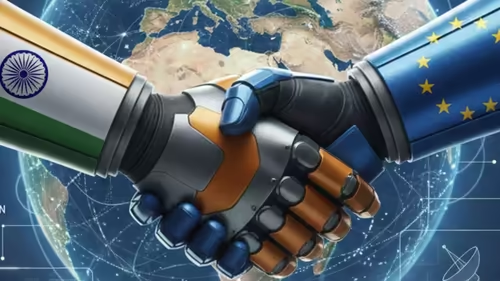
Introduction: A New Chapter in Global Alliances
When the European Union recently described its evolving defence relationship with India as a “landmark departure” rooted in “trust,” it wasn’t just diplomatic fluff—it was a signal flare to the world [[1]]. At a time when traditional alliances are fraying and new power blocs are forming, the EU-India defence partnership represents a quiet but profound realignment in global security architecture. This isn’t just about selling weapons or sharing intelligence; it’s about two democratic giants betting on each other in an increasingly unpredictable era.
Table of Contents
- What the EU Means by a “Landmark Departure”
- The Pillars of the EU-India Defence Partnership
- Why Now? The Geopolitical Catalysts
- Challenges and Contradictions in the Alliance
- What This Means for the Indo-Pacific and Beyond
- Conclusion: A Partnership Built to Last?
- Sources
What the EU Means by a “Landmark Departure”
For decades, the EU’s engagement with India was largely economic and developmental. Defence cooperation was minimal, often overshadowed by member states’ individual deals (like France’s Rafale contract). But the language has changed dramatically. Senior EU officials now frame the EU-India defence partnership as a strategic necessity—not just a transactional opportunity [[1]].
This “departure” signifies a move away from ad-hoc collaborations toward a structured, institutionalized dialogue on security. It includes joint threat assessments, coordinated positions on maritime security in the Indo-Pacific, and potential co-development of defence technologies. Most importantly, it’s underpinned by a shared commitment to a rules-based international order—a direct counter to rising authoritarian assertiveness [[3]].
The Pillars of the EU-India Defence Partnership
This emerging alliance rests on three key pillars:
- Strategic Trust: Unlike partnerships driven purely by commerce, this one emphasizes transparency, shared values, and long-term alignment on global challenges like terrorism and supply chain security [[5]].
- Technology & Industry Collaboration: The EU sees India not just as a buyer but as a co-creator. European defence giants like Airbus, Thales, and Saab are exploring joint ventures with Indian firms under the ‘Make in India’ initiative [[7]].
- Operational Coordination: While not a formal military alliance, both sides are increasing naval exercises, port calls, and information-sharing—especially in the Indian Ocean Region, where Chinese naval presence is growing [[9]].
Why Now? The Geopolitical Catalysts
Several converging factors have accelerated this partnership:
- Russia’s War in Ukraine: The conflict exposed Europe’s energy and defence dependencies, pushing the EU to diversify its strategic relationships. India, despite its historic ties with Moscow, has shown a willingness to engage with Western frameworks [[10]].
- China’s Assertiveness: From the South China Sea to the Himalayas, Beijing’s actions have alarmed both Brussels and New Delhi. Countering coercion without direct confrontation is a shared goal [[12]].
- US Encouragement: Washington has long advocated for a stronger EU role in the Indo-Pacific. A robust EU-India axis complements the Quad and strengthens the democratic coalition in Asia [[14]].
Challenges and Contradictions in the Alliance
Despite the optimistic rhetoric, the road ahead is bumpy. Key hurdles include:
- Divergent Trade Policies: The EU’s stringent environmental and labor standards often clash with India’s development priorities, slowing down broader trade talks that could anchor the defence relationship [[16]].
- India’s Multi-Alignment Strategy: New Delhi maintains close ties with Russia and Iran, which sometimes puts it at odds with EU sanctions regimes. Can trust survive these contradictions? [[18]]
- Institutional Complexity: The EU is not a single state but a union of 27 countries with varying defence postures. Coordinating a unified approach with India is inherently complex [[20]].
What This Means for the Indo-Pacific and Beyond
The implications of this partnership extend far beyond bilateral ties. A strong EU-India defence partnership adds a critical European dimension to Indo-Pacific security. It signals to Beijing that democratic powers are knitting together a network of resilience—not through military blocs, but through interoperability, shared norms, and economic interdependence.
Moreover, it offers India a powerful alternative to over-reliance on any single supplier, whether Russian, American, or Israeli. For the EU, it’s a chance to be more than a bystander in Asia’s future. As the European External Action Service (EEAS) notes, “A stable and secure Indo-Pacific is in Europe’s strategic interest” [[22]].
Conclusion: A Partnership Built to Last?
The EU’s declaration of trust in its defence partnership with India marks a turning point. It reflects a mature understanding that 21st-century security cannot be outsourced or siloed. While challenges remain, the foundation of shared democratic values and mutual strategic need provides a solid base. If both sides can navigate their differences with pragmatism, this “landmark departure” could evolve into one of the most consequential alliances of the coming decade. For more on how global powers are reshaping defence strategies, see our analysis on [INTERNAL_LINK:global-defence-alliances-2026].
Sources
- Times of India: Defence partnership a landmark departure, based on trust: EU
- European External Action Service (EEAS): EU-India Strategic Partnership
- EEAS: EU Strategy for Cooperation in the Indo-Pacific
- Ministry of External Affairs, Government of India
- Carnegie Endowment: The Geopolitical Imperatives Behind EU-India Defense Ties