Introduction: A Wake-Up Call Wrapped in Praise
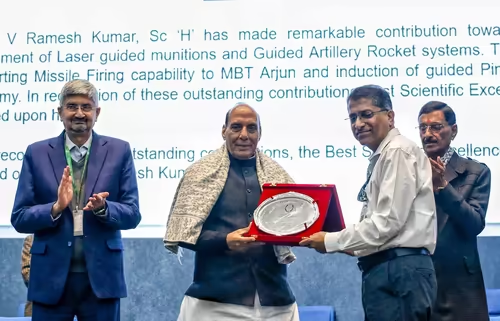
At a recent event celebrating the achievements of India’s defence research community, Defence Minister Rajnath Singh delivered a message that was equal parts commendation and challenge. While lauding the hard work of DRDO scientists, he issued a clear directive: it’s time to stop playing it safe. In an era where global powers are racing ahead with hypersonic weapons, AI-driven warfare, and next-gen stealth tech, Singh warned that incremental progress won’t cut it. The real mission? To build a culture where bold, high-risk research is not just accepted—but encouraged [[1]].
Table of Contents
- Rajnath Singh’s Message to DRDO Scientists
- Why Risk Is the New Requirement in Defence R&D
- The Successes and Stumbles of India’s Defence Ecosystem
- Global Lessons for Indian Innovation
- The Path Forward: Building a Culture of Bold Research
- Conclusion: From Complacency to Courage
- Sources
Rajnath Singh’s Message to DRDO Scientists
Speaking at the DRDO headquarters in New Delhi, Rajnath Singh acknowledged major milestones—like the successful test of the Agni-V ICBM and the development of the indigenous Light Combat Aircraft (Tejas). But his tone quickly shifted from celebration to urgency. “You have done well,” he said, “but now you must increase your appetite for risk in research” [[1]].
This wasn’t just motivational rhetoric. It was a strategic pivot. The minister emphasized that true Atmanirbhar Bharat (self-reliant India) in defence cannot be achieved by merely replicating foreign systems or making minor tweaks. It demands original thinking, disruptive prototypes, and the willingness to fail fast and learn faster.
He also highlighted the need for closer collaboration between DRDO, private industry, startups, and academia—a move that aligns with the government’s broader push to open up the defence sector to non-traditional players [[3]].
Why Risk Is the New Requirement in Defence R&D
In today’s battlefield, speed and surprise are decisive. Consider these global trends:
- Hypersonic Arms Race: China and Russia have already fielded hypersonic glide vehicles. The U.S. is racing to catch up. India’s HSTDV program is promising but still experimental [[5]].
- AI & Autonomous Systems: From drone swarms to AI-enabled command systems, the future of warfare is algorithmic. Playing it safe means falling behind.
- Quantum & Cyber Warfare: Next-gen threats won’t come from tanks or jets alone—they’ll emerge from code and quantum encryption.
In this context, a conservative R&D approach is a strategic liability. As one former DRDO official noted, “We’ve spent decades perfecting systems that are obsolete by the time they’re deployed” [[7]]. Rajnath Singh’s call is a direct response to this inertia.
The Successes and Stumbles of India’s Defence Ecosystem
Let’s be fair: DRDO scientists have delivered under immense pressure. Projects like Akash missile, Arjun tank, and the recent anti-satellite (ASAT) test showcase genuine capability. Yet, delays, cost overruns, and dependency on imports persist.
For instance, despite decades of effort, India still imports critical components for its fighter jets, submarines, and radars. The much-touted Kaveri engine for Tejas remains unrealized after 40 years [[8]]. These aren’t failures of talent—they’re symptoms of a risk-averse system that penalizes failure more than it rewards innovation.
Rajnath Singh’s message implicitly acknowledges this. By urging scientists to “take risks,” he’s signaling a cultural shift—one that tolerates intelligent failure as a necessary step toward breakthrough success.
Global Lessons for Indian Innovation
Look at DARPA—the U.S. Defense Advanced Research Projects Agency. It’s famous for funding “moonshot” projects with no guaranteed outcome. The internet, GPS, and stealth technology all emerged from DARPA’s high-risk bets [[10]].
Similarly, Israel’s defence ecosystem thrives on rapid prototyping and battlefield feedback loops. Startups work hand-in-hand with the military to iterate quickly—often deploying unpolished but functional systems in real combat scenarios.
India doesn’t need to copy these models, but it can learn from them. As the Stockholm International Peace Research Institute (SIPRI) notes, India remains the world’s largest arms importer—a status that undermines strategic autonomy [[12]]. True self-reliance demands a new R&D philosophy, one where DRDO scientists are empowered to experiment, not just execute.
The Path Forward: Building a Culture of Bold Research
So how can this vision become reality? Experts suggest several steps:
- Reform Evaluation Metrics: Stop judging projects solely on on-time delivery. Reward innovation, even if it leads to partial failure.
- Create “Skunkworks” Teams: Small, autonomous units within DRDO focused on high-risk, high-reward projects with minimal bureaucracy.
- Strengthen Industry-Academia Links: Partner with IITs, IISc, and private firms through joint labs and challenge grants.
- Fast-Track Procurement for Prototypes: Allow the armed forces to trial and provide feedback on early-stage tech, creating a live feedback loop.
This is where initiatives like iDEX (Innovations for Defence Excellence) come in—already fostering over 200 startups in the defence space [[15]]. But scaling this mindset across the entire DRDO is the real challenge.
Conclusion: From Complacency to Courage
Rajnath Singh’s message to DRDO scientists is more than a pep talk—it’s a strategic imperative. In a world where technological superiority defines national security, playing it safe is the riskiest move of all. By embracing uncertainty, encouraging bold ideas, and building a system that learns from failure, India can finally turn its defence dreams into deployable reality. The ball is now in the court of its brilliant scientists—to not just defend the nation, but to invent its future.
Sources
- Times of India: Rajnath praises DRDO scientists, asks them to ‘increase appetite for risk in research’
- Defence Research and Development Organisation (DRDO) Official Website
- Ministry of Defence – Department of Defence
- SIPRI Yearbook 2025: Trends in International Arms Transfers
- DARPA: About Us – High-Risk, High-Reward Innovation
- Innovations for Defence Excellence (iDEX)