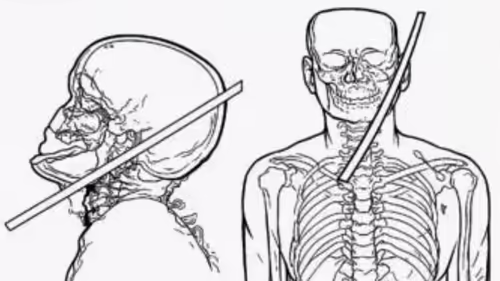
It sounds like a scene ripped straight from a Hollywood thriller—but this was real life, and the stakes were a man’s life. In Gurgaon, India, a construction worker experienced a freak accident that left a long metal rod embedded deep in his neck after a fall from height. By all medical logic, the injury should have been fatal. Yet, against staggering odds, he not only survived but walked away with no neurological deficits—all because the rod missed two of the body’s most critical structures: the brain and the spinal cord [[1]].
This extraordinary case is now being hailed as a textbook example of precision trauma care, rapid response, and sheer luck. But what really happened? And how did a team of surgeons pull off what many would call a medical miracle?
Table of Contents
- The Accident: A Freak Construction Site Fall
- Why the Metal Rod in Neck Was So Dangerous
- The Surgical Rescue: A Multidisciplinary Marathon
- Recovery and Aftermath: No Neurological Deficits
- What This Case Teaches Us About Trauma Care
- Conclusion: A Testament to Modern Medicine
The Accident: A Freak Construction Site Fall
The incident occurred at a bustling construction site in Gurgaon, where the unnamed 38-year-old worker was performing routine tasks at height. According to initial reports, he lost his balance and fell onto a vertical steel reinforcement rod—an object commonly used in concrete structures. The rod entered his neck laterally at an angle, piercing through soft tissue and lodging itself deep inside [[1]].
Witnesses described the scene as “horrifying,” yet remarkably, the man remained conscious. Emergency responders acted swiftly, stabilizing his head and neck to prevent any movement that could shift the rod and cause catastrophic damage. He was rushed to a nearby hospital equipped with advanced trauma capabilities.
Why the Metal Rod in Neck Was So Dangerous
A metal rod in neck is one of the most perilous types of penetrating trauma a human body can endure. The neck is a densely packed corridor housing:
- The **spinal cord**, which controls all motor and sensory functions below the head.
- The **carotid arteries and jugular veins**, major blood vessels supplying the brain.
- The **trachea (windpipe)** and **esophagus**, critical for breathing and swallowing.
- Numerous vital nerves, including the vagus nerve, which regulates heart rate and digestion.
Any significant deviation in the rod’s path—even by a few millimeters—could have severed the spinal cord (causing paralysis or death) or punctured a major artery (leading to rapid exsanguination). The fact that it navigated this minefield without hitting the brainstem or spine is what doctors are calling “anatomical luck of the highest order” [[1]].
The Surgical Rescue: A Multidisciplinary Marathon
Upon arrival at the hospital, a full trauma team was assembled within minutes. This wasn’t a job for a single surgeon—it required a symphony of specialists:
- Neurosurgeons to assess spinal cord and brain integrity.
- Vascular surgeons to monitor and protect major blood vessels.
- ENT (Ear, Nose, and Throat) surgeons to manage airway and soft tissue structures.
- Radiologists to provide real-time imaging guidance during extraction.
Using high-resolution CT angiography, the team mapped the rod’s exact trajectory in 3D. They discovered it had passed between the carotid sheath and the cervical vertebrae—a narrow corridor less than a centimeter wide. The extraction had to be performed with micrometer-level precision to avoid dislodging clots or tearing vessel walls.
After hours of meticulous planning and execution, the rod was successfully removed. The patient was kept under close observation in the ICU for 72 hours to watch for delayed complications like infection or internal bleeding.
Recovery and Aftermath: No Neurological Deficits
In what can only be described as miraculous, the patient showed **no neurological deficits** post-surgery. He could move all limbs, speak clearly, and swallow normally. Within days, he was transferred out of intensive care and began physical therapy as a precaution [[1]].
Doctors credit three key factors for his full recovery:
- Immediate stabilization at the accident site, preventing secondary injury.
- Rapid transport to a facility with Level I trauma capabilities.
- Perfect anatomical miss—the rod’s path avoided all critical neural and vascular structures.
[INTERNAL_LINK:trauma-care-in-india] This case underscores why access to advanced emergency care is non-negotiable in high-risk industries like construction.
What This Case Teaches Us About Trauma Care
Beyond the drama of survival, this incident offers valuable lessons for public health and workplace safety:
- Prevention is paramount: Construction sites must enforce strict fall-protection protocols, including harnesses and guardrails.
- Golden hour matters: Survival in penetrating trauma hinges on getting to a trauma center within 60 minutes—the so-called “golden hour.”
- Team-based care saves lives: Complex injuries demand integrated teams, not solo heroes. India’s growing network of trauma centers is a step in the right direction [[2]].
According to the World Health Organization, over 350,000 people die annually from falls globally—many of them in low- and middle-income countries. This case is a rare bright spot in an otherwise grim statistic.
Conclusion: A Testament to Modern Medicine
The story of the man who survived a metal rod in neck is more than just a medical curiosity—it’s a powerful reminder of human resilience, the precision of modern surgery, and the thin line between life and death. While we celebrate this miracle, we must also use it as a catalyst to improve workplace safety standards and expand access to high-quality trauma care across the country. Because the next victim might not be so lucky.
Sources
- [[1]] Times of India: Rod misses brain and spine, no neurological deficits for patient
- [[2]] World Health Organization (WHO): Falls Fact Sheet