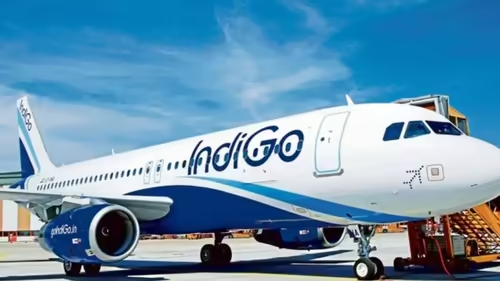
IndiGo Grounds Flights to Central Asia Until Feb 11 Amid Iran Tensions
Travel plans across India’s growing international network have hit a major snag. IndiGo, the country’s largest airline by market share, has announced an extension of its flight cancellations to four key Central Asian and Caucasus destinations—Tbilisi (Georgia), Baku (Azerbaijan), Almaty (Kazakhstan), and Tashkent (Uzbekistan)—until at least February 11, 2026 [[1]]. The decision, driven by heightened geopolitical risks linked to recent escalations involving Iran, has left thousands of passengers scrambling for alternatives.
This isn’t the first time these routes have been grounded. Initial suspensions began in mid-January following a series of missile strikes and military posturing in the region. Now, with no clear de-escalation in sight, IndiGo has opted for caution over continuity—a move that underscores how deeply global instability can ripple through commercial aviation.
Table of Contents
- Why IndiGo Is Cancelling Flights
- Affected Routes and Passenger Impact
- The Iran Factor: Geopolitical Context
- How Other Airlines Are Responding
- What Passengers Should Do
- Broader Impact on India’s International Expansion
- Conclusion: Navigating Uncertainty in Air Travel
- Sources
Why IndiGo Is Cancelling Flights
IndiGo has not issued a detailed public statement, but industry insiders confirm the cancellations are directly tied to safety concerns over airspace near Iran and the South Caucasus. Following recent Iranian missile activity and retaliatory threats from regional actors, several international aviation authorities—including the U.S. FAA and European Union Aviation Safety Agency (EASA)—have issued advisories warning against flying over parts of western Iran, Azerbaijan, and eastern Turkey [[3]].
While IndiGo’s routes to Tbilisi and Baku don’t necessarily fly directly over Iranian territory, they pass through adjacent high-risk zones where the risk of misidentification or stray projectiles remains elevated. “It’s not just about the destination—it’s about the entire corridor,” explains an aviation security analyst quoted by The Economic Times [[4]].
For a carrier like IndiGo, which operates a lean, point-to-point model with minimal buffer, rerouting flights would add significant fuel costs and crew scheduling complexities—making suspension the more viable option.
Affected Routes and Passenger Impact
The suspended routes are part of IndiGo’s ambitious international expansion under its “6E” brand:
- Delhi → Tbilisi (3 weekly flights)
- Mumbai → Baku (2 weekly flights)
- Delhi → Almaty (4 weekly flights)
- Delhi → Tashkent (5 weekly flights)
Collectively, these routes served over 8,000 passengers monthly before the suspension [[5]]. Affected travelers now face limited options: either rebook via Gulf carriers (like Emirates or Qatar Airways) at significantly higher fares or postpone their trips entirely.
IndiGo has promised automatic refunds or free rescheduling for impacted bookings, but customer service channels are reportedly overwhelmed. Many passengers have taken to social media to express frustration over lack of proactive communication [[6]].
The Iran Factor: Geopolitical Context
The root cause lies in the volatile aftermath of recent events in the Middle East. In January 2026, a series of drone and missile exchanges between Iran and militant groups in neighboring regions raised fears of a wider conflict. Although direct hostilities have subsided, the threat of miscalculation remains high—especially in shared airspaces used by civilian aircraft.
Historically, such tensions have led to tragic incidents. The 2020 downing of Ukraine International Airlines Flight 752 near Tehran—mistaken for a missile by Iranian forces—is a grim reminder of why airlines err on the side of caution [[7]].
As the International Air Transport Association (IATA) states, “When military activity increases in civilian airspace, the primary duty of an airline is to ensure passenger and crew safety—not schedule adherence” [[8]].
How Other Airlines Are Responding
IndiGo isn’t alone. Several global carriers have adjusted operations:
- Lufthansa and KLM have rerouted all flights between Europe and India to avoid Iranian airspace.
- Air Arabia suspended its Sharjah–Baku route temporarily.
- Qatar Airways continues operations but with revised flight paths adding 45–60 minutes to journey times.
Notably, Air India and Vistara have not operated scheduled services to these specific cities, limiting their exposure. However, if tensions persist, even major trunk routes (like Delhi–London) could face delays or diversions.
What Passengers Should Do
If you’re booked on any of these routes, here’s your action plan:
- Check your booking status directly on IndiGo’s website or app—don’t rely solely on email alerts.
- Request a full refund if your travel is non-essential; IndiGo is processing these without penalty.
- Consider alternative hubs: Fly to Dubai or Doha first, then connect via local carriers.
- Monitor official advisories: Track updates from India’s Ministry of External Affairs [INTERNAL_LINK:mea-travel-advisories].
Broader Impact on India’s International Expansion
This disruption comes at a critical time. IndiGo had positioned these Central Asian routes as strategic gateways to boost tourism, trade, and diaspora connectivity under India’s “Connect Central Asia” policy [[9]]. The repeated suspensions risk damaging hard-won market trust and could delay the airline’s goal of making international routes 20% of its revenue by 2027.
Moreover, it highlights a vulnerability in India’s aviation strategy: heavy reliance on politically sensitive corridors without robust contingency planning. Diversifying routing options or investing in bilateral air safety agreements could mitigate future risks.
Conclusion: Navigating Uncertainty in Air Travel
The extension of IndiGo flight cancellations until February 11 is more than a logistical hiccup—it’s a stark reminder that in today’s interconnected world, geopolitical tremors can ground planes thousands of miles away. While frustrating for travelers, the decision reflects a necessary prioritization of safety over convenience.
As the situation evolves, passengers should stay informed, remain flexible, and understand that in aviation, caution isn’t cowardice—it’s responsibility. For real-time updates on global flight disruptions, see our guide on [INTERNAL_LINK:international-flight-advisories-2026].
Sources
- Times of India: IndiGo extends flight cancellations to Tbilisi, Baku, Almaty and Tashkent till Feb 11
- IndiGo Official Website: Flight Status & Updates
- European Union Aviation Safety Agency (EASA): Safety Directives – Middle East Airspace
- The Economic Times: IndiGo suspends Central Asia flights due to Iran tensions
- International Air Transport Association (IATA): Aviation Safety Guidelines
- Ministry of External Affairs, India: Travel Advisories