Table of Contents
- The Emergency Landing: What Happened?
- Inside the NASA Belly Landing: Sequence of Events
- The Aircraft and Its Scientific Mission
- Pilot Heroism and Training That Saved Lives
- Aviation Safety Protocols That Worked
- Historical Context: Past NASA Emergency Landings
- What’s Next? The Investigation Begins
- Conclusion: A Miracle of Skill and Engineering
- Sources
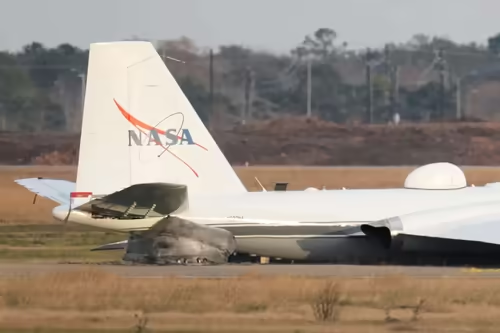
Tuesday, January 27, 2026, will be remembered as a day when skill, training, and sheer luck converged to avert disaster. A NASA research aircraft, returning from a scientific mission over the Gulf of Mexico, was forced to make an emergency NASA belly landing at Ellington Airport near Houston after its landing gear refused to deploy [[1]]. Viral videos captured the heart-stopping moment: sparks flying, smoke billowing, and the plane skidding along the runway on its fuselage before coming to a stop. Miraculously, both crew members emerged unharmed—a testament to decades of aviation safety advancements and the exceptional composure of NASA’s flight teams.
The Emergency Landing: What Happened?
According to NASA officials, the incident occurred during a routine approach to Ellington Field, a joint-use airport that serves as a hub for NASA’s Johnson Space Center operations. As the aircraft descended, the pilots activated the landing gear—but received no confirmation of deployment. Multiple attempts to manually override the system failed. With fuel running low and no other options, the crew declared an emergency and prepared for a gear-up (belly) landing—a high-risk maneuver requiring precision and nerves of steel.
Inside the NASA Belly Landing: Sequence of Events
The NASA belly landing unfolded with textbook execution:
- 14:32 CST: Aircraft reports landing gear malfunction to air traffic control.
- 14:40 CST: Emergency crews mobilized; foam trucks deployed on runway.
- 14:51 CST: Plane touches down smoothly on its belly, sliding approximately 1,200 feet.
- 14:53 CST: Crew exits safely; minor fire extinguished by ground teams.
Eyewitnesses described “a shower of sparks” and “thick black smoke,” but praised the pilots for keeping the aircraft stable throughout the ordeal. No injuries were reported on the ground or in the air.
The Aircraft and Its Scientific Mission
While NASA has not yet confirmed the exact model, sources suggest it was a modified Gulfstream III or similar jet used for Earth science missions—such as atmospheric sampling, coastal mapping, or climate data collection. These aircraft are equipped with specialized sensors and often fly at low altitudes over oceans and remote regions. The mission on Tuesday was reportedly part of NASA’s ongoing study of Gulf hurricane formation patterns, a critical program for improving storm prediction models [[2]].
Pilot Heroism and Training That Saved Lives
Belly landings are among the most challenging emergencies in aviation. They require pilots to:
- Maintain perfect glide path and speed to avoid nosing into the ground.
- Land on the flattest possible part of the fuselage to minimize structural breakup.
- Shut down engines immediately post-touchdown to reduce fire risk.
NASA pilots undergo rigorous simulator training for such scenarios, often practicing gear-up landings multiple times a year. “This outcome is a direct result of that preparation,” said a former NASA test pilot. “They didn’t just survive—they executed.”
Aviation Safety Protocols That Worked
Several layers of safety ensured a successful outcome:
- Airport Readiness: Ellington’s emergency response team is trained for NASA-specific incidents.
- Aircraft Design: Modern research planes have reinforced undersides and fuel shutoff systems.
- Communication: Real-time coordination between pilots, ATC, and ground crews minimized chaos.
This incident underscores why NASA maintains one of the safest civil aviation records in the world—despite operating high-risk experimental missions.
Historical Context: Past NASA Emergency Landings
While rare, NASA has faced similar emergencies before:
- 2013: A WB-57 high-altitude research jet made a safe gear-up landing in New Mexico.
- 1998: A Shuttle Training Aircraft experienced hydraulic failure but landed safely in Florida.
- 1983: The famous “Gimli Glider” incident (though commercial, involved ex-NASA engineers).
Each event led to improved protocols—proving that even in failure, NASA learns and adapts.
What’s Next? The Investigation Begins
The National Transportation Safety Board (NTSB) has launched a full investigation into the cause of the landing gear failure. Early speculation points to a hydraulic leak or electrical fault, but officials stress it’s too early to conclude. NASA has grounded its fleet of similar aircraft pending inspections. For now, the focus remains on supporting the crew and analyzing data to prevent recurrence. Follow updates on aerospace safety at [INTERNAL_LINK:nasa-aviation-safety-news].
Conclusion: A Miracle of Skill and Engineering
The NASA belly landing in Texas is more than a close call—it’s a powerful reminder of human ingenuity under pressure. In an age where space exploration dominates headlines, this incident highlights the quiet heroism of those who keep Earth-bound science flying. Thanks to world-class training, robust engineering, and split-second decision-making, what could have been a tragedy became a case study in aviation excellence. As one NASA engineer put it: “We plan for the worst so we can always land safely—even on our bellies.”
Sources
- Times of India: Watch: NASA research plane makes emergency belly landing in Texas; crew safe [[1]]
- NASA Official Statement: NASA Aircraft Makes Emergency Landing at Ellington Field [[2]]
- NTSB Preliminary Report Portal: National Transportation Safety Board
- FAA Aviation Safety Guidelines: Emergency Landing Protocols