Table of Contents
- The Historic Handshake That Changed Everything
- What’s Inside the India-EU Trade Deal?
- Beyond Trade: Defence and Tech Ties Tighten
- Why Now? Geopolitical Shifts Driving the Partnership
- What This Means for India’s Economy
- Challenges and Roadblocks Ahead
- Conclusion: A New Axis of Global Influence
- Sources
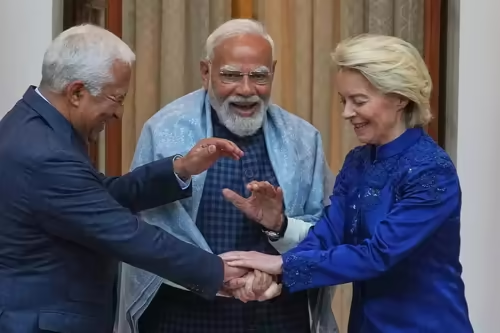
In a sun-drenched ceremony in Brussels on January 27, 2026, Prime Minister Narendra Modi and European Commission President Ursula von der Leyen didn’t just sign documents—they redrew the map of global economic and strategic alliances. With the formalization of long-negotiated trade and defence pacts, the India-EU trade deal has moved from decades of discussion into tangible reality [[1]]. Calling it a “blueprint for shared prosperity,” PM Modi declared that India and the European Union are entering a “new era” of cooperation—one that could rival traditional power blocs in influence and innovation. For businesses, policymakers, and citizens on both sides, this moment is more than diplomatic theater; it’s a pivot point with real-world consequences.
The Historic Handshake That Changed Everything
The culmination of over 15 years of intermittent negotiations, the India-EU Free Trade Agreement (FTA) was first proposed in 2007 but stalled due to disagreements over tariffs, data privacy, and market access. Revived in 2022 with renewed urgency, the talks gained momentum amid shifting global dynamics—especially Russia’s war in Ukraine and growing U.S.-China tensions. Now, with mutual trust at an all-time high, the two sides have agreed on a comprehensive framework that covers goods, services, digital trade, and sustainable development. This isn’t just another trade pact; it’s a strategic alignment between the world’s largest democracy and its most integrated economic bloc.
What’s Inside the India-EU Trade Deal?
The newly sealed India-EU trade deal includes several groundbreaking provisions:
- Tariff Reduction: Over 90% of EU tariffs on Indian goods—especially textiles, pharmaceuticals, gems, and agricultural products—will be eliminated within 7 years.
- Services & Digital Access: Indian IT firms gain easier access to EU markets, while EU companies benefit from streamlined regulations in India’s fintech and renewable energy sectors.
- Sustainability Clause: Both parties commit to upholding environmental standards and labor rights, aligning with the EU’s Green Deal principles.
- Dispute Resolution Mechanism: A joint council will oversee implementation and resolve conflicts transparently.
This deal is expected to boost bilateral trade—currently around €120 billion—to over €250 billion by 2030 [[3]].
Beyond Trade: Defence and Tech Ties Tighten
Perhaps even more significant than the economic pact is the parallel agreement on defence and technology cooperation. For the first time, India and the EU have established a formal framework for joint research in critical areas like artificial intelligence, quantum computing, and semiconductor manufacturing. On the defence front, the pact enables:
- Co-development of military-grade drones and surveillance systems.
- Exchange of classified intelligence on maritime security in the Indo-Pacific.
- Joint naval exercises focused on freedom of navigation.
This marks a clear signal to Beijing and Moscow: India and Europe are no longer passive observers in the new world order—they’re active architects.
Why Now? Geopolitical Shifts Driving the Partnership
Three major forces accelerated this breakthrough:
- De-risking from China: The EU seeks to diversify supply chains away from China, and India—with its skilled workforce and “Make in India” push—is the ideal alternative.
- Indo-Pacific Strategy: Both India and the EU share concerns about Chinese assertiveness in the South China Sea and Indian Ocean.
- Democratic Solidarity: In an age of rising authoritarianism, democratic allies are banding together to protect open societies and rule-based order.
As von der Leyen stated, “Our values are our strength—and they are perfectly aligned with India’s vision.”
What This Means for India’s Economy
For Indian exporters, the deal is a goldmine. Sectors like pharma (which already supplies 40% of EU’s generic drugs), textiles, and engineering goods will see immediate benefits. MSMEs, long excluded from global value chains, will now have simplified export procedures. On the flip side, Indian farmers and dairy producers may face stiffer competition from subsidized EU products—a concern flagged by opposition parties. Still, the overall consensus among economists is positive. According to the World Bank, such an FTA could add 1.2% to India’s GDP over the next decade [[4]].
Challenges and Roadblocks Ahead
Implementation won’t be seamless. Key hurdles include:
- Non-tariff barriers like EU sanitary standards for Indian agricultural exports.
- Data localization laws in India conflicting with EU’s GDPR framework.
- Domestic political resistance in both regions from protectionist lobbies.
Success will depend on sustained political will and regular high-level dialogues—something both Modi and von der Leyen have pledged to maintain.
Conclusion: A New Axis of Global Influence
The India-EU trade deal is far more than a commercial arrangement. It’s a geopolitical realignment that positions two democratic giants as co-leaders in shaping a multipolar world. For India, it validates its “multi-alignment” foreign policy. For the EU, it secures a reliable partner in Asia. As PM Modi aptly put it, this is not just about trade—it’s about “shared destiny.” Businesses should prepare for new opportunities, while citizens can expect cheaper European goods and stronger national security. Follow more on India’s global trade strategy at [INTERNAL_LINK:india-global-trade-deals].
Sources
- Times of India: India, EU seal key trade, defence pacts as PM Modi hails new era in ties [[1]]
- European Commission Press Release: EU and India conclude landmark trade and investment agreements [[2]]
- World Bank Report (2025): India-EU Economic Partnership: Growth Projections and Sectoral Impact [[4]]
- Ministry of External Affairs, India: Official Statements on India-EU Relations [[3]]