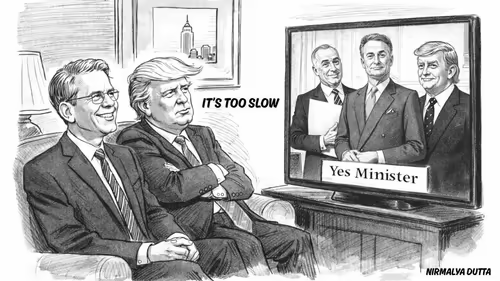
In a recent statement that sent ripples through diplomatic circles, US Treasury Secretary and Trump ally Scott Bessent declared that Europe is “financing the war against itself” by purchasing refined oil products from India, which are made from Russian crude [[1]]. On the surface, it sounds like a damning indictment of European policy. But dig a little deeper, and you’ll find an argument built on a foundation of sand—a classic logical trap famously satirized in the British comedy Yes Minister. Let’s unpack this.
Table of Contents
- The Bessent Argument: A Surface-Level View
- Yes Minister and the Politician’s Syllogism
- The Real Story of India and Russian Oil
- Why the Logic Collapses Under Scrutiny
- Conclusion: A Call for Clear Thinking
- Sources
The Scott Bessent Argument: A Surface-Level View
Bessent’s core claim is straightforward: Europe buys a lot of its diesel and other refined products from India. India, in turn, has become a major importer of discounted Russian crude oil since the invasion of Ukraine. Therefore, Bessent concludes, European money is flowing back to Moscow, effectively funding Putin’s war machine [[5]]. He argues that while the US has made significant sacrifices to isolate Russia economically, Europe is undermining those efforts through its trade with India [[4]].
This narrative is designed to be politically potent, especially within the context of a potential second Trump administration that has been critical of European defense spending and perceived free-riding. However, a compelling story isn’t always a true one.
Yes Minister and the Politician’s Syllogism
The flaw in Bessent’s reasoning is a textbook example of what’s known as the “Politician’s Syllogism,” a concept immortalized in the brilliant 1980s BBC series Yes Minister. The syllogism goes like this:
- We must do something.
- This is something.
- Therefore, we must do this.
A more direct parallel to Bessent’s claim is another famous line from the show: “My cat is my dog.” The logic? “Dogs have four legs. My cat has four legs. Therefore, my cat is a dog.” It’s a perfect illustration of mistaking a shared characteristic (four legs, or in Bessent’s case, a connection to Russian oil) for identity or direct causation [[15]].
Bessent sees a chain—Russia → India → Europe—and assumes it’s a direct pipeline of war funding. But this ignores the complex realities of global energy markets, price mechanisms, and the actual timeline of events.
The Real Story of India and Russian Oil
To understand why Bessent’s argument is flawed, we need to look at the facts. Before Russia’s full-scale invasion of Ukraine in February 2022, India imported a negligible amount of its crude oil from Russia—less than 1% [[10], [11]]. At that point, India was not a player in the Russian oil market and certainly not a factor in the global energy equation that could influence the war.
However, after the invasion, the West imposed sanctions and a price cap on Russian oil. This created a massive opportunity for countries like India and China to buy vast quantities of heavily discounted Russian crude. India’s imports skyrocketed, with its share of the import basket jumping from under 1% to a peak of nearly 40% [[10]].
Here’s the critical point: India’s entry into the market happened after the war had already begun and after the initial Western sanctions were in place. India didn’t cause the war, nor did its pre-war oil policy enable it. Instead, India acted as a rational economic actor, taking advantage of a new market reality to secure cheaper energy for its own economy. This activity, while controversial, is distinct from the responsibility of starting or funding the initial aggression.
Why the Logic Collapses Under Scrutiny
Bessent’s argument collapses for several key reasons:
- Mistaking Activity for Responsibility: Just because India is now a major buyer of Russian oil doesn’t mean it shares blame for the war. The responsibility lies squarely with the aggressor, Vladimir Putin. To punish or blame a third party for engaging in legal trade after the fact is a misdirection of accountability.
- Ignores the Price Cap Mechanism: The entire point of the G7’s oil price cap was to allow Russian oil to flow to the global market—but at a price that would limit Moscow’s revenue. India’s purchases, while large in volume, are often at or near this cap, meaning they are not providing Russia with the windfall profits it enjoyed before the war. In fact, this system helps keep global oil prices lower, which benefits everyone, including Europe and the US.
- Overlooks Europe’s Own Direct Actions: While Bessent points fingers at Europe’s indirect purchases, he glosses over the fact that many European nations were directly dependent on Russian gas and oil before the war. The continent’s journey to energy independence has been a massive, costly, and ongoing effort that deserves recognition, not criticism based on a logical fallacy.
In essence, Bessent’s claim is a form of political theater that uses a simplistic and flawed logic to create a villain where the situation is far more nuanced. It’s a strategy that might play well in a soundbite but fails under the weight of factual analysis.
Conclusion: A Call for Clear Thinking
The debate over how to handle the economic fallout of the Ukraine war is complex and requires clear, fact-based thinking. Accusations like those from Scott Bessent, while attention-grabbing, rely on a dangerous oversimplification that can lead to misguided policy. By invoking the spirit of Yes Minister, we can see that his “my cat is my dog” logic is more about creating a convenient narrative than addressing the real challenges of global energy security and geopolitical strategy. For a deeper dive into the geopolitics of energy, check out our guide on [INTERNAL_LINK:global-energy-markets].
Sources
- India Today. “Europe funding war against itself, says Scott Bessent as EU-India trade deal concludes.” https://www.indiatoday.in/… [[2]]
- The Indian Express. “Top Trump aide Scott Bessent says Europe financing ‘war against itself’…” https://indianexpress.com/… [[4]]
- The Economic Times. “Europe financing ‘war’ against itself by buying Russian oil products from India…” https://m.economictimes.com/… [[5]]
- The Times of India. “Russia oil trade: India imported €144 billion worth of crude since start of Ukraine war…” https://timesofindia.indiatimes.com/… [[10]]
- Mok Sheung Ming. “Yes Minister: The Politician’s Syllogism.” https://moksheungming.tripod.com/yes.html [[15]]