Table of Contents
- What Is the 4B Movement?
- Origins in South Korea: A Response to Extreme Gender Inequality
- The ‘Four Nos’ Explained: What Each Pillar Means
- From Seoul to Mumbai: Is the 4B Movement Gaining Traction in India?
- Criticism, Controversy, and Counterarguments
- Conclusion: A Mirror to Society, Not Just a Manifesto
- Sources
What Is the 4B Movement?
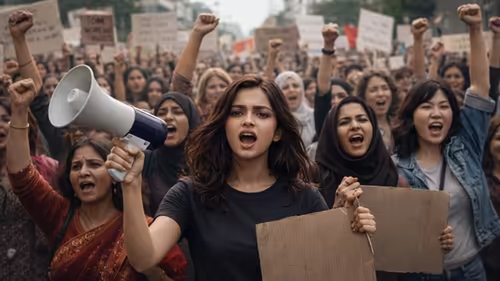
The 4B movement isn’t just another internet trend—it’s a radical feminist philosophy that’s shaking traditional gender norms to their core. Emerging from South Korea’s intense patriarchal landscape, it champions four definitive rejections: No marriage, no dating, no sex, and no childbirth. For its followers, these aren’t lifestyle choices—they’re acts of political resistance.
In a world where women are still expected to prioritize family over self, the 4B movement flips the script entirely. It argues that opting out of heteronormative institutions is the most effective way to dismantle systemic oppression. And now, as conversations about autonomy, consent, and equality grow louder in India, many are wondering whether this controversial ideology could take root here.
Origins in South Korea: A Response to Extreme Gender Inequality
The 4B movement (or “Four Nos” movement) began in South Korea around the mid-2010s, born out of deep frustration with one of the world’s most entrenched patriarchal systems. Despite being a high-income democracy, South Korea consistently ranks among the worst OECD countries for gender equality [[1]].
Women there face:
- A massive gender pay gap (women earn ~31% less than men)
- Intense workplace discrimination
- Rampant digital sex crimes (like spy cam pornography)
- Societal pressure to become “good wives and wise mothers”
In this context, the 4B movement emerged not as a rejection of love or intimacy, but as a survival strategy—a way to withdraw from systems that exploit female labor, bodies, and emotional energy without offering real reciprocity [[3]].
The ‘Four Nos’ Explained: What Each Pillar Means
Let’s break down the core tenets of the movement:
- No Marriage (結婚しない): Seen as an institution that legally and socially binds women to unpaid domestic labor and male authority.
- No Dating (交際しない): Romantic relationships are viewed as gateways to emotional manipulation and unequal expectations.
- No Sex (セックスしない): Rejects the commodification of female sexuality and the risk of non-consensual dynamics in patriarchal contexts.
- No Childbirth (出産しない): A refusal to reproduce in a world deemed unsafe and unjust for women and future generations.
Supporters argue this isn’t misandry—it’s self-preservation. By withdrawing participation, they aim to collapse the economic and social structures that rely on women’s compliance [[5]].
From Seoul to Mumbai: Is the 4B Movement Gaining Traction in India?
India’s gender landscape is complex. While urban centers see rising female education and workforce participation, deeply rooted patriarchy persists—from dowry demands to son preference and marital rape exemptions.
On Indian social media, hashtags like #NoMarriage and #ChildfreeByChoice are gaining visibility, especially among Gen Z and millennial women. Reddit threads and Instagram posts echo 4B sentiments, though few explicitly label themselves as part of the movement [[7]].
Yet, cultural realities differ vastly from South Korea. In India, family pressure, economic dependence, and lack of social safety nets make total withdrawal far more difficult. Still, the underlying sentiment—“I refuse to sacrifice my life for a system that doesn’t value me”—resonates deeply.
As discussions around [INTERNAL_LINK:Lifestyle] and gender roles evolve, the 4B philosophy may not spread wholesale, but its core questions are already influencing Indian feminist discourse.
Criticism, Controversy, and Counterarguments
The 4B movement has drawn sharp criticism from multiple angles:
- Feminist critics argue it’s exclusionary, ignoring LGBTQ+ relationships and reinforcing heteronormativity by defining resistance only in opposition to men.
- Traditionalists call it “anti-family” and “destructive to society.”
- Pragmatists point out that complete disengagement isn’t feasible for most women, especially in collectivist cultures like India’s.
Moreover, some scholars warn that framing liberation solely through abstinence risks reducing feminism to negation rather than creation—of new models of care, community, and kinship [[9]].
Conclusion: A Mirror to Society, Not Just a Manifesto
Whether or not the 4B movement takes hold in India, its existence forces a vital conversation: Why do so many women feel that the only path to freedom is total withdrawal? The movement isn’t really about saying “no”—it’s about demanding a world where “yes” feels safe, equal, and truly voluntary.
As India grapples with rising gender-based violence, declining female labor participation, and persistent regressive norms, the 4B movement may serve less as a blueprint and more as a stark warning: if society fails to offer women dignity within its systems, they may choose to build lives entirely outside them.
Sources
- Times of India: 4B movement: The ‘four nos’ that scared patriarchy; is India ready? Link
- OECD Gender Equality Data: Gender wage gap statistics
- Al Jazeera: South Korea’s 4B feminist movement explained Link
- UN Women: Progress on the Sustainable Development Goals: The Gender Snapshot 2023
- The Guardian: ‘I will not marry’: South Korea’s radical feminist movement Link
- Reddit r/IndiaSpeaks & Twitter/X trends on #ChildfreeIndia (2025–2026)
- Brookings Institution: Gender inequality in India: Status, challenges, and policy options