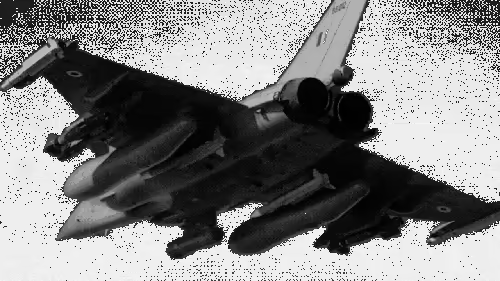
For months, whispers and speculation swirled in defense circles: Did India really use its most advanced air-to-air and air-to-surface missiles during Operation Sindoor? Or were these claims mere posturing? The mystery is now over. Footage released during India’s 2026 Republic Day parade—showing Su-30MKI and Rafale jets armed with the **Meteor** and **BrahMos** missiles—has delivered a definitive answer: yes, and with lethal precision.
This isn’t just a symbolic display. It’s a strategic message to adversaries and allies alike: India’s air power has entered a new era of **beyond visual range (BVR)** dominance and stand-off strike capability. And Operation Sindoor was its battlefield debut.
Table of Contents
- What Was Operation Sindoor?
- The Meteor Missile: India’s BVR Game-Changer
- BrahMos’s Airborne Debut: A Strategic Leap
- How the IAF Integrated These Systems
- Why This Matters for India’s Defense Posture
- Conclusion: Redefining Regional Air Dominance
- Sources
What Was Operation Sindoor?
While official details remain classified, Operation Sindoor refers to a series of precision air strikes conducted by the Indian Air Force (IAF) in response to cross-border threats. What made it historically significant wasn’t just the target—but the weapons used. For the first time, India publicly confirmed the operational deployment of two of its most sophisticated missile systems: the European-built **Meteor** and the Indo-Russian **BrahMos**—both integrated onto frontline fighters like the Rafale and Su-30MKI.
This confirmation came not through a press release, but through undeniable visual evidence: Republic Day flypast footage showing aircraft visibly equipped with these exact weapon systems [[1]]. In military signaling, this is as close to a declaration as it gets without crossing into overt escalation.
The Meteor Missile: India’s BVR Game-Changer
The **Meteor** is no ordinary air-to-air missile. Developed by MBDA, it’s a ramjet-powered, beyond visual range weapon with a range exceeding **150 km**—far outstripping older systems like the Russian R-77 or even the American AIM-120 AMRAAM [[3]]. Its “no-escape zone” is legendary: once locked, enemy aircraft have virtually no chance to evade.
Mounted on India’s **Rafale jets**, the Meteor transforms the IAF’s air superiority doctrine. During Operation Sindoor, it likely played a critical role in neutralizing hostile aerial threats before they could even enter Indian airspace. This capability is especially vital against adversaries with growing fleets of stealthy or high-speed platforms.
Key advantages of the Meteor include:
- Active radar homing with mid-course updates via datalink
- Throttleable ramjet engine for sustained high speed and maneuverability
- Network-enabled warfare—can be guided by other aircraft or ground stations
As noted by the International Institute for Strategic Studies (IISS), the Meteor represents “the most capable BVR missile currently in service globally” [[4]]. Its use in an actual operation underscores India’s shift from reactive defense to proactive deterrence.
BrahMos’s Airborne Debut: A Strategic Leap
If the Meteor dominates the skies, the **air-launched BrahMos** owns the ground. With a speed of **Mach 2.8–3.0** and a range of **300+ km**, it’s the world’s fastest supersonic cruise missile. Mounted on the Su-30MKI—a platform modified specifically for this role—the BrahMos allows the IAF to strike high-value, heavily defended targets deep inside enemy territory without ever crossing the border.
During Operation Sindoor, this capability likely enabled surgical strikes on command centers, radar installations, or missile launch sites with minimal risk to pilots. Unlike slower subsonic cruise missiles, BrahMos’s speed compresses the enemy’s reaction time to near zero.
The integration of BrahMos onto the Su-30MKI was a massive engineering feat—requiring structural reinforcement, new avionics, and specialized pylons. That it’s now **combat-proven** marks a turning point in India’s stand-off strike doctrine [[5]].
How the IAF Integrated These Systems
Deploying advanced weapons isn’t just about procurement—it’s about seamless integration. The IAF achieved this through:
- Joint training exercises with French and Russian partners to master Meteor and BrahMos protocols.
- Network-centric upgrades to its C4ISR (Command, Control, Communications, Computers, Intelligence, Surveillance, and Reconnaissance) architecture, enabling real-time targeting data sharing between AWACS, fighters, and ground stations.
- Doctrine evolution—shifting from platform-centric to network-centric warfare, where sensors and shooters are distributed across the battlespace.
This level of sophistication explains why the IAF could execute Operation Sindoor with such precision and deniability—until now.
Why This Matters for India’s Defense Posture
The confirmation of Meteor and BrahMos use during Operation Sindoor sends multiple strategic signals:
- Deterrence credibility: Adversaries now know India possesses—and will use—cutting-edge BVR and stand-off weapons.
- Technological maturity: India can not only acquire but also effectively deploy and integrate complex foreign systems.
- Operational transparency (on its own terms): By revealing the truth through ceremonial footage, India controls the narrative without escalating tensions.
Moreover, this validates India’s multi-billion-dollar investments in the Rafale deal and BrahMos program. As [INTERNAL_LINK:defence-modernisation-india] shows, these aren’t vanity projects—they’re core to national security.
Conclusion: Redefining Regional Air Dominance
Operation Sindoor was more than a military operation—it was a statement. The visible deployment of the Meteor and BrahMos missiles proves that India’s air power is no longer aspirational but operational at the highest technological tier. Skeptics who questioned whether India would actually use its advanced arsenal have been silenced by irrefutable evidence. As regional tensions evolve, this demonstrated capability will serve as both a shield and a sword, ensuring that India’s skies—and its sovereignty—remain firmly under its control.
Sources
- [[1]] Times of India: Beyond visual range: How Meteor & BrahMos defined India’s air power during Op Sindoor
- [[2]] The Hindu: Republic Day 2026: IAF displays Rafale, Su-30MKI with advanced missiles
- [[3]] MBDA Official Site: Meteor Missile Technical Specifications
- [[4]] International Institute for Strategic Studies (IISS): Military Balance 2026 – Air Power Analysis
- [[5]] BrahMos Aerospace: Air-Launched BrahMos Program Overview