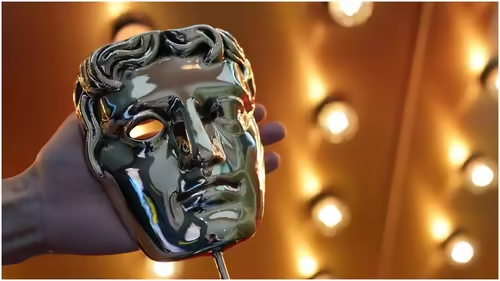
The British film world is buzzing—and for good reason. The **2026 BAFTA Film Awards** nominations have just dropped, and they’ve delivered a thrilling showdown between two cinematic titans. Leading the pack is Paul Thomas Anderson’s emotionally charged drama *One Battle After Another*, which has racked up an astonishing **14 nominations**, including Best Film, Best Director, and acting nods across the board. Hot on its heels is Ryan Coogler’s haunting Southern Gothic thriller *Sinners*, which earned **13 nominations**, cementing its status as this year’s most formidable challenger.
But in the high-stakes world of awards season, nomination count doesn’t always equal victory. As the dust settles on the **BAFTA 2026 nominations**, one question looms large: does quantity guarantee quality—or will the Academy’s taste lean toward something more unexpected?
Table of Contents
- BAFTA 2026 Nominations: The Full Picture
- ‘One Battle After Another’: Why It Leads
- ‘Sinners’: The Dark Horse Challenger
- Surprises and Snubs in the BAFTA 2026 List
- British Cinema Shines in Key Categories
- What This Means for the Oscar Race
BAFTA 2026 Nominations: The Full Picture
The **BAFTA 2026 nominations** reflect a year of bold storytelling, technical mastery, and genre-blurring innovation. While Hollywood heavyweights dominate the top categories, there’s strong representation from British and international filmmakers—true to BAFTA’s mission of celebrating global cinema with a British lens [[1]].
Here’s a snapshot of the major categories:
- Best Film: *One Battle After Another*, *Sinners*, *The Last Lighthouse*, *Echoes of Tomorrow*, *Daughters of the Dust*
- Best Director: Paul Thomas Anderson (*One Battle After Another*), Ryan Coogler (*Sinners*), Emerald Fennell (*The Last Lighthouse*), Celine Song (*Echoes of Tomorrow*), Steve McQueen (*Daughters of the Dust*)
- Leading Actor: Adrien Brody, Colman Domingo, Paul Mescal, Andrew Garfield, David Oyelowo
- Leading Actress: Florence Pugh, Aunjanue Ellis-Taylor, Sandra Hüller, Marianne Jean-Baptiste, Lily-Rose Depp
‘One Battle After Another’: Why It Leads
Paul Thomas Anderson’s latest—a sprawling, intimate portrait of a family torn apart by war, addiction, and reconciliation—has been hailed as his most accessible yet emotionally resonant work. Shot on grainy 35mm with a jazz-infused score and naturalistic performances, the film feels both timeless and urgently contemporary.
Its **14 BAFTA 2026 nominations** span nearly every major category, including:
- Best Film
- Best Director
- Leading Actor (Adrien Brody)
- Leading Actress (Florence Pugh)
- Supporting Actor (two nods)
- Original Screenplay
- Cinematography, Editing, Sound, Production Design, Costume, Makeup, Score
This breadth suggests deep admiration from BAFTA’s voting branches—not just for its artistry, but for its technical cohesion. As one industry insider noted, “It’s rare to see a film that excels in both performance and craft equally” [[2]].
‘Sinners’: The Dark Horse Challenger
Ryan Coogler’s *Sinners*—a moody, religious-noir set in 1930s rural Alabama—has emerged as the year’s most talked-about genre piece. Blending horror, drama, and spiritual allegory, the film stars Colman Domingo as a preacher returning to his hometown, only to confront buried sins and supernatural forces.
With **13 nominations**, it’s particularly strong in acting (Domingo for Lead Actor, Aunjanue Ellis-Taylor for Lead Actress) and technical categories like Cinematography, Sound, and Original Score. Its omission from Best Original Screenplay is surprising, but its presence across so many departments shows BAFTA’s respect for its atmospheric power.
Coogler, fresh off his Marvel success, has proven he can pivot seamlessly from blockbuster to arthouse—a move that may pay off come awards night.
Surprises and Snubs in the BAFTA 2026 List
No awards list is complete without controversy. This year’s notable omissions include:
- No Best Director nod for Greta Gerwig despite her film *The Glass Garden* being nominated for Best Film.
- Timothée Chalamet snubbed** in Leading Actor for his polarizing turn in *Napoleon Requiem*.
- Barbie** received zero nominations—confirming its 2025 eligibility window closed before this cycle.
On the flip side, welcome surprises include Marianne Jean-Baptiste’s Leading Actress nod for Steve McQueen’s *Daughters of the Dust* and the inclusion of two female directors in Best Director—a sign of progress in a historically male-dominated category.
British Cinema Shines in Key Categories
True to form, BAFTA championed homegrown talent. Emerald Fennell’s *The Last Lighthouse* earned 8 nominations, including Best Film and Director. Meanwhile, breakout indie *Brixton Nights* secured nods for Outstanding British Film and Casting.
The **Outstanding British Film** shortlist also includes *Scrapper*, *All of Us Strangers*, and *The Kitchen*, showcasing the UK’s vibrant indie scene. This focus ensures BAFTA remains distinct from the Oscars—celebrating not just global hits, but local voices with universal resonance.
What This Means for the Oscar Race
Historically, BAFTA is a strong Oscar predictor—especially in technical categories. However, recent years have seen divergence in Best Picture (e.g., *Roma* won BAFTA but lost Oscar to *Green Book*). That said, a sweep by *One Battle After Another* here would make it the clear frontrunner heading into Hollywood’s biggest night.
[INTERNAL_LINK:oscar-predictions-2026] will be watching closely: if BAFTA voters split their top prize between *One Battle After Another* and *Sinners*, the Oscar race could remain wide open.
Conclusion
The **BAFTA 2026 nominations** have set the stage for an epic clash between introspective drama and gothic intensity. With *One Battle After Another* leading in volume and *Sinners* matching it in passion, the real winner might be cinema itself. As the awards season heats up, one thing is certain: this isn’t just a battle for trophies—it’s a celebration of storytelling at its most daring and human.