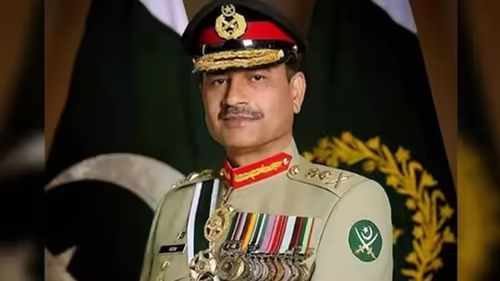
In a rare and scathing public rebuke, India has accused Pakistan of orchestrating a **“constitutional coup”** by granting **lifetime legal immunity** to its powerful army chief, General Asim Munir. The move—part of a broader legislative shield passed by Pakistan’s Parliament—has triggered alarm in New Delhi, with officials warning it entrenches military dominance over civilian institutions and sets a dangerous precedent for democratic governance in the region.
“Pakistan must introspect on this constitutional coup,” India’s Ministry of External Affairs (MEA) declared, framing the immunity law not just as an internal Pakistani matter, but as a threat to regional stability and the very principles of accountable governance. This marks one of the strongest official reactions from India to Pakistan’s domestic political maneuvers in recent years.
Table of Contents
- What Is the Asim Munir Lifetime Immunity Law?
- India’s Response: A Diplomatic Salvo
- Why Pakistan Passed This Law: Context and Controversy
- Historical Precedent: Military Immunity in Pakistan
- Regional Implications for South Asia and Beyond
- What Happens Next? Diplomatic Fallout
What Is the Asim Munir Lifetime Immunity Law?
In early January 2026, Pakistan’s National Assembly passed an amendment to the Pakistan Army Act, granting **full legal immunity** to the sitting Chief of Army Staff (COAS)—currently General Asim Munir—for the duration of his service **and for life thereafter**. This means Munir cannot be prosecuted, investigated, or even summoned by civilian courts for any actions taken during or after his tenure.
The law also extends retroactive protection, shielding past decisions made by current and former army chiefs. Critics inside Pakistan—including opposition leaders, civil society groups, and legal experts—have labeled it a “blanket amnesty” that places the military above the law. Proponents argue it’s necessary to protect national security decision-making from “frivolous litigation.”
India’s Response: A Diplomatic Salvo
India’s reaction was swift and uncharacteristically blunt. In a formal statement, the MEA said:
“The enactment of a law providing lifetime immunity to the head of the armed forces is not merely an internal affair. It represents a deliberate erosion of constitutional checks and balances—a constitutional coup that subordinates democratic institutions to unaccountable military authority.” [[1]]
This language is significant. By using the term “constitutional coup,” India is drawing a direct line between Pakistan’s internal power dynamics and its external behavior—particularly its alleged support for cross-border terrorism. The implication is clear: a military unchecked by civilian oversight poses a greater risk to regional peace.
Why Pakistan Passed This Law: Context and Controversy
The timing is no coincidence. General Asim Munir, who took charge in November 2023, has overseen a period of intense political turbulence in Pakistan, including the controversial 2024 general elections and the jailing of former Prime Minister Imran Khan. With Khan’s PTI party accusing the military of rigging and repression, the immunity law appears designed to insulate the army leadership from future legal challenges.
Key motivations likely include:
- Preventing post-retirement prosecutions: Former COAS like Gen. Pervez Musharraf faced legal action after leaving office.
- Consolidating military authority: Reinforcing the army’s role as the ultimate arbiter of Pakistan’s political fate.
- Deterring judicial activism: Curtailing the judiciary’s ability to question military decisions.
Ironically, the law was passed with support from both the ruling coalition and segments of the opposition—highlighting the military’s pervasive influence across party lines.
Historical Precedent: Military Immunity in Pakistan
Pakistan’s history is littered with instances of military dominance. Since independence in 1947, the army has directly ruled for over three decades and indirectly controlled policy for much of the rest. Legal protections for top brass are not new—but **lifetime immunity** is unprecedented.
Previous attempts to hold generals accountable—such as the treason trial of Musharraf—were either abandoned or rendered symbolic. The new law effectively closes that door forever. As noted by the International Commission of Jurists, such measures “violate international standards on equality before the law and accountability for human rights violations” [[2]].
Regional Implications for South Asia and Beyond
India’s strong stance reflects deeper strategic concerns:
- Terrorism & Proxy Warfare: An unaccountable military may feel emboldened to continue supporting militant groups targeting India.
- Diplomatic Engagement: India may further downgrade bilateral talks, citing lack of civilian control in Pakistan.
- Global Perception: New Delhi aims to rally international opinion against what it sees as Pakistan’s “militarized autocracy.”
Western democracies, already wary of Pakistan’s instability, may now face pressure to reassess security partnerships. The U.S. State Department has previously expressed concern about “democratic backsliding” in Pakistan [[3]], and this law could intensify those worries.
What Happens Next? Diplomatic Fallout
While full-scale diplomatic rupture is unlikely, expect India to:
- Highlight the issue in multilateral forums like the UN and SCO.
- Use it to justify continued skepticism in any future dialogue with Pakistan.
- Strengthen ties with other South Asian nations wary of Pakistani militarism.
Domestically, the Indian government will likely frame this as validation of its long-standing position: that sustainable peace with Pakistan is impossible without genuine civilian supremacy.
[INTERNAL_LINK:pakistan-army-political-influence] remains a core obstacle to normalization—and this law just cemented it.
Conclusion
The **Asim Munir lifetime immunity** law is more than a legal technicality—it’s a stark declaration of where real power lies in Pakistan. By calling it a “constitutional coup,” India isn’t just criticizing a neighbor; it’s sounding an alarm about the fragility of democracy in South Asia. As long as the military operates above the law, prospects for lasting peace, accountability, and regional cooperation remain dim. For now, New Delhi’s message is clear: you cannot claim to be a democracy while enshrining impunity at its highest levels.
Sources
- Times of India: ‘Introspect your constitutional coup’: India targets Pak over lifetime immunity to Munir
- International Commission of Jurists: Pakistan’s Military Immunity Law Violates International Law
- U.S. Department of State: Pakistan Country Report
- Dawn: Pakistan Parliament Passes Army Chief Immunity Bill