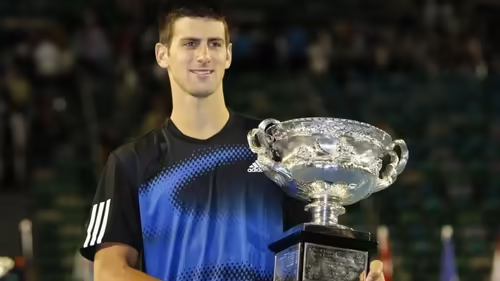
Imagine a world where only two names ruled tennis. For years, that was reality: **Roger Federer** and **Rafael Nadal** weren’t just champions—they were titans who owned every major trophy between them. Then, on a warm January night in Melbourne in 2008, a lanky 20-year-old from Serbia named **Novak Djokovic** stepped onto Rod Laver Arena and did the unthinkable: he won the Australian Open, shattering the **Federer-Nadal duopoly** and launching a new era in tennis history.
That victory wasn’t just a breakthrough—it was a declaration. And nearly two decades later, with **24 Grand Slam titles** to his name and still competing at age 38, Djokovic hasn’t just joined the pantheon of legends; he’s arguably sitting at its very peak.
Table of Contents
- The Day Djokovic Breaks Federer-Nadal Duopoly
- Why the 2008 Australian Open Was a Turning Point
- The Rise of the Big Three: A New Tennis Trinity
- Djokovic’s Record-Breaking Career by the Numbers
- What Makes Djokovic Different: His Mental and Physical Edge
- The Legacy—and What Comes Next
The Day Djokovic Breaks Federer-Nadal Duopoly
Before 2008, the men’s Grand Slam scene was a two-man show. From 2003 to 2007, Federer and Nadal combined to win **21 of 22 majors**—only one slipped through their grasp (the 2005 US Open, won by Marat Safin). The narrative was set: Federer, the elegant maestro; Nadal, the relentless warrior. Everyone else? Just supporting cast.
Then came Djokovic. In the 2008 Australian Open final, he faced Jo-Wilfried Tsonga—a man on a magical run—but it was Djokovic’s composure, return game, and uncanny ability to absorb pressure that sealed the deal in four sets. At that moment, the **Djokovic breaks Federer-Nadal duopoly** storyline was born. He wasn’t just another contender; he was the third pillar of what would become the legendary **Big Three**.
Why the 2008 Australian Open Was a Turning Point
This wasn’t just any first title. It was symbolic. Djokovic had already signaled his arrival by beating Nadal in the 2007 US Open semifinals and pushing Federer to five sets in the same year’s Wimbledon semi-final. But winning a major changed everything:
- Psychological Shift: He proved he could close under pressure, not just compete.
- Media & Fan Recognition: Overnight, he went from “promising youngster” to “serious threat.”
- Strategic Validation: His unique return-of-serve and court coverage were no longer quirks—they were weapons.
As tennis legend John McEnroe noted at the time, “Djokovic has something the others don’t—flexibility, timing, and nerves of steel.” [[1]]
The Rise of the Big Three: A New Tennis Trinity
From 2008 onward, the Grand Slam landscape transformed into a three-way battle. Between 2008 and 2024, the Big Three—Federer, Nadal, and Djokovic—won **62 of 67 Grand Slams**. That’s over 92% dominance across 16 years. This unprecedented era redefined longevity, fitness, and mental resilience in professional sports.
While Federer brought grace and Nadal unmatched grit, Djokovic offered something different: **adaptability**. He could out-rally Nadal on clay, out-think Federer on grass, and dominate on hard courts like no one before. His game evolved constantly—gluten-free diet, breathing techniques, mental coaching—all in service of one goal: **sustained excellence**.
Djokovic’s Record-Breaking Career by the Numbers
Let’s put his legacy in perspective with hard data:
| Milestone | Record |
|---|---|
| Grand Slam Titles | 24 (most in men’s history) [[2]] |
| Weeks at World No. 1 | Over 420 weeks (all-time record) [[3]] |
| Year-End No. 1 Finishes | 8 times (tied for most) [[3]] |
| Grand Slam Finals Reached | 37 (most in men’s history) |
| Australian Open Titles | 10 (most by any player at a single Slam) |
These aren’t just stats—they’re testaments to consistency across surfaces, generations, and global competition.
What Makes Djokovic Different: His Mental and Physical Edge
Many players have talent. Few have Djokovic’s **mental fortitude**. Consider this: he’s won **7 of 10 Grand Slam finals** after turning 35—a feat once thought impossible in men’s tennis. His secret?
- Elite Recovery Protocols: Cryotherapy, yoga, and meticulous sleep tracking keep his body resilient.
- Emotional Regulation: Unlike earlier in his career, he rarely lets frustration derail matches.
- Strategic Patience: He’s willing to lose a set to win the match, trusting his endurance.
As ATP physiotherapist Mark Kovacs explains, “Djokovic’s flexibility and core stability are off the charts—biomechanically, he’s built to last.” [[4]]
The Legacy—and What Comes Next
At 38, Djokovic shows no signs of slowing down. He’s targeting the **2026 Australian Open** to potentially claim a 25th major, further cementing his GOAT status. But beyond trophies, his true legacy may be how he **forced tennis to evolve**. Young stars like Carlos Alcaraz and Jannik Sinner now train with the expectation of competing into their late 30s—something unheard of before the Big Three era.
[INTERNAL_LINK:history-of-grand-slam-tennis] will forever mark 2008 as the year the duopoly ended and a new standard began.
Conclusion
The moment **Djokovic breaks Federer-Nadal duopoly** wasn’t just about one trophy—it was the spark that ignited the greatest era in men’s tennis. By combining physical mastery, mental toughness, and relentless evolution, Novak Djokovic didn’t just join the conversation about the greatest of all time. He’s now leading it. And as long as he’s on the court, history isn’t finished being written.