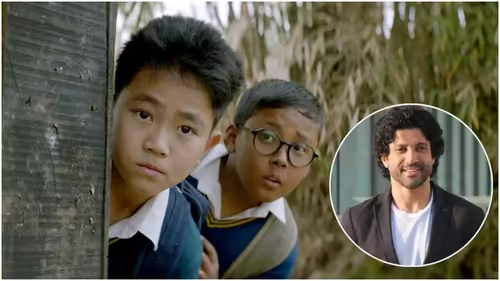
Hold onto your seats, cinephiles. A quiet revolution is brewing in the world of Indian cinema, and its name is Boong. The announcement of the 2026 BAFTA nominations wasn’t just about the usual Hollywood heavyweights; it was punctuated by a moment of pure, unadulterated history for India. For the first time, a Manipuri-language film has crashed the party, earning a coveted spot in the Best Children’s and Family Film category. This isn’t just a win for the film; it’s a seismic shift for an entire cinematic landscape.
Table of Contents
- The Boong BAFTA Nomination: Why It Matters
- Inside the Heart of Boong: Story and Creator
- Farhan Akhtar’s Excel Entertainment: A New Chapter
- A Historical Glance: Indian Cinema at the BAFTAs
- What This Means for the Future of Indian Regional Cinema
The Boong BAFTA Nomination: Why It Matters
The official 2026 EE BAFTA Film Awards nominations list confirmed what many in the industry had been buzzing about: Boong BAFTA nomination is a reality [[7]]. This is monumental. While Indian films have occasionally appeared in BAFTA’s longlists or in technical categories, a nomination in a major competitive category like Best Children’s and Family Film for a non-Hindi, regional language film is unprecedented. It shatters the glass ceiling that has often confined the global perception of Indian cinema to Bollywood song-and-dance spectacles. This nomination is a powerful validation of the nuanced, human stories being told in every corner of India, from Manipur to Maharashtra, from Assam to Andhra Pradesh.
Inside the Heart of Boong: Story and Creator
At its core, Boong is a coming-of-age tale that transcends its specific setting to speak a universal language of love, loss, and resilience. The film follows the journey of a young boy whose singular mission is to reunite with his estranged father. But the true magic lies in its authenticity. The film is the brainchild of debutante director Lakshmipriya Devi, a storyteller who drew inspiration from the very soil of her homeland. Her vision was reportedly shaped by the folk tales her grandmother shared during Manipur’s turbulent times in the late 70s and early 80s [[13]]. This personal connection infuses the narrative with a raw, emotional honesty that resonates far beyond its regional context. As a graduate in Economics and Mass Communications, Devi’s transition to directing with such a powerful first feature is a testament to her unique voice [[12]].
Key Themes in Boong
- Enduring Friendship: The film expertly centers the power of friendship as a beacon of hope amidst adversity [[15]].
- Ethno-Racial Discord: It doesn’t shy away from the complex social realities of its setting, weaving them into the personal journey of its protagonist [[15]].
- Family and Belonging: The central quest for paternal reunion taps into a fundamental human desire for connection and belonging.
Farhan Akhtar’s Excel Entertainment: A New Chapter
Behind this groundbreaking project is none other than Farhan Akhtar’s production house, Excel Entertainment. Known for its trendsetting Hindi films like Dil Chahta Hai and Zindagi Na Milegi Dobara, Excel’s decision to back Boong marks a significant and welcome evolution in its strategy. In recent years, Excel has shown a growing commitment to diverse storytelling, with projects like Superboys of Malegaon and the upcoming 120 Bahadur [[26]]. By championing a Manipuri-language film, Excel isn’t just producing content; it’s actively investing in the future of a more inclusive and representative Indian film industry. This move signals that major production houses are finally recognizing the immense talent and compelling narratives waiting to be discovered outside the traditional Mumbai-centric system. Their partnership with Chalkboard Entertainment and Suitable Pictures for Boong is a model for collaborative, pan-Indian filmmaking [[9]].
A Historical Glance: Indian Cinema at the BAFTAs
To fully appreciate the weight of Boong‘s achievement, one must look back. Historically, Indian cinema’s presence at the BAFTAs has been sparse and largely confined to Satyajit Ray’s Apu Trilogy, which received nominations in the late 1950s [[35]]. In recent years, there’s been a slight uptick, with films by Indian-origin filmmakers like Santosh and Sister Midnight gaining recognition in the Outstanding Debut category at the 2025 awards [[28]]. However, these were primarily British productions. Boong stands apart because it is an authentically Indian production, in a native Indian language, telling a story rooted in a specific Indian experience, yet finding its place on a global shortlist. It’s a different kind of breakthrough—one that comes from within the country’s own diverse cinematic ecosystem.
What This Means for the Future of Indian Regional Cinema
The ripple effects of the Boong BAFTA nomination could be profound. Here’s what it might unlock:
- Global Spotlight: International distributors and streaming platforms will take notice, potentially leading to wider releases for other high-quality regional films.
- Investor Confidence: Success breeds confidence. Producers may be more willing to fund ambitious projects in languages like Marathi, Malayalam, Kannada, or Assamese, knowing there’s a global audience.
- Empowerment of Filmmakers: Directors like Lakshmipriya Devi will inspire a new generation of storytellers from across India to tell their local stories with global ambition.
- Redefining “Indian Cinema”: The world will begin to see Indian cinema not as a monolith, but as a vibrant, multifaceted tapestry of hundreds of distinct film industries.
This moment is a powerful reminder that great stories can come from anywhere. [INTERNAL_LINK:history-of-indian-cinema] has always been rich with them, and now, thanks to Boong, the world is finally paying attention.
Conclusion
The Boong BAFTA nomination is far more than just an accolade for a single film. It is a cultural milestone, a defiant statement that the heart of Indian cinema beats strongest in its diversity. With its poignant story, visionary director, and the backing of a powerhouse like Excel Entertainment, Boong has not only earned its place on the BAFTA stage but has also paved a new path forward for every regional filmmaker in the country. The world is watching, and the future of Indian cinema has never looked more promising—or more beautifully varied.
Sources
- BAFTA.org: Nominations Announced for the 2026 EE BAFTA Film Awards
- Wikipedia: Boong (film)
- IANS: Director Lakshmipriya Devi on ‘Boong’
- TIFF: Boong
- The Indian Express: Excel Entertainment’s 2025 Slate
- Asianews.network: Indian-Origin Filmmakers at BAFTA 2025
- Wikipedia: List of Indian winners and nominees of the BAFTA Awards