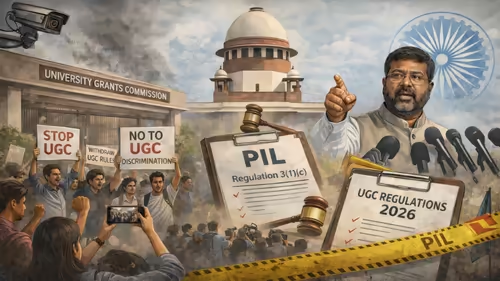
It was meant to be a landmark step towards a more inclusive campus life. On January 13, 2026, the University Grants Commission (UGC) rolled out its ambitious UGC 2026 equity rules, the ‘Promotion of Equity in Higher Education Institutions Regulations, 2026.’ The goal was noble: to create a robust framework to combat discrimination and ensure a safe environment for all students [[8]].
But instead of applause, the regulations were met with an immediate and fierce backlash. From the corridors of Lucknow University to the streets of Delhi, students took to the streets in protest [[11]]. Simultaneously, a Public Interest Litigation (PIL) landed on the desk of the Supreme Court, challenging the very heart of the new policy [[1]]. At the epicenter of this storm is a single, deceptively simple clause: Regulation 3(1)(c).
Table of Contents
- What Are the UGC 2026 Equity Rules?
- The Controversial Core: Regulation 3(1)(c)
- Why Students Are Protesting on Campus
- The Supreme Court PIL and Legal Challenge
- The Government’s Response and Future Outlook
What Are the UGC 2026 Equity Rules?
The new regulations are a comprehensive set of guidelines designed to institutionalize anti-discrimination measures in all higher education institutions (HEIs). Key provisions include:
- Mandatory Committees: Every university must establish an Equal Opportunity Centre (EOC) and an Internal Complaints Committee (ICC) to handle grievances.
- Equity Squads: These squads are tasked with monitoring sensitive areas like hostels, canteens, and laboratories to prevent discriminatory acts before they happen [[17]].
- Broader Scope: The rules aim to protect students from discrimination based on caste, religion, gender, disability, race, and place of birth [[28]].
On paper, these measures appear to be a significant leap forward for social justice in academia. However, the devil, as they say, is in the details—and that detail is Regulation 3(1)(c).
The Controversial Core: Regulation 3(1)(c)
This specific regulation provides a formal definition for “caste-based discrimination.” According to the text, it means “discrimination only on the basis of caste or tribe” against members of the Scheduled Castes (SC), Scheduled Tribes (ST), and Other Backward Classes (OBC) [[3]].
At first glance, this seems logical. But critics argue this definition is dangerously narrow and exclusionary. They contend that by specifying “only” SC, ST, and OBC, the rule implicitly excludes other groups from its protection. This has led to widespread fear, particularly among students from the General category, that they could be left vulnerable to harassment or false complaints without any recourse under this new framework [[14]].
Why Students Are Protesting on Campus
The protests are not just about a technical definition; they are fueled by deep-seated anxieties about fairness and potential misuse. Student groups have raised several key concerns:
- Burden of Proof: Protesters fear that the rules might shift the burden of proof onto the accused, making it difficult to defend against allegations.
- “Surveillance” State: The creation of Equity Squads has been described by some as an overreach, creating a climate of surveillance and suspicion on campuses [[17]].
- Political Weaponization: There is a concern that the vague language could be exploited for political vendettas or personal grudges, turning a tool for justice into a weapon for harassment [[15]].
These fears have translated into real-world action, with large-scale demonstrations at major universities and even political fallout, including resignations from state-level leaders in Uttar Pradesh [[16]].
The Supreme Court PIL and Legal Challenge
The campus unrest quickly found its way to the highest court in the land. A PIL has been filed in the Supreme Court directly challenging the constitutionality of Regulation 3(1)(c) [[22]]. The petition argues that the regulation is “arbitrary, discriminatory and violative of the right to equality” because its narrow definition creates a two-tiered system of justice on campus [[23]].
The petitioners are seeking an immediate stay on the enforcement of this specific clause until it can be thoroughly reviewed and re-drafted to be more inclusive and fair [[6]]. This legal battle will be crucial in determining the future of the entire regulatory framework.
The Government’s Response and Future Outlook
Facing mounting pressure, the Union Ministry of Education has issued a statement attempting to calm the situation. It has assured the public that “misuse won’t be allowed” and that official “clarifications are coming soon” to address the ambiguities in the current text [[24]].
However, for many students and legal experts, these assurances are not enough. The core issue remains: can a policy designed to promote equity truly succeed if its foundational definition is perceived as itself being inequitable? The government now faces a delicate balancing act—upholding the rights of historically marginalized communities while ensuring that the new system is fair and just for every single student on campus.
Conclusion
The controversy surrounding the UGC 2026 equity rules is a stark reminder that crafting social policy is an immensely complex task. While the intent to create safer, more inclusive campuses is commendable, the execution has opened a Pandora’s box of legal, social, and ethical dilemmas. The outcome of the Supreme Court case and the government’s forthcoming clarifications will be pivotal in deciding whether these regulations become a beacon of progress or a cautionary tale of good intentions gone awry. For more on the evolving landscape of Indian higher education policy, see our guide on [INTERNAL_LINK:higher-education-reforms-india].
Sources
- Times of India: Protests, PIL and campus pushback: Why UGC’s equity rules have opened a can of worms
- India Today: PIL filed in SC against UGC 2026 rules on caste-based discrimination
- LiveLaw: Plea In Supreme Court Challenges UGC Regulation
- Times of India: Lucknow University students protest UGC’s new equity regulations
- CollegeDekho: UGC Anti-Discrimination Rules 2026