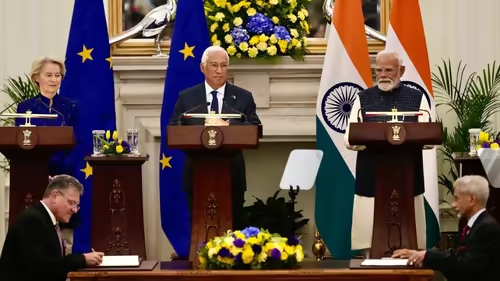
Big news just broke: after **19 years** of on-and-off negotiations, India and the European Union have officially **concluded talks** on a comprehensive Free Trade Agreement (FTA). Headlines are calling it a “landmark deal” that will reshape trade between the world’s largest democracy and its biggest trading bloc [[1]].
But here’s the twist: the deal won’t be signed today. In fact, it might not be formally inked until late 2026—and won’t take effect until early 2027. So what gives? If the hard part is over, why the delay?
The answer reveals the intricate machinery behind international diplomacy—and why even a “sealed” **India-EU trade deal** still has a long road ahead before it becomes law.
Table of Contents
- What Was Agreed in the India-EU Trade Deal?
- Why the India-EU Trade Deal Won’t Be Signed Today
- The Road to Ratification: A Step-by-Step Breakdown
- What This Deal Means for Indian Businesses
- Potential Challenges and Criticisms
- Conclusion: What to Watch Next
- Sources
What Was Agreed in the India-EU Trade Deal?
The final agreement covers far more than just tariffs. After intense rounds of negotiation since talks resumed in 2022, both sides reached consensus on key pillars:
- Market Access: The EU will grant improved access for Indian exports like textiles, pharmaceuticals, gems & jewelry, and agricultural products.
- Tariff Reduction: Over 90% of EU tariff lines on Indian goods are expected to be eliminated, significantly boosting competitiveness [[2]].
- Services & Investment: Enhanced provisions for Indian IT and professional services firms operating in Europe.
- Geographical Indications (GIs): Protection for iconic Indian products like Darjeeling tea, Basmati rice, and Alphonso mangoes in the EU market [[3]].
- Sustainability & Labor Standards: The deal includes commitments to uphold environmental and labor norms, addressing long-standing EU concerns.
This isn’t just a trade pact—it’s a strategic alignment between two major economic powers seeking to diversify supply chains amid global uncertainty.
Why the India-EU Trade Deal Won’t Be Signed Today
Despite the fanfare, “concluding talks” is not the same as “signing a treaty.” Think of it like agreeing on the terms of a house sale—you’ve settled on price and conditions, but you still need lawyers to draft the contract, inspectors to verify details, and both parties to sign at the closing table.
In diplomatic terms, the deal now enters a **legally binding phase** that involves multiple critical steps:
- Legal Scrubbing: Lawyers from both sides must translate the political agreement into precise, unambiguous legal text—a process that can take months.
- Translation: The final document must be translated into all 24 official EU languages, ensuring consistency across versions.
- Domestic Review: In India, the Cabinet and possibly Parliament will review the text. In the EU, the European Commission submits it to the Council and European Parliament for scrutiny.
- Formal Signing: Only after all parties approve the final legal text will leaders schedule an official signing ceremony—likely during a high-level summit later in 2026.
As one EU official told Reuters, “The political agreement is huge, but the legal process is non-negotiable. We cannot afford ambiguity in a document that will govern €150 billion in annual trade” [[4]].
The Road to Ratification: A Step-by-Step Breakdown
Even after signing, the **India-EU trade deal** won’t automatically take effect. It must be ratified:
- In the EU: The European Parliament must approve the deal. Depending on its scope, individual EU member states may also need to ratify it through their national parliaments—a process that derailed the EU-Canada CETA deal for years [[5]].
- In India: While parliamentary approval isn’t always required for FTAs, the government will likely seek broad political consensus, especially given the deal’s economic significance.
Based on current timelines, experts project the agreement could enter into force by **Q1 2027**—assuming no major political roadblocks emerge [[1], [6]].
What This Deal Means for Indian Businesses
For Indian exporters, the implications are massive. Consider these potential benefits:
- Pharma Sector: Faster market access for generic drugs in Europe, currently hindered by regulatory barriers.
- IT & Tech Services: Easier movement of professionals and clearer rules for digital trade.
- MSMEs: Lower tariffs could open new export avenues for small manufacturers previously priced out of the EU market.
- Agriculture: GI protection ensures premium pricing for authentic Indian products, combating counterfeit imports.
However, domestic industries like dairy and automobiles may face stiffer competition from high-quality EU imports. [INTERNAL_LINK:india-eu-trade-impact-on-local-industries] explores these sectoral effects in depth.
Potential Challenges and Criticisms
Not everyone is celebrating. Critics raise valid concerns:
- Job Displacement: Cheaper EU machinery and vehicles could hurt local manufacturers.
- Data Privacy & Digital Rules: The EU’s strict GDPR could complicate operations for Indian tech firms.
- Environmental Safeguards: Some activists worry the deal lacks enforceable climate commitments.
Nonetheless, most economists agree the net benefit for India is strongly positive. According to the World Bank, such agreements typically boost GDP by 0.5–1.5% over a decade [[7]].
Conclusion: What to Watch Next
The **India-EU trade deal** marks a historic turning point in bilateral relations. While it won’t be signed today—or even next month—the foundation has been laid for a transformative economic partnership. Businesses should start preparing now: assess export opportunities, understand new compliance requirements, and engage with industry associations shaping the implementation phase.
The delay isn’t a setback; it’s standard procedure. And when this deal finally goes live in 2027, it could unlock billions in new trade and position India as a central player in the global economic realignment.
Sources
- Times of India. “India-EU trade deal sealed: Why won’t FTA be signed today?” https://timesofindia.indiatimes.com/business/india-business/india-eu-trade-deal-sealed-why-wont-fta-be-signed-today-check-how-long-will-it-take-to-make-agreement-official/articleshow/127608606.cms
- European Commission. “EU-India Trade and Investment Relations.” https://trade.ec.europa.eu/doclib/press/index.cfm?id=2432
- Ministry of Commerce and Industry, Government of India. “India-EU Bilateral Trade and Investment Agreement (BTIA).” https://commerce.gov.in/international-trade/trade-agreements/bilateral-plurilateral-agreements/eu/
- Reuters. “EU and India close in on trade deal after 19 years of talks.” https://www.reuters.com/world/india/eu-india-close-trade-deal-after-19-years-talks-2026-01-26/
- European Parliamentary Research Service. “The EU’s trade agreement with Canada: CETA.” https://www.europarl.europa.eu/RegData/etudes/BRIE/2023/747103/EPRS_BRI(2023)747103_EN.pdf
- Business Standard. “India-EU FTA likely to be signed by end-2026, effective from 2027.” https://www.business-standard.com/article/economy-policy/india-eu-fta-likely-to-be-signed-by-end-2026-effective-from-2027-126012700528_1.html
- World Bank. “The Impact of Trade Agreements on Economic Growth.” https://www.worldbank.org/en/topic/trade/publication/deep-trade-agreements