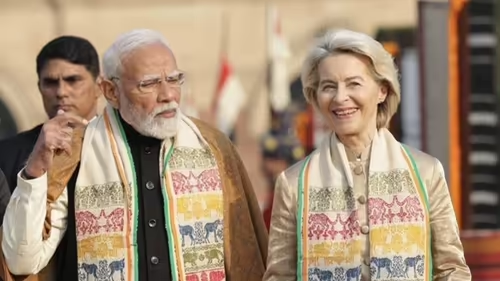
It’s been a long time coming—twenty years, to be exact. But the wait is finally over. India and the European Union have sealed a landmark India-EU FTA, a comprehensive pact that promises to reshape the economic landscape for both sides. And the numbers are staggering: Commerce Minister Piyush Goyal has announced that this deal could unlock exports worth a colossal **Rs 6.4 lakh crore** for India [[3]].
This isn’t just another trade agreement; it’s a strategic masterstroke that arrives at a time of global economic uncertainty. By granting India unprecedented market access for over 99% of its tariff lines, the deal is a massive win for the nation’s exporters, particularly its backbone: the labour-intensive sectors and Micro, Small, and Medium Enterprises (MSMEs) [[3]].
Table of Contents
- The Historic Deal: Two Decades in the Making
- India-EU FTA: The Rs 6.4 Lakh Crore Opportunity
- Sectors Poised for Explosive Growth
- Beyond Goods: Services and Professional Mobility
- What This Means for Indian MSMEs
- Conclusion
- Sources
The Historic Deal: Two Decades in the Making
The journey to this agreement has been a marathon, not a sprint. Negotiations began in 2007 but were suspended in 2013 due to various sticking points. The revival of talks in recent years, driven by a shared desire for resilient and diversified supply chains, has finally borne fruit. The resulting pact is being hailed as one of the most significant trade deals for India in the 21st century, covering a partnership that represents about 25% of the global GDP [[5]].
This agreement is far more than a simple tariff reduction. It’s a comprehensive framework designed to deepen economic integration, enhance regulatory cooperation, and create a level playing field for businesses from both regions.
India-EU FTA: The Rs 6.4 Lakh Crore Opportunity
The headline figure of **Rs 6.4 lakh crore** isn’t just a random estimate; it’s a projection based on the new, enhanced market access Indian goods will enjoy. With tariffs on over 99% of India’s exports to the EU being eliminated or significantly reduced, a vast array of products will become more competitive overnight [[3]].
This export surge won’t be concentrated in a single region. Minister Goyal emphasized that the benefits will flow from “various states,” creating a nationwide economic ripple effect. From the textile hubs of Tiruppur and Surat to the leather clusters of Agra and Kanpur, local economies are set for a major boost.
Sectors Poised for Explosive Growth
While the entire export ecosystem stands to gain, certain sectors are positioned to be the biggest winners. The government has specifically highlighted the following labour-intensive industries that will see a dramatic increase in their competitiveness:
- Textiles and Garments: A major employment generator, this sector will benefit immensely from duty-free access to the EU market, allowing Indian fashion and fabric to compete directly with global brands.
- Leather, Footwear, and Sports Goods: Known for their quality and craftsmanship, these products will find a much larger and more receptive audience in Europe [[3]].
- Gems and Jewellery: India is a global hub for diamond cutting and polishing. The FTA will streamline exports of these high-value items, boosting a key foreign exchange earner.
- Marine Products and Processed Foods: The deal also opens doors for India’s rich agricultural and seafood exports, meeting the EU’s growing demand for diverse and high-quality food products [[6]].
Beyond Goods: Services and Professional Mobility
The India-EU FTA is not just about physical goods. It includes a robust chapter on services, which is crucial for India’s world-leading IT and professional services sector. The agreement grants EU companies privileged access to the Indian services market, and in return, it enhances mobility for Indian professionals, making it easier for them to work on projects in Europe [[2]].
This is a critical component for the future of the Indian workforce, fostering knowledge exchange and creating high-value job opportunities both at home and abroad. It signals a move towards a more balanced and modern trade relationship.
What This Means for Indian MSMEs
For India’s millions of MSMEs, this deal is a potential lifeline and a launchpad. Historically, complex EU regulations and high tariffs have been significant barriers to entry for smaller firms. The FTA directly addresses these challenges by simplifying customs procedures and providing clearer regulatory pathways.
This means a small leather workshop in Tamil Nadu or a toy manufacturer in Delhi can now realistically dream of exporting their products to Paris or Berlin. The government is expected to roll out support programs to help these businesses understand the new rules and seize the opportunities presented by [INTERNAL_LINK:india-export-policy] and [INTERNAL_LINK:msme-support-schemes].
Conclusion
The India-EU FTA is more than a trade deal; it’s a strategic alliance for the future. The projected Rs 6.4 lakh crore export boost is a powerful testament to its potential. By empowering labour-intensive sectors and MSMEs, the agreement promises inclusive economic growth that reaches every corner of the country. As the world navigates a complex geopolitical landscape, this pact positions India as a reliable, competitive, and indispensable partner in the global economy. The next chapter of India’s economic story is being written, and it’s being written in Brussels and New Delhi, together.