Table of Contents
- The Urgent Plea from a Cricket Legend
- Why Politics in Cricket Is a Loss for Humanity
- The Frozen Rivalry: India-Pakistan Cricket on Hold
- A Call to Action for the ICC and Board Leaders
- Conclusion: Reclaiming Cricket for the Fans
- Sources
The Urgent Plea from a Cricket Legend
In a world where sports are often seen as a unifying force, the persistent intrusion of politics in cricket has become a thorny issue. Now, one of the game’s most respected voices has spoken out with startling clarity. Former Pakistan off-spinner and ex-national coach, Saqlain Mushtaq, has issued a blunt and impassioned warning to the global cricket community: “Politics should be eradicated.”
Mushtaq, renowned for inventing the “doosra,” isn’t just lamenting a scheduling conflict; he’s sounding an alarm about a fundamental threat to the spirit of the game. In a recent interview, he stated that politics is not only harming cricket but is also causing damage to humanity itself [[5]]. This is a powerful indictment from a man who has seen the sport from every angle—as a player, a coach, and a fan.
Why Politics in Cricket Is a Loss for Humanity
Mushtaq’s core argument transcends the boundary ropes. He believes that cricket’s true power lies in its ability to connect people across divides. “It is a loss for humanity as a whole,” he proclaimed, emphasizing that the sport should be a source of entertainment and unity, not a proxy battleground for geopolitical tensions [[6]].
When politics dictates fixture lists, it robs billions of fans of the spectacle they love. It turns what should be a celebration of skill and competition into a complex diplomatic chess match. The consequences are clear:
- Diminished Fan Experience: Fans are denied the chance to witness historic rivalries and epic contests.
- Stunted Player Development: Players lose the opportunity to test themselves against the best in high-pressure, traditional rivalries.
- Erosion of Cricket’s Spirit: The core values of sportsmanship and mutual respect are overshadowed by external agendas.
This perspective aligns with the long-held belief that sport can be a powerful tool for diplomacy—a concept known as “cricket diplomacy”—which has been largely forgotten in recent years [[INTERNAL_LINK:history-of-cricket-diplomacy]].
The Frozen Rivalry: India-Pakistan Cricket on Hold
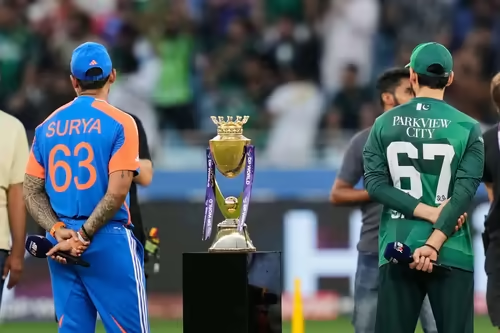
The most glaring example of this political stranglehold is the prolonged absence of a full India-Pakistan bilateral series. Once the pinnacle of the cricketing calendar, these tours have become a rare commodity, limited to brief encounters in ICC tournaments or multi-nation events like the Asia Cup.
Mushtaq expressed deep regret over this situation, calling it a significant loss for the sport. He even went so far as to challenge the BCCI, asking, “If you are truly a top team, why not play a comprehensive series?” [[3]]. His frustration is shared by millions of fans on both sides of the border who remember the electric atmosphere of a full Test series or a pulsating ODI tour.
The recent controversy surrounding Bangladesh’s travel plans for the T20 World Cup further highlights the fragility of the sport in the face of political winds. While Mushtaq chose not to take sides on that specific issue, his overarching message was clear: such situations are a direct symptom of the larger problem of politics in cricket [[8]].
A Call to Action for the ICC and Board Leaders
Mushtaq’s warning isn’t just a complaint; it’s a direct call to action for the International Cricket Council (ICC) and the leaders of national cricket boards. He is urging them to prioritize the game over political posturing.
The ICC, as the global governing body, has a responsibility to create a framework that insulates the sport from external political pressures. This could involve stronger mandates for member nations to fulfill their bilateral commitments or creating more neutral venues for politically sensitive matches.
For boards like the BCCI and the PCB, the message is equally stark. They must find a way to separate their sporting relationship from their complex political one. The commercial and cultural value of an India-Pakistan series is immense, and its continued absence is a self-inflicted wound on the global game. As a trusted source on international sports governance, the BBC Sport Cricket section often covers the intricate balance between sport and state, providing context for these ongoing challenges.
Conclusion: Reclaiming Cricket for the Fans
Saqlain Mushtaq’s plea to eradicate politics in cricket is a timely and necessary reminder of what the sport is supposed to be about. It’s about the roar of the crowd, the tension of a close finish, and the shared joy of a perfectly executed cover drive. It’s about humanity coming together, if only for a few hours, to celebrate a common passion.
His warning serves as a critical juncture for cricket’s custodians. Will they continue to let external forces dictate the game’s future, or will they take a stand to protect its integrity and its soul? For the sake of the fans and for the sake of the sport itself, the answer must be clear: politics has no place on the cricket field.
Sources
- Times of India: ‘Politics should be eradicated’: Ex-Pak cricketer issues blunt warning to world cricket
- Zee News: Former Pakistan spinner Saqlain Mushtaq slams politics for hurting India-Pakistan cricket relations
- Crex: Saqlain Mushtaq slams India-Pakistan politics; calls for ‘peace’
- A-Sports: Saqlain Mushtaq throws down challenge to BCCI for bilateral series