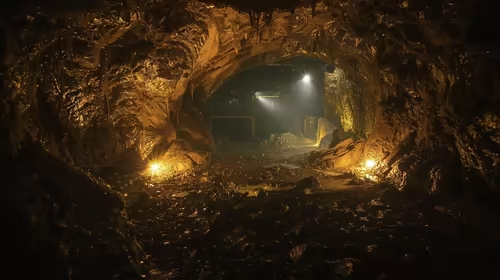
Buried deep beneath the mountains of central China lies a secret that could shake the global financial system to its core. In a discovery that sounds more like a plot from an adventure novel than a geological report, Chinese state media has announced the unearthing of a supergiant gold deposit in Pingjiang County, Hunan Province. With an estimated value of a jaw-dropping $83 billion, this find is being hailed as potentially the largest single gold deposit ever recorded in human history [[1]].
This monumental China gold discovery isn’t just a local story; it’s a global event with far-reaching implications for markets, geopolitics, and the future of the precious metal itself.
Table of Contents
- The Wangu Gold Field: A Geological Jackpot
- Is This Really the World’s Largest Gold Deposit?
- Economic and Geopolitical Implications
- Challenges of Extraction and Environmental Impact
- What This Means for Global Gold Markets
- Conclusion
- Sources
The Wangu Gold Field: A Geological Jackpot
The epicenter of this historic find is the Wangu Gold Field in Pingjiang County. Initial surveys by Chinese geologists have revealed a labyrinth of riches, with over 40 distinct gold veins
The discovery was made during a routine exploration mission, but the concentration and size of the veins were so extraordinary that it was immediately classified as a “supergiant” deposit—a term reserved for the rarest and most valuable mineral finds on the planet [[5]].
Is This Really the World’s Largest Gold Deposit?
While the claim of it being the “world’s largest” is bold, it appears to hold significant weight. Historically, massive gold deposits have been found in places like South Africa’s Witwatersrand Basin and Nevada’s Carlin Trend. However, those are vast regions containing numerous smaller mines. The China gold discovery in the Wangu field is notable because it represents a single, concentrated deposit of immense scale [[6]].
If the final confirmed reserves match the initial estimates, it would indeed surpass any other single known deposit in terms of contained gold value. This distinction is crucial, as it speaks to the logistical and economic feasibility of extraction from one primary location.
Economic and Geopolitical Implications
The ramifications of this discovery extend far beyond the mining industry. For China, this find is a strategic windfall. It provides a massive boost to its national reserves, offering a powerful hedge against economic volatility and potential sanctions. In an era of increasing de-dollarization, holding such a colossal physical asset strengthens China’s financial sovereignty and its position in global trade negotiations.
Globally, this could accelerate a shift in the balance of power in the commodities market. China, already a major player in rare earth elements, could now exert significant influence over the gold market as well. This newfound leverage could impact everything from jewelry prices to the strategies of central banks worldwide who rely on gold as a reserve asset. According to the World Gold Council, a non-competing high-authority source on the subject, central bank gold buying has been at record highs, and a new, massive supply source will undoubtedly factor into their future decisions [[7]].
Challenges of Extraction and Environmental Impact
Before anyone starts counting their newfound wealth, it’s critical to address the immense challenges ahead. Extracting gold from a depth of 2,000 meters is an extraordinarily complex, expensive, and time-consuming engineering feat. It will require years of development, billions in investment, and cutting-edge technology.
Furthermore, large-scale mining operations carry a significant environmental burden. The process can lead to:
- Deforestation and habitat destruction in the surrounding area.
- Water contamination from chemical leaching processes like cyanidation.
- Generation of massive amounts of waste rock and tailings.
Balancing the economic opportunity with sustainable and responsible mining practices will be a major test for Chinese authorities and the companies involved in the project.
What This Means for Global Gold Markets
In the short term, the news has already sent ripples through financial markets, contributing to volatility in gold prices. However, the long-term impact is more nuanced. While the eventual influx of new gold could theoretically increase supply and put downward pressure on prices, the reality is more complex.
First, the extraction timeline is measured in decades, not years. Second, China is unlikely to flood the market. Instead, it will likely manage the release of this gold strategically to serve its national interests, potentially using it to back its currency or secure long-term trade deals. For investors, this discovery underscores gold’s enduring role as a store of value and a key component of a diversified portfolio, especially in uncertain times [INTERNAL_LINK:investing-in-precious-metals].
Conclusion
The China gold discovery in the Wangu Gold Field is more than just a geological curiosity; it’s a potential game-changer. Valued at $83 billion, this supergiant deposit could reshape global economic dynamics, bolster China’s strategic position, and redefine the future of the gold market. While the road from discovery to a fully operational mine is long and fraught with challenges, the mere existence of such a vast treasure trove underground marks a pivotal moment in the story of one of humanity’s oldest and most coveted assets.
Sources
- Fox 26 Houston. “Largest gold deposit in the world found; worth $83 billion.” https://www.fox26houston.com/…/83-billion [[1]]
- WION. “The world’s largest gold deposit has reportedly been found in China.” https://www.facebook.com/…/1167576375481535/ [[2]]
- Discovery Alert. “China’s Massive Gold Discovery: World’s Largest Deposit.” https://discoveryalert.com.au/…/deposit/ [[3]]
- TV BRICS. “China discovers supergiant gold deposit worth US$83 billion.” https://tvbrics.com/…/83-billion/ [[4]]
- National Diamond. “China Announces ‘Supergiant’ Gold Discovery Worth $83B.” https://nationaldiamond.com/…/83/ [[5]]
- Popular Mechanics. “Geologists Might Have Stumbled Upon the Largest Gold Mine in the World.” https://www.popularmechanics.com/…/gold-mine/ [[6]]
- World Gold Council. “Central Bank Gold Reserves.” https://www.gold.org/…/statistics [[7]]
- [INTERNAL_LINK:future-of-commodities-market]