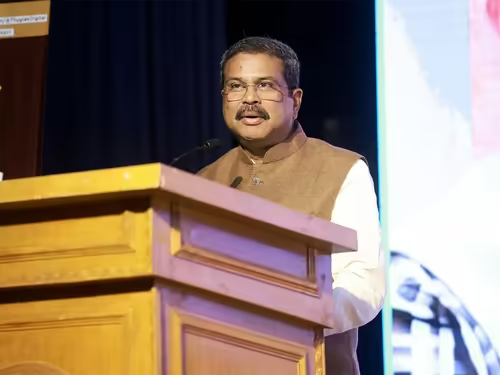
India’s higher education landscape is once again at the center of a heated national debate. The University Grants Commission (UGC) recently rolled out a set of stringent new rules aimed at curbing caste-based discrimination on university campuses—and Union Education Minister Dharmendra Pradhan isn’t backing down.
“We won’t allow misuse,” Pradhan declared, defending the controversial framework that mandates every higher education institution to establish an Internal Complaints Committee (ICC) and report incidents of caste-based harassment within 24 hours [[1]].
But while the intent sounds noble—protecting marginalized students from systemic abuse—the rollout has sparked intense backlash. Activists fear the rules could be weaponized to suppress dissent, while administrators worry about vague definitions and operational chaos. So, what’s really going on with these UGC caste rules?
Table of Contents
- What Are the New UGC Caste Rules?
- Dharmendra Pradhan’s Defense: “Won’t Allow Misuse”
- Why Are Students and Activists Concerned?
- Legal and Institutional Challenges
- Global Context: How Other Countries Handle Campus Discrimination
- What This Means for Indian Universities
- Conclusion: Balancing Protection and Freedom
- Sources
What Are the New UGC Caste Rules?
Issued in early January 2026, the UGC’s latest directive requires all universities and colleges receiving central funding to:
- Constitute an Internal Complaints Committee (ICC) specifically trained to handle caste-based grievances.
- Ensure complaints are filed and acknowledged within 24 hours.
- Mandate that investigations conclude within 30 days.
- Submit quarterly compliance reports to the UGC.
- Face penalties—including withdrawal of grants—for non-compliance [[2]].
The rules cite rising incidents of caste-based harassment, particularly against Dalit and Adivasi students, as the driving force behind this intervention. Tragic cases like those at IITs and central universities have long highlighted systemic failures in campus safety mechanisms [INTERNAL_LINK:education-news].
Dharmendra Pradhan’s Defense: “Won’t Allow Misuse”
In a press briefing, Pradhan emphasized that the UGC caste rules are not about policing speech but about ensuring dignity and safety for every student. “This is not a tool for vendetta,” he asserted. “It’s a shield for the oppressed.”
He pointed to data from the National Crime Records Bureau (NCRB), which shows a steady rise in reported atrocities against Scheduled Castes—many occurring in educational institutions [[3]]. According to him, the new framework fills a critical gap left by the Prevention of Atrocities Act, which often lacks on-ground enforcement in academic settings.
Pradhan also stressed that the ICCs will operate under strict procedural safeguards, including representation from legal experts and social scientists, to prevent arbitrary actions.
Why Are Students and Activists Concerned?
Despite the government’s assurances, skepticism runs deep. Student unions and civil society groups argue that the rules are dangerously vague.
“What constitutes ‘caste-based discrimination’?” asks Dr. Anjali Rao, a sociologist at JNU. “Is it a derogatory remark? A biased grading pattern? Or simply expressing an unpopular opinion in a seminar?”
Critics highlight three major red flags:
- Ambiguous Definitions: The guidelines don’t clearly define actionable offenses, leaving room for subjective interpretation.
- Chilling Effect on Free Speech: Students may self-censor for fear of being reported, stifling academic debate.
- Lack of Due Process: The 30-day investigation window may pressure committees into rushed judgments without thorough evidence.
Historically, similar mechanisms—like anti-ragging cells—have sometimes been misused to target political opponents or settle personal scores [[4]].
Legal and Institutional Challenges
Legal experts note that the UGC’s authority to enforce such rules is debatable. While it can regulate grant-in-aid institutions, autonomous universities and private colleges may challenge the mandate in court.
Moreover, many state universities lack the infrastructure to form functional ICCs overnight. Training members, ensuring confidentiality, and integrating with existing grievance redressal systems will require significant resources—and time.
Global Context: How Other Countries Handle Campus Discrimination
For perspective, countries like the U.S. and U.K. have robust anti-discrimination frameworks in higher education—but they’re backed by decades of legal precedent, independent oversight bodies, and strong student rights protections.
The U.S. Department of Education’s Office for Civil Rights, for instance, investigates campus bias under Title VI of the Civil Rights Act—but only after exhaustive internal processes fail [[5]]. India’s model, by contrast, appears more centralized and punitive.
What This Means for Indian Universities
In the short term, institutions will scramble to comply. Vice-chancellors are already holding emergency meetings to draft protocols. In the long run, success hinges on two factors:
- Training & Sensitization: ICC members must understand caste dynamics beyond textbook definitions.
- Transparency: Public dashboards showing complaint volumes, resolutions, and outcomes could build trust.
If implemented fairly, these rules could mark a turning point in making campuses truly inclusive. If misused, they risk deepening divisions.
Conclusion: Balancing Protection and Freedom
The UGC caste rules emerge from a genuine crisis—caste-based violence and exclusion in spaces meant for learning. Dharmendra Pradhan’s intent to protect vulnerable students is commendable. But good intentions aren’t enough. Without precise definitions, judicial oversight, and community dialogue, even well-meaning policies can backfire.
The real test won’t be in the rulebook—it’ll be in the classrooms, hostels, and committee rooms where these guidelines come to life.
Sources
- [[1]] Times of India: “‘Won’t allow misuse’: Dharmendra Pradhan defends new UGC rules” – Original Article
- [[2]] University Grants Commission (UGC) Official Notification, January 2026
- [[3]] National Crime Records Bureau (NCRB): “Crime in India 2024 Report” – https://ncrb.gov.in
- [[4]] Human Rights Watch: “Caste Discrimination in Indian Higher Education” (2023)
- [[5]] U.S. Department of Education, Office for Civil Rights – https://www2.ed.gov/about/offices/list/ocr/index.html