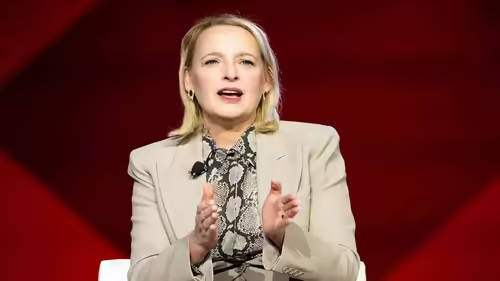
It’s a turbulent time for global business. Trade wars, geopolitical tensions, and policy whiplash from past administrations continue to cast long shadows over corporate strategy. Yet, according to Accenture CEO Julie Sweet, one of the most powerful voices in global consulting, the path forward isn’t about reacting to every headline—it’s about relentless execution.
In a recent interview, Sweet addressed the lingering impact of Trump tariffs, which once sent shockwaves through supply chains and boardrooms worldwide. While acknowledging their disruptive force, she offered a clear-eyed perspective: “CEOs admit it’s a challenging and uncertain environment, but they have to focus on execution,” she stated [[1]].
This pragmatic stance—cutting through political noise to prioritize operational excellence—has become a hallmark of Sweet’s leadership at Accenture, the $65 billion tech and consulting giant. Her comments come at a critical juncture as businesses navigate inflation, AI disruption, and shifting trade dynamics.
Table of Contents
- What Are Trump Tariffs—and Why Do They Still Matter?
- Julie Sweet’s Strategic Response to Trade Uncertainty
- US Digital Leadership vs. European Catch-Up
- Why Execution Beats Reaction in Volatile Times
- The Future of Global Business Under Policy Uncertainty
What Are Trump Tariffs—and Why Do They Still Matter?
The Trump tariffs refer to a series of import duties imposed by the U.S. government between 2018 and 2020, primarily targeting China but also affecting allies like the EU, Canada, and Mexico. These included steep levies on steel (25%) and aluminum (10%), along with hundreds of billions in tariffs on Chinese goods under Section 301 of the Trade Act of 1974 [[3]].
While some tariffs have been modified or removed, many remain in place—and their legacy persists. Companies rewired global supply chains, absorbed higher costs, or passed them to consumers. For CEOs, the episode was a harsh lesson in how quickly policy can upend decades of globalization. As Sweet notes, the memory of that volatility still shapes strategic risk assessments today, even if the immediate threat has faded.
Julie Sweet’s Strategic Response to Trade Uncertainty
Sweet doesn’t dismiss the challenges. Instead, she reframes them. In her view, external shocks like Trump tariffs are inevitable—but they shouldn’t paralyze decision-making. “The environment is uncertain, yes,” she concedes, “but great companies don’t wait for perfect conditions. They build agility into their DNA.”
At Accenture, this means investing heavily in cloud infrastructure, AI-driven analytics, and modular supply chain designs that can pivot quickly. It also means advising clients to focus on what they *can* control: customer experience, innovation velocity, and workforce reskilling. This execution-first mindset is why Accenture continues to grow despite macro headwinds.
US Digital Leadership vs. European Catch-Up
Beyond trade policy, Sweet highlighted a broader trend: the United States’ commanding lead in digital transformation. “U.S. companies have strong foundations—they’ve invested early and aggressively in technology, data, and talent,” she explained [[1]].
This advantage has allowed American firms to absorb shocks more effectively and innovate faster. However, Sweet warned against complacency. “European companies are catching up rapidly,” she noted. Driven by EU-wide digital initiatives like the Digital Markets Act and significant public-private investment, European enterprises are closing the gap in areas like sustainability tech, industrial automation, and cybersecurity.
This competitive dynamic is good for global innovation—but it also means U.S. firms can’t rest on past successes. Continuous reinvention is now table stakes.
Why Execution Beats Reaction in Volatile Times
Sweet’s philosophy boils down to a simple truth: you can’t control the world, but you can control your response to it. Here’s how top-performing companies are applying this principle:
- Scenario Planning Over Panic: Instead of reacting to every tariff rumor, they model multiple futures and build flexible response protocols.
- Customer-Centric Agility: They use real-time data to adjust offerings, pricing, and delivery—keeping value front and center.
- Tech-Enabled Resilience: Cloud, AI, and automation aren’t just buzzwords; they’re tools to maintain operations during disruption [[5]].
- Talent as a Strategic Asset: Reskilling workforces ensures companies can pivot without losing institutional knowledge.
As Sweet puts it: “Execution isn’t just doing things right—it’s doing the *right* things, consistently, even when the ground is shaking.”
The Future of Global Business Under Policy Uncertainty
With another U.S. presidential election on the horizon, the specter of renewed trade wars looms large. A potential second Trump term could reignite aggressive tariff policies, while other candidates may pursue different approaches. Either way, volatility is guaranteed.
For business leaders, Sweet’s advice is clear: stop waiting for clarity. Build systems that thrive in ambiguity. Invest in digital core capabilities. And remember—policy may set the stage, but execution writes the story.
In an era where headlines shift by the hour, Julie Sweet’s message is a steadying anchor: focus on what you can build, not just what you must endure.