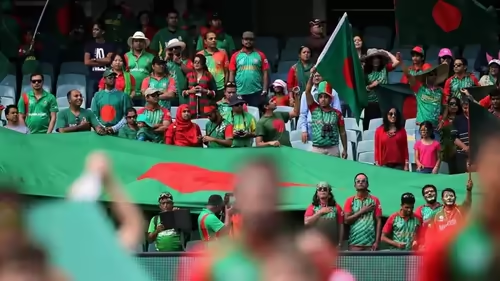
The world of cricket is facing a new controversy, but this time it’s not on the pitch—it’s in the press box. The International Cricket Council (ICC) has found itself at the center of a storm after reports emerged that it rejected the media accreditation requests of approximately 80 to 90 Bangladeshi journalists for the T20 World Cup 2026 [[26]]. This decision comes on the heels of Bangladesh’s own withdrawal from the tournament due to security concerns, leaving a void not just in the competition, but now in its media coverage as well.
The message from the ICC was blunt and final: they simply “can’t accommodate” the large number of applications from a nation whose team is no longer participating. But for many, this raises serious questions about fairness, transparency, and the very principles of sports journalism.
Table of Contents
- The ICC Decision and the Numbers Game
- Why Did Bangladesh Withdraw from the T20 World Cup?
- The Impact on Bangladeshi Journalists and Fans
- ICC Media Accreditation Policy Under Scrutiny
- BCB Seeks Clarification: What Happens Next?
The ICC Decision and the Numbers Game
Initial reports from the Times of India indicated that around 80–90 Bangladeshi journalists had formally applied for ICC media accreditation to cover the T20 World Cup 2026 [[26]]. However, other sources, including statements from the Bangladesh Cricket Board’s (BCB) media committee chairman, have cited a much higher figure, claiming between 130 and 150 applications were submitted [[18]].
Regardless of the exact number, the outcome was the same: a near-total rejection. The ICC’s rationale appears to be logistical. With Bangladesh out of the tournament, the governing body seems to have drastically reduced or eliminated the quota for media from that country, arguing that their presence is no longer essential to the event’s core narrative. This has left many seasoned journalists, who have covered countless ICC events, feeling blindsided and unfairly penalized for a political and security decision made by their cricket board.
Why Did Bangladesh Withdraw from the T20 World Cup?
To understand the context of this media ban, one must look at the reason for Bangladesh’s absence from the tournament itself. The Bangladesh Cricket Board (BCB) officially withdrew its team from the T20 World Cup 2026, which is being co-hosted by India and Sri Lanka, citing serious security concerns for its players and officials [[11]].
The BCB had reportedly requested the ICC to relocate Bangladesh’s matches away from Indian venues, a request that was firmly rejected by the global governing body [[12]]. Faced with this impasse and standing by its security assessment, Bangladesh chose to pull out of the competition entirely. This decision, while a major blow to the tournament’s competitive balance, was a sovereign choice made by the national board. The question now is whether that decision should have also resulted in a complete blackout for its independent media.
The Impact on Bangladeshi Journalists and Fans
The ICC’s decision has far-reaching consequences beyond the individual journalists who lost their assignments. It directly impacts millions of passionate cricket fans in Bangladesh who rely on their local media for nuanced, culturally relevant coverage of the sport.
Without their own accredited reporters on the ground, Bangladeshi audiences will be forced to consume international or Indian media narratives, which may not fully capture the perspective or interests of their home audience. This creates an information gap and a sense of exclusion from a global event that their nation was originally meant to be a part of. Many see this as a form of collective punishment, where the media is being held accountable for the actions of its cricket board—a clear violation of the principle of a free and independent press.
ICC Media Accreditation Policy Under Scrutiny
This incident has thrown the ICC’s media accreditation process into the spotlight. While the ICC has a formal application system for media covering its events [[5]], the criteria for approval, especially in extraordinary circumstances like a team’s withdrawal, remain opaque.
Critics argue that the policy lacks flexibility and fails to account for the role of journalists as independent observers, not mere cheerleaders for their national teams. A high-authority source like Committee to Protect Journalists (CPJ) consistently advocates for the principle that journalists should be able to report on international events without being tied to their government’s or national sports body’s political stances. The ICC’s current stance appears to contradict this fundamental tenet of journalism.
BCB Seeks Clarification: What Happens Next?
In response to the outcry from its media fraternity, the Bangladesh Cricket Board has officially stepped in. The BCB is now actively seeking clarification from the ICC regarding the sudden and sweeping changes to the accreditation process that led to the mass rejections [[26]].
It remains to be seen what, if any, concessions the ICC might make. Will they offer a limited number of passes for senior journalists? Or will they stand firm on their logistical argument? The outcome of this dialogue will set a crucial precedent for how future global sporting bodies handle media access in politically sensitive situations. For now, the door to the T20 World Cup press box appears firmly shut for Bangladesh, a stark reminder of how deeply politics and sport are intertwined.
Sources
- Times of India: ‘Can’t accommodate … ‘: ICC on 80–90 Bangladeshi applications for T20 World Cup
- Brand Synario: ICC Bars Bangladesh Journalists from T20 World Cup Coverage
- Olympics.com: Bangladesh withdraws from T20 World Cup 2026
- ICC: Media Accreditation Process for ICC Men’s T20 World Cup 2024 is now open
- Committee to Protect Journalists (CPJ)