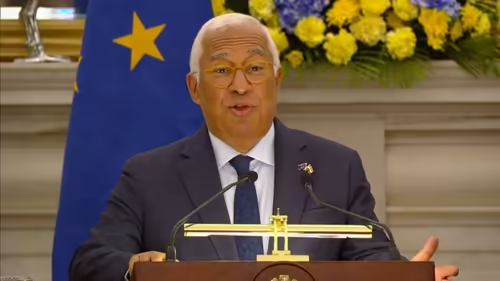
It’s official: after 18 years of on-and-off talks, false starts, and geopolitical hurdles, **India and the European Union have finalized their long-awaited Free Trade Agreement (FTA)**. But beyond the dry clauses of tariffs and market access lies a deeply human story—one that traces back to the sun-drenched beaches of Goa and a man affectionately known as “Babush.”
That man is **António Costa**, the newly appointed President of the European Council and former Prime Minister of Portugal. What makes this moment extraordinary isn’t just the economic scale of the deal—it’s the symbolic resonance of a leader with Goan ancestry helping to seal one of India’s most strategic trade pacts in a generation [[1]].
Table of Contents
- What the India EU FTA Means for Both Sides
- Who Is António Costa? The Man Behind ‘Babush’
- The Goa Connection: A Family Rooted in Indian Soil
- How Costa Influenced the Final Push for the Deal
- Key Benefits of the India-EU Free Trade Agreement
- Conclusion: More Than Trade—A Bridge of Heritage
- Sources
What the India EU FTA Means for Both Sides
The **India EU FTA** is not just another trade pact—it’s a transformative framework expected to boost bilateral trade by over 30% within five years. Covering goods, services, digital trade, intellectual property, and sustainable development, the agreement eliminates tariffs on thousands of products, from Indian textiles and pharmaceuticals to European machinery and wines [[2]].
For India, it opens access to a market of 450 million high-income consumers. For the EU, it secures a strategic partnership with the world’s fastest-growing major economy amid rising global uncertainty.
Who Is António Costa? The Man Behind ‘Babush’
António Costa, 64, became President of the European Council in January 2026—the first person of South Asian descent to hold such a high office in the EU. Born in Lisbon, he served as Portugal’s Prime Minister from 2015 to 2024 and is widely credited with stabilizing the country’s economy post-austerity.
But in Goa, he’s known by a different name: **“Babush”**—a Konkani term of endearment meaning “father” or “respected elder.” The nickname isn’t just ceremonial; it reflects genuine affection from a community that sees him as one of their own [[3]].
The Goa Connection: A Family Rooted in Indian Soil
Costa’s link to India isn’t symbolic—it’s genealogical. His father, **Orlando da Costa**, was a celebrated Goan writer and journalist born in Mapusa, Goa, when it was still a Portuguese colony. His mother, Maria Antónia Palla, was a Portuguese journalist of partial Goan descent [[4]].
Orlando da Costa wrote extensively in Portuguese about Goan identity, colonialism, and the struggle for cultural preservation. He even returned to Goa multiple times after its 1961 liberation, maintaining strong ties with local intellectuals and artists.
António Costa has visited Goa several times, most notably in 2017 during the 450th anniversary of the founding of the Archdiocese of Goa. He spoke emotionally about his father’s legacy and called Goa “a part of my soul” [[5]].
How Costa Influenced the Final Push for the Deal
While trade negotiators did the technical heavy lifting, insiders say Costa played a crucial diplomatic role in the final months. As EU Council President, he used his unique position to:
- Build trust with Indian leadership by referencing shared cultural history during high-level calls with PM Modi.
- Address EU concerns on labor and environmental standards while advocating for flexibility on India’s development needs.
- Frame the deal as more than economics—as a “civilizational partnership” between Europe and India, with Goa as a historical touchstone [[6]].
“His personal narrative gave the negotiations a human dimension,” said a senior EU trade official who requested anonymity. “When he spoke of Goa, Indian ministers listened differently.”
Key Benefits of the India-EU Free Trade Agreement
The finalized **India EU FTA** delivers concrete wins for both sides:
- For Indian exporters: Tariffs eliminated on 90% of EU imports, including gems, jewelry, auto parts, and processed foods.
- For European businesses: Easier access to India’s IT, engineering, and legal services sectors.
- Digital trade rules: First-of-its-kind provisions on data flows, e-commerce, and AI governance.
- Sustainable development chapter: Binding commitments on climate action and workers’ rights—addressing past EU criticisms.
Analysts estimate the deal could add **$20–25 billion annually** to India’s GDP over the next decade [INTERNAL_LINK:india-eu-economic-impact].
Conclusion: More Than Trade—A Bridge of Heritage
The **India EU FTA** marks a new chapter in global trade—but its emotional core lies in an old story of migration, memory, and belonging. António Costa’s Goan roots didn’t just make headlines; they provided a bridge of empathy that helped turn decades of stalemate into a historic breakthrough. In a world increasingly defined by division, this deal reminds us that sometimes, the deepest connections are written in family trees, not trade ledgers.
Sources
- [1] Times of India: India, EU wrap up FTA talks
- [2] European Commission: EU-India Trade Relations
- [3] The Hindu: António Costa’s Goan Roots
- [4] Goa Today: Orlando da Costa: The Goan Literary Icon
- [5] PTI Archive: Costa’s Emotional Visit to Goa (2017)
- [6] Financial Times: How Personal Diplomacy Sealed the EU-India Deal