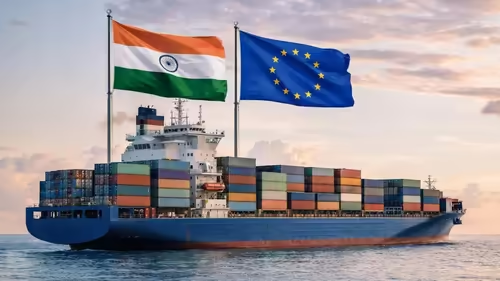
After two decades of negotiations, the wait is over. The India-European Union Free Trade Agreement (FTA), already being hailed as the “mother of all deals,” has been finalized. This landmark pact isn’t just another trade document; it’s a strategic masterstroke poised to reshape India’s economic landscape for a generation.
At its heart, the deal promises something incredibly powerful: zero tariffs. But who exactly wins? And what does this mean for your business, your job, or the future of Indian manufacturing? Let’s cut through the jargon and get to the real story.
Table of Contents
- What is the India-EU FTA?
- Why This Deal is a Game-Changer for India
- Deep Dive: Key Sectors Set to Benefit from Zero Tariffs
- The Fine Print: Phasing and Exceptions
- Beyond Tariffs: The Broader Economic Impact
- Conclusion: A New Era of India-EU Trade
- Sources
What is the India-EU FTA?
The India-EU FTA is a comprehensive agreement designed to eliminate most barriers to trade and investment between India and the 27-nation European bloc. It covers not just goods, but also services, intellectual property, and digital trade. For context, the EU is already one of India’s largest trading partners, with bilateral trade in goods and services reaching a staggering $136.5 billion in the fiscal year 2024-25 [[15]].
This new deal aims to turbocharge that relationship by making it significantly cheaper and easier for Indian companies to sell their products in the lucrative European market.
Why This Deal is a Game-Changer for India
Historically, high tariffs in the EU have been a major roadblock for many Indian exporters, especially in labour-intensive sectors. The FTA directly addresses this by committing the EU to cut tariffs to zero on a vast array of Indian goods. This levels the playing field against competitors from countries that already have FTAs with the EU, such as South Korea and Vietnam.
The implications are profound:
- Boost to Exports: Indian exports to the EU could see a massive surge, particularly in sectors that were previously uncompetitive due to duties.
- Job Creation: Increased production for export markets will create millions of new jobs across manufacturing, logistics, and related services, especially benefiting MSMEs, women, and youth [[23]].
- Economic Growth: A significant increase in exports translates directly into higher GDP growth for India.
Deep Dive: Key Sectors Set to Benefit from Zero Tariffs
While the deal covers a wide range of industries, three sectors stand out as the primary beneficiaries of the promised zero tariffs: gems and jewellery, plastics, and textiles. Here’s what the deal means for each.
Gems and Jewellery: Unlocking a $16 Billion Opportunity
India is a global powerhouse in cutting and polishing diamonds and precious stones. However, EU tariffs of up to 4% on these items have been a persistent hurdle. The FTA changes everything by granting duty-free access for almost all products in this category, which was valued at €2.1 billion in recent trade [[4]].
This move is expected to unlock an estimated $16 billion in untapped potential for the Indian gem and jewellery sector in the European market [[5]]. For a country that processes over 90% of the world’s rough diamonds, this is a monumental win.
Plastics: A Major Win for Chemical and Manufacturing Industries
The plastics industry, a critical component of India’s chemical and manufacturing ecosystem, is another huge winner. The EU currently imposes tariffs of up to 16.5% on various plastic products. Under the new India-EU FTA, these tariffs will be reduced to zero for almost all products in this segment, which saw trade worth €2.2 billion [[4]].
This will make Indian plastic goods—from packaging materials to industrial components—far more competitive in Europe, providing a massive boost to domestic manufacturers.
Textiles, Leather, and Apparel: Empowering Labour-Intensive Sectors
India has long pushed for better market access in the EU for its labour-intensive sectors. The FTA delivers on this promise, with the EU agreeing to cut tariffs to zero on marine products, leather goods, textiles, and apparel [[2], [7]]. These sectors are crucial for employment generation in India and will now have a much clearer path to European consumers.
The Fine Print: Phasing and Exceptions
It’s important to note that the transition to zero tariffs won’t happen overnight. The agreement stipulates that tariffs will be phased out over a period of seven years [[8]]. This gives European industries time to adjust to the new competitive landscape.
Furthermore, not every single product is covered. Sensitive sectors like agriculture, steel, and automobiles were largely kept off the table to protect domestic EU producers [[8]]. So while the deal is comprehensive, it’s not without its strategic carve-outs.
Beyond Tariffs: The Broader Economic Impact
The benefits of the India-EU FTA extend far beyond just tariff elimination. The agreement also includes provisions to:
- Harmonize Regulations: Reducing non-tariff barriers by aligning standards and certifications, making it easier for Indian companies to comply with EU rules.
- Boost Services Trade: Granting EU companies privileged access to India’s services market, including finance and IT, while also creating opportunities for Indian service providers in Europe [[24]].
- Attract Investment: The stable and predictable trade environment created by the FTA is expected to attract significant European investment into India, particularly in sectors like IT, automotive, and pharmaceuticals [[25]].
For more on how global trade deals are shaping India’s economy, check out our analysis on [INTERNAL_LINK:global-trade-strategy].
Conclusion: A New Era of India-EU Trade
The India-EU FTA is more than just a trade pact; it’s a strategic declaration of a deepened partnership between the world’s largest democracy and a major economic bloc. By eliminating zero tariffs on critical sectors like gems, jewellery, and plastics, the deal provides a powerful engine for India’s export-led growth. While the full benefits will unfold over the next seven years, the foundation has been laid for a new era of prosperity and collaboration. The “mother of all deals” is finally here, and its impact will be felt for decades to come.
Sources
- [[2]] Economic Times: India-EU trade pact the biggest in history, Modi says, as tariffs head to zero
- [[4]] Economic Times: India-EU FTA highlights: ‘Mother-of-all deals’ eliminates aircraft tariffs, cuts duties on alcohol, food, chemicals
- [[5]] Whalesbook: India Eyes EU Tariff Cuts for Jewellery Export Boom
- [[7]] Global Banking & Finance Review: India EU Trade Agreement: Tariff Cuts Boost Economic Ties
- [[8]] Economic Times: Mother-of-all deals, but these three things were off the table in the Brussels-New Delhi trade pact
- [[15]] Economic Times: Explainer: India–EU FTA expected to lift Indian exports to Europe
- [[23]] Rediff Money: India-EU FTA: Key Highlights & Benefits
- [[24]] European Commission: EU and India conclude landmark Free Trade Agreement
- [[25]] VRF Bharat: The India-EU trade agreement is likely to close on 7 out of 23 sectors