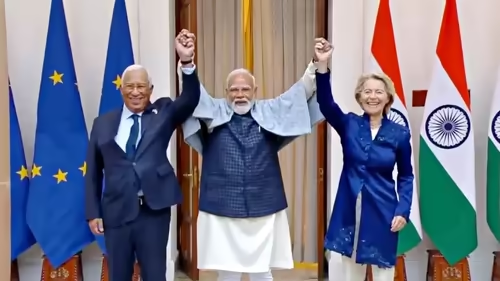
It’s official. After nearly two decades of fits, starts, and diplomatic wrangling, the long-awaited India-EU FTA has been signed into existence on January 27, 2026 [[4]]. Dubbed the ‘mother of all deals,’ this landmark pact promises to reshape the economic landscape for both regions. For the average Indian consumer, the headlines are sweet: get ready for significantly cheaper European cars, premium beers, and gourmet food products. But beneath the surface of this celebratory announcement lies a complex web of opportunities and threats that could redefine entire sectors of the Indian economy.
Table of Contents
- The Long Road to the Deal
- What the India-EU FTA Means for You
- The Winners: Indian Exporters and European Consumers
- The Potential Losers: Indian Domestic Industries
- Beyond Tariffs: A Strategic Partnership
- Conclusion: Is It Really the ‘Mother of All Deals’?
- Sources
The Long Road to the Deal
The journey to this agreement has been anything but smooth. Formal negotiations between India and the EU began way back in 2007, only to be suspended in 2013 due to major disagreements over market access and regulatory standards [[25]]. The talks were officially relaunched in 2022, driven by a shared desire to counterbalance global economic uncertainties and strengthen their strategic autonomy. This 18-year saga underscores just how complex and high-stakes this negotiation was for both parties.
What the India-EU FTA Means for You
For the everyday Indian shopper, the most immediate impact will be felt at the mall and the supermarket. The deal eliminates or drastically reduces tariffs on a vast array of European goods. Here’s a quick look at what’s set to become more affordable:
- Automobiles: High import duties of up to 100% on certain vehicles will be slashed, making premium European brands far more accessible [[13]].
- Food & Beverages: From fine wines and craft beers to olive oil, fruit juices, and processed foods, your pantry is about to get a European upgrade [[12]].
- Pharmaceuticals & Medical Devices: Duties on life-saving drugs and advanced medical equipment, which were as high as 11% and 10% respectively, will be mostly eliminated, potentially lowering healthcare costs [[14]].
- Chemicals & Machinery: Industrial inputs and capital goods will see significant duty cuts, which could lower production costs for many Indian manufacturers [[15]].
In total, India has agreed to remove or cut tariffs on a staggering 96.6% of goods exported by the EU bloc, which is expected to save European exporters up to €4 billion annually in duties [[11]].
The Winners: Indian Exporters and European Consumers
This isn’t a one-way street. The India-EU free trade agreement is a major victory for key Indian export sectors that have long sought greater access to the lucrative European market. India has successfully negotiated for near duty-free access for its labour-intensive industries, which are crucial for employment generation.
Key beneficiaries on the Indian side include:
- Textiles, Apparel, and Leather: These sectors will gain a massive competitive edge in Europe, potentially creating millions of new jobs [[10]].
- Gems and Jewellery: A cornerstone of India’s export economy, this industry is poised for a significant boost.
- Handicrafts and Agricultural Products: Unique Indian products will find a more receptive and tariff-friendly market in the EU.
This expanded market access is a core part of India’s strategy to integrate deeper into global value chains and move up the manufacturing ladder.
The Potential Losers: Indian Domestic Industries
While consumers and exporters cheer, a shadow of concern falls over certain domestic industries. The sudden influx of cheaper, high-quality European goods could put immense pressure on local players who may not be able to compete on price or quality immediately. Sectors like automotive components, specialty chemicals, and even some segments of the food processing industry might face a period of intense disruption.
It’s worth noting that the agreement does include safeguards. Sensitive European agricultural sectors like beef and poultry are fully protected, and the deal likely contains similar, though less publicized, protections for vulnerable Indian industries [[9]]. The real test will be in the implementation phase and whether the government provides adequate support for domestic firms to adapt and innovate. [INTERNAL_LINK:how-to-protect-your-business-from-import-competition] offers some strategic insights for business owners in this new era.
Beyond Tariffs: A Strategic Partnership
Framing this deal purely as a trade agreement misses the bigger picture. In an increasingly fragmented world, the India-EU strategic partnership is a powerful geopolitical statement. It signals a mutual commitment to a rules-based international order, sustainable development, and digital cooperation. The FTA is just the economic pillar of a much broader relationship that aims to create a vast zone of stability and prosperity between Asia and Europe.
Conclusion: Is It Really the ‘Mother of All Deals’?
The signing of the India-EU FTA is undoubtedly a historic milestone. It promises immense benefits for consumers and a powerful engine for growth for key Indian exports. However, calling it the ‘mother of all deals’ comes with a caveat. Its ultimate success will be measured not just by the volume of trade it generates, but by how well it manages the transition for domestic industries and ensures that the gains are widely shared across the economy. The deal is signed, but the real work—of adaptation, innovation, and strategic support—has only just begun.
Sources
- Prime Minister’s Office, India. (2026, January 27). PM Modi announces signing of India-EU Free Trade Agreement. The Hindu. [[4]]
- European Commission. (2026, January 27). EU and India conclude landmark Free Trade Agreement. Press Corner. [[11]]
- European Commission. (2026, January 27). Questions and answers on the EU-India Free Trade Agreement. Press Corner. [[9]]
- Moneycontrol. (2026, January 27). EU says India to remove, cut tariffs on 96.6% of bloc’s goods via FTA. [[14]]
- Business Today. (2026, January 27). India–EU trade pact sealed: From cars to wine, what becomes cheaper. [[13]]