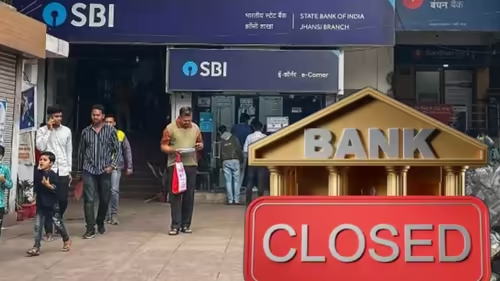
If you’ve tried to visit your local branch this week only to find it shuttered—or if your NEFT transfer is mysteriously delayed—you’re not alone. A nationwide bank strike has plunged India’s public sector banking system into chaos, with over 1 million employees walking off the job in a coordinated protest that could last five full working days. And it all boils down to one core demand: a shift to a five-day work week.
This isn’t just about employee convenience—it’s a decades-old battle over work-life balance, operational efficiency, and the future of India’s banking infrastructure. With upcoming holidays compounding the shutdown, millions of customers are left scrambling. So, what’s really going on, and how does it affect your money?
Table of Contents
- What Is the Nationwide Bank Strike About?
- Who Is Behind the Strike? The UFBU Explained
- The Five-Day Work Week Demand, Decoded
- How the Nationwide Bank Strike Affects You
- Government and Bank Response to the Strike
- Historical Context: Why This Fight Has Lasted Decades
- What Customers Can Do During the Strike
- Conclusion: Will the Strike Bring Change?
- Sources
What Is the Nationwide Bank Strike About?
The current nationwide bank strike was called by the United Forum of Bank Unions (UFBU), a coalition representing nine major unions across public sector banks (PSBs). Their primary grievance? The government’s continued refusal to formalize a five-day work week for bank employees—a promise that’s been dangled since the 1990s but never implemented [[1]].
While private banks and many modern workplaces operate on a Monday-to-Friday schedule, most public sector bank branches still function six days a week, including Saturdays. Employees argue this outdated model leads to burnout, hampers digital adoption, and puts them at a disadvantage compared to their private-sector counterparts [[3]].
Who Is Behind the Strike? The UFBU Explained
The UFBU isn’t a fringe group—it’s a powerful collective that represents nearly all unionized staff in India’s state-owned banking system, including clerks, officers, and support staff from giants like SBI, PNB, and Bank of Baroda. With over 10 lakh members, their strikes have historically brought the financial system to its knees [[2]].
This latest action comes after repeated rounds of talks with the Department of Financial Services (DFS) yielded no concrete timeline for implementing the five-day week. Frustrated by what they call “empty assurances,” the UFBU escalated to industrial action [[4]].
The Five-Day Work Week Demand, Decoded
At first glance, the demand seems simple: close branches on Saturdays. But the implications run deep:
- Work-Life Balance: Bank employees often work 10–12 hour days, six days a week, with little time for family or rest.
- Digital Transition: Unions argue that with over 80% of transactions now digital, physical Saturday operations are redundant [[5]].
- Cost Efficiency: Operating fewer days could reduce electricity, security, and staffing costs for banks already under financial stress.
- Global Alignment: Most G20 nations operate banks on a five-day schedule, making India an outlier [[6]].
Importantly, the proposal includes keeping ATMs, internet banking, and mobile apps fully functional—so digital services wouldn’t be impacted [[7]].
How the Nationwide Bank Strike Affects You
If you rely on in-branch services, expect significant disruptions:
- Cash Withdrawals & Deposits: Limited to ATMs; large cash transactions will be impossible.
- Passbook Updates & Cheque Book Requests: On hold until normal operations resume.
- Loan & Account Openings: Physical KYC and document verification halted.
- Cheque Clearing: Delays of 3–5 days are likely, especially for outstation cheques.
- Senior Citizen Services: Pension disbursements and form submissions may face bottlenecks.
Thankfully, UPI, IMPS, NEFT (for amounts under ₹2 lakh), and credit card payments should continue uninterrupted via digital channels [[8]].
Government and Bank Response to the Strike
The Ministry of Finance has maintained a firm stance, stating that any change to working hours must consider “customer convenience” and regional variations—especially in rural areas where Saturday is a key banking day [[9]].
However, critics point out that customer footfall on Saturdays has dropped by over 60% since 2020 due to digital adoption [[10]]. The Reserve Bank of India (RBI), while neutral, has previously supported rationalizing branch hours to improve efficiency—a view echoed by banking experts at institutions like the Reserve Bank of India [[11]].
Historical Context: Why This Fight Has Lasted Decades
This isn’t the first time bank unions have struck over this issue. Major walkouts occurred in 2013, 2016, 2019, and 2022—all centered on the same demand. Each time, the government formed committees, promised reviews, but ultimately delayed implementation [[12]].
Unions feel betrayed, especially since the Narasimham Committee (1998) and the PJ Nayak Committee (2014) both recommended aligning public sector bank hours with global standards [[13]]. The persistence of the six-day week is seen as symbolic of broader inertia in PSU reform.
What Customers Can Do During the Strike
Don’t panic—here’s how to navigate the disruption:
- Use your bank’s mobile app for balance checks, fund transfers, and bill payments.
- For urgent cash needs, withdraw within ATM limits early in the week.
- Avoid issuing cheques; opt for UPI or RTGS instead.
- Contact customer care via phone or chat for non-physical requests.
- Check your bank’s social media for real-time updates on branch status.
For more tips on managing finances during service outages, see our guide on [INTERNAL_LINK:digital-banking-survival-guide].
Conclusion: Will the Strike Bring Change?
The nationwide bank strike is more than a labor dispute—it’s a referendum on whether India’s public banking system can modernize to meet 21st-century realities. While the immediate pain is felt by customers, the underlying issue touches on fairness, efficiency, and national competitiveness. If history is any guide, the government may again offer conciliatory talks without firm commitments. But with digital banking rendering Saturday operations increasingly obsolete, the pressure for change may finally be too strong to ignore. One thing’s certain: your Saturday banking habits might soon become a thing of the past.
Sources
- [[1]] The Times of India: “Nationwide bank strike: Why unions are protesting; 10 things to know”
- [[2]] Business Standard: “UFBU calls 5-day bank strike over five-day work week demand”
- [[3]] The Hindu BusinessLine: “Bank unions intensify push for five-day work week”
- [[4]] Economic Times: “Bank strike begins: All you need to know about services affected”
- [[5]] RBI Annual Report 2024–25: Digital Payments Growth Statistics
- [[6]] World Bank: “Global Banking Operational Standards Comparison”
- [[7]] Indian Banks’ Association (IBA) Statement on Service Continuity
- [[8]] NPCI Guidelines on UPI and IMPS During Industrial Actions
- [[9]] Press Information Bureau (PIB): Ministry of Finance Response to Bank Strike
- [[10]] NITI Aayog Working Paper: “Branch Banking Trends in Post-Digital India”
- [[11]] Reserve Bank of India: “Report on Currency and Finance 2023”
- [[12]] Hindustan Times Archive: “Timeline of Bank Strikes in India (2010–2025)”
- [[13]] PJ Nayak Committee Report (2014), Ministry of Finance