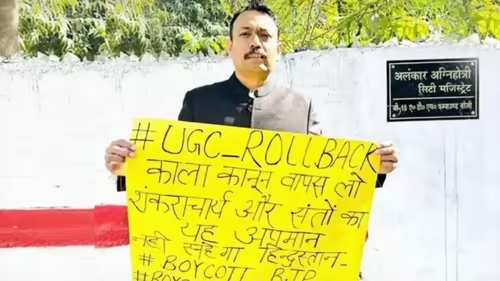
In a dramatic turn of events on India’s 77th Republic Day, Bareilly City Magistrate Alankar Agnihotri sent shockwaves through the administrative and political corridors by submitting his resignation. His reasons? A vehement opposition to the newly introduced UGC rules, which he branded a “black law,” and a deeply personal grievance stemming from the recent Magh Mela. This isn’t just a bureaucratic resignation; it’s a flashpoint in a national debate about caste, equity, and the future of higher education.
Table of Contents
- The Resignation Letter: A Republic Day Bombshell
- What Are the New UGC Rules of 2026?
- Agnihotri’s Claims: Why He Called It a ‘Black Law’
- The Magh Mela Snub and the Hostage Allegation
- Political Fallout and Government Response
- Conclusion: A Nation at a Crossroads
- Sources
The Resignation Letter: A Republic Day Bombshell
Alankar Agnihotri, a 2019-batch IAS officer, didn’t just quit his post; he issued a powerful statement of dissent. In his resignation letter, he argued that a government servant’s duty is not only to implement policy but also to awaken the state when its actions are deemed harmful to society. He stated, “It becomes necessary to awaken the government when it adopts policies that divide society and the nation” [[7]]. His resignation was a direct protest against what he perceived as two major injustices: the new UGC rules and an incident at the Magh Mela that he felt was an insult to saints and an act of oppression against Brahmins [[22]].
What Are the New UGC Rules of 2026?
The University Grants Commission (UGC) officially notified its new “Regulations for Prevention of Caste-Based Discrimination in Higher Education Institutions” on January 13, 2026 [[8]]. On the surface, the intent is noble and aligns with constitutional values. The primary goal is to create a safe and equitable environment for all students and staff by mandating universities to:
- Establish Internal Complaints Committees (ICCs) to handle grievances.
- Set up dedicated helplines and online portals for reporting incidents.
- Conduct regular awareness workshops and sensitization programs.
- Ensure strict disciplinary action against perpetrators of caste-based discrimination [[9], [10]].
These regulations were developed in response to longstanding concerns and directives from the Supreme Court to address the persistent issue of caste bias on university campuses [[14]]. The Ministry of Education has defended the rules, stating they are designed to be fair for all and aim to clarify any existing confusions around equity [[19]].
UGC rules: Why Agnihotri Called Them a ‘Black Law’
Despite the stated objectives, Agnihotri sees a dangerous subtext. He alleges that the new UGC rules are not about equity but are instead a tool for an “anti-Brahmin campaign” being run by the Uttar Pradesh government [[2]]. He fears that the regulations, by focusing heavily on protection for SC/ST/OBC groups, will inadvertently foment caste discontent and could even lead to false cases and atrocities against members of the so-called ‘general’ or upper castes, particularly Brahmins [[1], [6]].
His core argument is that these rules, rather than healing societal fractures, will deepen them by institutionalizing a new form of division. He believes they threaten the very fabric of academic harmony and social peace, hence his dramatic label of “black law” [[3], [7]]. This perspective has ignited a fierce debate, with some student groups expressing concerns about fairness, while others see it as a long-overdue measure for justice [[13], [15]].
The Magh Mela Snub and the Hostage Allegation
Agnihotri’s resignation wasn’t solely about policy. He was reportedly deeply hurt by an incident during the Prayagraj Magh Mela on Mauni Amavasya, where he felt disciples of the Jyotir Math Shankaracharya were assaulted and humiliated [[20], [21]]. He viewed this as a direct attack on Sanatan Dharma and its followers.
Adding another layer of controversy, Agnihotri made a startling claim after submitting his resignation. He alleged that he was held “hostage” at the residence of Bareilly District Magistrate Avinash Singh and was not allowed to leave for several hours [[25], [26]]. However, this claim has been firmly and repeatedly denied by the District Magistrate and other officials, who called it “completely baseless” and stated there was no mistreatment whatsoever [[24], [27]]. The UP government has since suspended Agnihotri for “indiscipline” and ordered a probe into the matter [[23], [32]].
Political Fallout and Government Response
The resignation has triggered a significant political storm. Opposition leaders have seized on the incident to criticize the state government, alleging immense pressure on bureaucrats and a breakdown of administrative neutrality [[1]]. The ruling party, meanwhile, has stood by its officials, dismissing Agnihotri’s more sensational claims and framing his actions as a breach of service conduct.
The government’s swift suspension of Agnihotri signals its intent to maintain discipline within its ranks, but it has done little to quell the larger debate his resignation has unleashed. The controversy now sits at the intersection of education policy, caste politics, and administrative freedom, forcing a national conversation on where to draw the line between protective legislation and perceived reverse discrimination.
Conclusion: A Nation at a Crossroads
The case of Alankar Agnihotri is far more than a local administrative dispute. It is a potent symbol of the deep-seated tensions surrounding caste, equity, and governance in modern India. His resignation over the UGC rules has thrown a critical spotlight on well-intentioned policies that can have complex and unintended social consequences. As the government investigates his allegations and the nation debates the merits of the new regulations, one thing is clear: the path to a truly equitable society is fraught with challenges that require nuanced understanding and careful navigation from all sides. For more on how policy changes affect local governance, see our analysis on [INTERNAL_LINK:impact-of-central-policies-on-state-administration].
Sources
- [[1]] Madhyamam Online: “UP Magistrate resigns on Republic Day citing ‘insult to saints’ and ‘discriminatory’ UGC rules”
- [[2]] The Indian Express: “‘Anti-Brahmin campaign going on in UP govt’: Bareilly city magistrate says resigning over UGC rules”
- [[3]] NDTV: “Bareilly City Magistrate Resigns, Cites Disagreement With New UGC Policies”
- [[7]] The Times of India: “‘Black law’: Bareilly city magistrate resigns over new UGC rules, claims he was held hostage at DM’s home”
- [[8]] Bhaskar English: “UGC New Rules Opposed | Caste Discrimination Campus”
- [[9]] The Times of India: “Explained: UGC 2026 regulations to ensure equity and end caste bias in higher education”
- [[10]] Vajiram & Ravi: “UGC Act, New UGC Rules 2026, Provisions, Key Details”
- [[13]] Dainik Jagran MPCG: “UGC Anti-Discrimination Rules 2026: A Closer Look at Campus Equity”
- [[14]] University World News: “New rules aim to tackle campus-based caste discrimination”
- [[15]] Facebook Post (referenced in search): “UGC Rules: No right for General Caste”
- [[19]] Dynamite News: “UGC rules will be fair for all, Ministry to clarify confusions”
- [[20]] Bhaskar English: “Bareilly city magistrate Alankar Agnihotri resigns”
- [[21]] The Times of India: “Prima facie guilty as Bareilly city magistrate Alankar Agnihotri resigns”
- [[22]] MSN: “Bareilly magistrate resigns over Magh Mela incidents, UGC regulations”
- [[23]] The Hindu: “Bareilly Magistrate suspended for indiscipline, faces inquiry amid resignation row”
- [[24]] NDTV: “Bareilly City Magistrate Resigns…” (on hostage claim denial)
- [[25]] The Times of India: “Prima facie guilty as Bareilly city magistrate…” (on hostage allegation)
- [[26]] The Times of India: “‘Black law’: Bareilly city magistrate…” (on hostage claim)
- [[27]] Rediff: “Bareilly magistrate Alankar Agnihotri resigns over UGC rules…”
- [[32]] The Indian Express: “Hours after his ‘dramatic’ resignation, UP govt suspends Bareilly city magistrate”