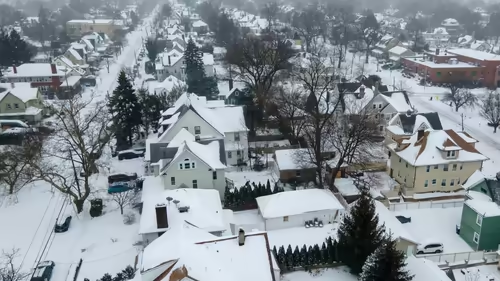
A monstrous US winter storm has unleashed unprecedented chaos across the country, shattering records and leaving a trail of devastation in its wake. Forget the initial reports of 30 deaths—this crisis has escalated dramatically. We’re now facing a grim reality with a confirmed death toll that has soared past 50, and a staggering number of Americans—over a million—are grappling with life-threatening conditions without power in sub-zero temperatures [[1]].
If you’re reading this, you’re likely either directly affected, worried about loved ones, or trying to understand the sheer scale of this national emergency. This isn’t just another snow day; it’s a full-blown disaster that has stretched emergency services to their limits and forced the federal government into action.
Table of Contents
- The Devastating Toll of the US Winter Storm
- States Battered by the Storm: A State-by-State Breakdown
- FEMA and Federal Response to the Crisis
- Massive Travel Disruptions and Economic Impact
- Staying Safe During Extreme Winter Weather
- Summary
- Sources
The Devastating Toll of the US Winter Storm
The human cost of this US winter storm is heartbreakingly high. As of January 26, 2026, authorities have confirmed at least 50 fatalities directly linked to the storm [[1]]. These aren’t just numbers; they represent lives lost to hypothermia, traffic accidents on icy roads, and carbon monoxide poisoning from unsafe attempts to stay warm. The storm, unofficially dubbed Winter Storm Fern by The Weather Channel, brought a deadly cocktail of heavy snow, crippling ice accumulations of up to an inch in multiple states, and wind chills that plunged far below zero [[6]].
Beyond the tragic loss of life, the storm’s impact on infrastructure has been crippling. At its peak, well over a million customers were left without electricity, a situation that is not just an inconvenience but a severe health hazard during a deep freeze [[19]].
States Battered by the Storm: A State-by-State Breakdown
This was not a localized event. The storm system, stretching over 2,000 miles, slammed into a vast swath of the United States, from the Southwest to the Northeast [[32]]. Here’s a look at some of the hardest-hit areas:
- Tennessee: Suffered the most significant power outages, with over 307,000 customers in the dark [[20]].
- Mississippi & Louisiana: Faced massive outages of approximately 175,300 and 145,100, respectively, as freezing rain brought down power lines [[16]].
- Ohio Valley (Indiana & Kentucky): Buried under a mix of 6 to 13 inches of snow and sleet, causing widespread travel chaos and power failures [[8]].
- New Mexico: Saw some of the highest snow totals, with nearly 31 inches recorded near Bonito Lake [[6]].
Emergency declarations have been issued in numerous states as local governments struggle to clear roads and restore essential services [INTERNAL_LINK:winter-weather-emergency-preparedness].
FEMA and Federal Response to the Crisis
In response to the escalating emergency, the Federal Emergency Management Agency (FEMA) has activated its full disaster response protocol. Federal disaster assistance has already been approved for states like Georgia and West Virginia to supplement their overwhelmed local resources [[26], [27]].
FEMA has established a dedicated landing page on its official website to provide the public with the latest information, safety guidelines, and details on how to access federal aid [[28]]. Their primary focus is on supporting search and rescue operations, providing emergency shelter, and coordinating the massive logistical effort required to restore power and critical infrastructure.
Massive Travel Disruptions and Economic Impact
The storm has brought the nation’s transportation network to a standstill. In a stunning display of its power, the system caused the cancellation or delay of more than 10,000 flights nationwide, stranding thousands of travelers during a busy period [[23], [34]]. Major highways were closed, and ground travel became extremely hazardous, if not impossible, across large regions.
The economic fallout from these disruptions, coupled with the cost of damage to property and infrastructure, is expected to be in the billions of dollars. For a deeper look at how extreme weather events affect the economy, see our analysis on [INTERNAL_LINK:economic-impact-of-natural-disasters].
Staying Safe During Extreme Winter Weather
If you are in an area affected by this or any future winter storm, your safety is paramount. The National Weather Service and other high-authority sources like Ready.gov offer critical guidance:
- Stay Indoors: Avoid all non-essential travel. Icy roads are a leading cause of storm-related deaths.
- Prevent Carbon Monoxide Poisoning: Never use a generator, grill, or camp stove inside your home, garage, or near a window.
- Conserve Phone Battery: Keep your phone charged and use it only for emergencies if the power is out.
- Check on Neighbors: Especially the elderly and those with medical needs who may be vulnerable.
Summary
The January 2026 US winter storm is a stark reminder of nature’s raw power. With a death toll exceeding 50 and over a million people left without power, the nation is facing a severe humanitarian and logistical challenge. From the ice-laden South to the snow-buried Midwest, the storm’s impact has been widespread and devastating. While FEMA and state authorities are working tirelessly on the response, the road to recovery will be long. Staying informed and prioritizing safety remains the most important action for everyone in the storm’s path.
Sources
- [[1]] Wikipedia: January 2026 North American winter storm
- [[6]] Wikipedia: January 2026 North American winter storm
- [[8]] National Weather Service: Winter Storm January 24-26, 2026
- [[16]] Fox Business: More than 1 million Americans lose power as monster winter storm sweeps across US
- [[19]] Yahoo News: A million power outages? Map shows winter storm impact
- [[20]] iHeartRadio: Nearly 1 Million Outages Reported In US Amid Massive Winter Storm
- [[23]] Wikipedia: January 2026 North American winter storm
- [[26]] FEMA: 2026 Winter Storm
- [[27]] WVEMD Facebook: FEMA announcement on federal disaster assistance
- [[28]] DHS: 2026 Winter Storm
- [[32]] Wikipedia: January 2026 United States winter storm
- [[34]] Times of India: U.S. Snow Storm 2026: Mass flight cancellations lead to travel disruptions