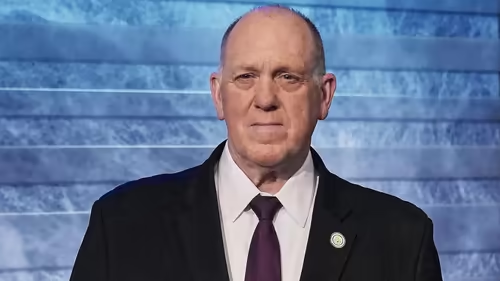
In the wake of two fatal shootings involving federal immigration agents, a tense Minneapolis has become the epicenter of a national firestorm. The city’s streets are filled with protesters demanding accountability, and into this maelstrom, President Donald Trump has sent a man known for his uncompromising stance on immigration: Tom Homan. But who is this figure being called a ‘border czar,’ and why is his arrival seen by many as pouring gasoline on an already raging fire?
Table of Contents
- Who is Tom Homan? The Hardline Enforcer
- The Minneapolis Crisis: What Sparked the Protests?
- Why Trump Sent Tom Homan to Minneapolis
- Tom Homan’s Controversial Legacy and Policies
- Public and Political Reaction to Homan’s Deployment
- Conclusion: What Homan’s Presence Signals for US Immigration Policy
- Sources
Who is Tom Homan? The Hardline Enforcer
Tom Homan is a career law enforcement official whose name has become synonymous with aggressive immigration enforcement in the United States. His journey began at the very bottom, as a police officer in West Carthage, New York, in 1983. He quickly moved up the ranks within the federal immigration system, which was then part of the Immigration and Naturalization Service (INS), the precursor to today’s ICE [[5]].
By 2013, Homan had risen to become the Executive Associate Director of ICE’s Enforcement and Removal Operations (ERO), the division responsible for tracking down, detaining, and deporting undocumented immigrants [[4]]. His reputation for toughness and a results-driven approach earned him the role of Acting Director of U.S. Immigration and Customs Enforcement (ICE) in 2017 under the Trump administration [[2]].
Homan’s tenure was marked by a dramatic increase in workplace raids and arrests of non-criminal undocumented immigrants, a significant shift from the Obama-era policy that prioritized serious offenders. He is a staunch advocate for policies like mandatory detention and has been a vocal critic of so-called “sanctuary cities” that limit cooperation with federal immigration authorities.
The Minneapolis Crisis: What Sparked the Protests?
The current unrest in Minneapolis stems from two separate, tragic incidents involving federal agents. The first involved the shooting of Renee Good, and the second, more recently, the fatal shooting of an ICU nurse, Alex Pretti, by a federal agent during what was described as an immigration enforcement operation [[10], [13]].
These events have ignited a wave of fury across the city, which is already sensitive to issues of law enforcement violence. Demonstrations have erupted under the banner of “Operation Metro Surge,” with protesters demanding the immediate withdrawal of all federal immigration agents from their communities and calling for an independent investigation into the shootings [[12]].
The situation has become so volatile that the FBI has even asked its agents from other parts of the country to voluntarily travel to Minneapolis for temporary duty, highlighting the scale of the crisis [[11]].
Why Trump Sent Tom Homan to Minneapolis
Faced with mounting scrutiny over the aggressive tactics of his immigration forces, President Trump’s decision to send Tom Homan is a clear signal of his intent. Rather than de-escalate, the administration has doubled down. Homan has been officially appointed to lead and oversee all immigration enforcement operations in Minnesota [[14], [18]].
This move is classic Trump strategy: deploy your most loyal and aggressive lieutenant to a crisis zone to demonstrate strength and control. For the White House, Homan is not just a manager; he is a symbol of their “zero tolerance” immigration philosophy. His presence is meant to reassure the administration’s base that they are taking decisive action, regardless of the public outcry [[15]].
Tom Homan’s Controversial Legacy and Policies
Homan’s legacy is deeply intertwined with some of the most contentious policies of the Trump era. He was a key architect and enforcer of the administration’s family separation policy, which saw thousands of children taken from their parents at the southern border [[17]].
His philosophy on immigration can be summarized in his own words, often emphasizing a “tough but fair” approach—a description that critics argue is a euphemism for harsh and indiscriminate enforcement. Key aspects of his policy stance include:
- Ending “Catch and Release”: He vehemently opposed the practice of releasing undocumented immigrants while they awaited their court dates.
- Expanding Deportation Targets: Under his leadership, ICE targeted not just criminals, but any undocumented individual, arguing that their mere presence was a crime.
- Championing Workplace Raids: He oversaw a significant increase in large-scale raids on businesses suspected of employing undocumented workers, a tactic designed to create a climate of fear.
This hardline record is precisely why his deployment to a city already on edge is seen as a deliberate provocation by many activists and local officials.
Public and Political Reaction to Homan’s Deployment
The reaction to Homan’s arrival in Minneapolis has been swift and overwhelmingly negative from local leaders and the public. One state governor bluntly stated, “Sending Tom Homan to Minnesota is like pouring gasoline on a fire” [[17]].
Community organizers and civil rights groups view his appointment as a direct threat, fearing it will only lead to more aggressive and potentially deadly encounters between federal agents and residents. They see it not as a move towards justice or investigation, but as a consolidation of power for an agency they believe operates without sufficient oversight.
Conversely, the move has been praised by immigration hardliners and members of the president’s base, who see Homan as a hero who finally enforced the nation’s immigration laws without apology.
Conclusion: What Homan’s Presence Signals for US Immigration Policy
The deployment of Tom Homan to Minneapolis is far more than a personnel decision; it is a powerful political statement. It signals that the Trump administration has no intention of backing down from its aggressive immigration enforcement strategy, even in the face of deadly consequences and widespread public protest. As tensions continue to mount in the city, Homan’s actions in the coming days will be a critical test of both his leadership and the future direction of federal immigration policy in America.
Sources
- Al Jazeera. “Protesters demand immigration agents leave Minneapolis.” https://www.aljazeera.com/gallery/2026/1/25/protesters-demand-immigration-agents-leave-minneapolis
- GovExec. “Trump dispatches border czar to Minnesota amid protests over federal shootings.” https://www.govexec.com/management/2026/01/trump-dispatches-border-czar-minnesota-amid-protests-over-federal-shootings/410947/
- OpenSecrets. “Trump administration profile: Tom Homan.” https://www.opensecrets.org/news/2025/08/trump-administration-profile-tom-homan/
- ACLED. “Confrontations between ICE and protesters: How does Minnesota compare other states.” https://acleddata.com/report/confrontations-between-ice-and-protesters-how-does-minnesota-compare-other-states
- Congress.gov. “Thomas D. Homan Acting Director, ICE.” https://www.congress.gov/115/meeting/house/106057/witnesses/HHRG-115-AP15-Bio-HomanT-20170613.pdf