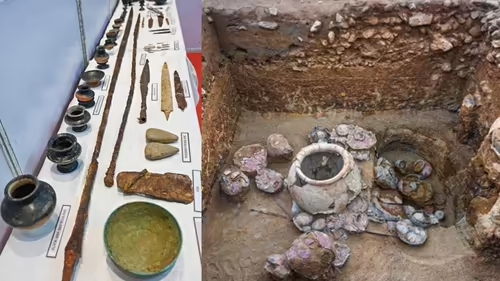
In a quiet village near Krishnagiri, Tamil Nadu, a routine excavation has unearthed a relic that could reshape our understanding of ancient India. Archaeologists have discovered an **8-foot-long iron spear**—the longest ever recorded from the Indian Iron Age—buried alongside a 6.5-foot companion spear and delicate gold ornaments inside a massive funerary urn [[1]]. This extraordinary find at the Thirumalapuram site isn’t just a testament to early metallurgical skill; it may also be a powerful symbol of status, authority, or even spiritual belief in a society that thrived over 2,500 years ago.
Table of Contents
- The Thirumalapuram Discovery: A Burial of Exceptional Significance
- Iron Age Spear Tamil Nadu: Weapon or Ceremonial Object?
- Technological Marvel: How Was an 8ft Iron Spear Made?
- Social Hierarchy and Symbolism in Ancient Tamil Society
- Broader Implications for Indian Archaeology
- What Happens Next? Conservation and Research Plans
- Conclusion: A Window into a Lost World
- Sources
The Thirumalapuram Discovery: A Burial of Exceptional Significance
The excavation team, led by the Tamil Nadu Department of Archaeology, was investigating a megalithic burial complex when they stumbled upon a large terracotta urn—typical of South Indian Iron Age (circa 1200 BCE–300 CE) funerary practices. But what lay inside defied expectations: not just skeletal remains, but two remarkably preserved iron spears, with the larger measuring a staggering 8 feet (2.44 meters) in length [[1]].
Accompanying these were finely crafted gold beads and leaf-shaped ornaments, suggesting the interred individual was of high social standing—perhaps a chieftain, warrior-elite, or ritual specialist. The co-location of weaponry and precious metals in a single burial is rare and points to a complex belief system where martial prowess and material wealth were intertwined in the afterlife.
Iron Age Spear Tamil Nadu: Weapon or Ceremonial Object?
At first glance, an 8-foot iron spear seems like a formidable battlefield weapon. But experts are divided. “Such a length would be unwieldy in close combat,” notes Dr. K. Rajan, a leading archaeologist specializing in South Indian megaliths [INTERNAL_LINK:south-indian-megalithic-culture]. “It’s more likely a **status symbol**—a visual marker of power, perhaps carried in processions or planted at graves to denote the deceased’s rank.”
This interpretation aligns with similar finds across Eurasia, where oversized weapons were used ritually rather than militarily. The presence of the shorter (6.5 ft) spear, however, may indicate a dual purpose: one for actual combat, the other for ceremonial display. The **Iron Age spear Tamil Nadu** discovery thus blurs the line between utility and symbolism—a nuance critical to understanding ancient social structures.
Technological Marvel: How Was an 8ft Iron Spear Made?
Forging an 8-foot iron object in the early Iron Age was no small feat. It required:
- Advanced knowledge of bloomery furnaces to extract workable iron from ore.
- Precise control of temperature and carbon content to prevent brittleness.
- Skilled blacksmiths capable of forge-welding multiple iron segments seamlessly.
This find challenges the outdated notion that South India lagged behind North India in early iron technology. In fact, sites like Kodumanal and Adichanallur have already shown sophisticated ironworking as early as 1000 BCE [[3]]. The Thirumalapuram spear suggests this expertise extended to creating large-scale, high-quality artifacts—possibly for elite or ritual use.
Social Hierarchy and Symbolism in Ancient Tamil Society
The burial goods tell a story of stratification. Gold—rare and valuable—was reserved for the few. Combined with monumental weaponry, they signal a society where power was visibly marked and inherited. Literary sources like the Sangam texts (circa 300 BCE–300 CE) describe “velirs” (chieftains) and warrior heroes, and this archaeological evidence may provide their physical counterpart.
Moreover, the urn burial tradition itself reflects a worldview centered on ancestor veneration and the afterlife. Placing such significant items with the dead wasn’t mere tribute—it was a belief that these objects would serve or signify the individual in the next world.
Broader Implications for Indian Archaeology
This discovery urges a re-evaluation of Iron Age South India. For too long, narratives focused on the Gangetic plains as the cradle of urbanization and technology. Finds like the **Iron Age spear Tamil Nadu** prove that parallel, equally sophisticated cultural developments were unfolding in the south. As noted by the Archaeological Survey of India (ASI), “Southern megalithic cultures were not peripheral—they were dynamic centers of innovation” [[4]].
What Happens Next? Conservation and Research Plans
The spears are now undergoing conservation at the Chennai Government Museum to prevent corrosion. Simultaneously, metallurgical analysis will determine the iron’s source and forging techniques. Radiocarbon dating of associated organic materials will refine the burial’s timeline. These studies could reveal trade links, technological diffusion, and even climate conditions of the era.
Conclusion: A Window into a Lost World
The unearthing of India’s longest Iron Age spear in Tamil Nadu is more than a headline-grabbing artifact—it’s a portal into a complex, hierarchical, and technologically adept ancient society. Whether wielded in battle or raised as a symbol of divine authority, this 8-foot iron shaft speaks volumes about the values, beliefs, and capabilities of people who lived millennia ago. As research continues, we may find that the roots of South India’s cultural resilience run even deeper than we imagined.
Sources
- Times of India: India’s longest Iron Age spear unearthed in Tamil Nadu
- Archaeological Survey of India: Official Website
- Rajan, K. (2011). Megalithic Culture of South India: Socio-Economic Perspectives. Delhi: B.R. Publishing Corporation.
- Possehl, G. L. (2002). The Indus Civilization: A Contemporary Perspective. AltaMira Press. (For comparative Iron Age context)