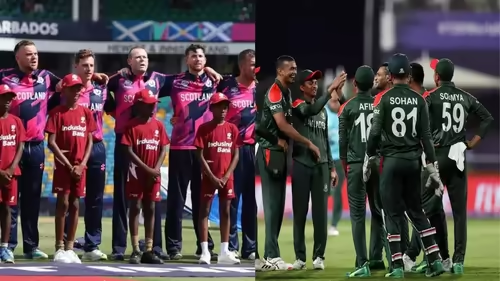
The road to the ICC Men’s T20 World Cup 2026 just took a sharp, unexpected turn. In a move that has sent shockwaves through the cricketing world, Scotland replaces Bangladesh T20 WC as an official participant—after Bangladesh was removed for refusing to accept the tournament’s finalized schedule [[1]]. The decision, backed by the International Cricket Council (ICC), has ignited debates over player safety, scheduling sovereignty, and the ethics of last-minute replacements.
Table of Contents
- Why Bangladesh Withdrew: The Security & Schedule Dispute
- Scotland’s Response: Empathy and Opportunity
- How Scotland “Qualified” (Or Didn’t)
- ICC Stance: Security Assurances and Scheduling Rigidity
- Fan and Player Reactions: A Divided World
- What This Means for Future ICC Tournaments
- Conclusion: A Bittersweet World Cup Debut?
- Sources
Why Bangladesh Withdrew: The Security & Schedule Dispute
Bangladesh’s exit wasn’t due to poor performance—it was a principled stand. The Bangladesh Cricket Board (BCB) formally requested a rescheduling of their group-stage matches, citing serious security concerns linked to the tournament’s host nation and timing [[1]]. However, the ICC, having already issued its final schedule and received government-level security guarantees from the host country, denied the request outright.
Faced with what they deemed an unacceptable risk to their players’ safety, Bangladesh made the unprecedented decision to withdraw. This wasn’t a casual refusal; it was a high-stakes gamble that ultimately cost them their World Cup berth—a devastating blow for a team ranked 9th globally and packed with T20 talent like Shakib Al Hasan and Mustafizur Rahman.
Scotland’s Response: Empathy and Opportunity
Enter Scotland. Ranked 14th in the ICC T20I rankings, they hadn’t qualified through the usual regional pathway—their own campaign had ended in disappointment [[1]]. Yet, as the next eligible team in the ICC’s reserve list, they were offered the vacant spot.
Cricket Scotland’s CEO didn’t celebrate. Instead, he expressed deep sympathy: “We do feel for Bangladesh players,” he said, acknowledging the human cost behind the administrative decision. He admitted their entry was “far from ideal” but added they were “happy to step in” given the rare chance to compete on cricket’s biggest T20 stage [INTERNAL_LINK:t20-world-cup-history].
How Scotland “Qualified” (Or Didn’t)
It’s crucial to clarify: Scotland did not earn this spot through on-field victory. Their path was administrative, not competitive. Here’s how the ICC’s contingency system works:
- Teams are ranked based on ICC T20I standings and recent performance in qualifiers.
- If a qualified team withdraws, the next highest-ranked non-qualified team is invited.
- Scotland, despite missing direct qualification, was the top reserve due to consistent performances in European and global qualifiers over the past cycle.
This system ensures tournament continuity—but at the cost of sporting meritocracy, a point critics are quick to highlight.
ICC Stance: Security Assurances and Scheduling Rigidity
The ICC has stood firm. In a public statement, it emphasized that “comprehensive security protocols” have been implemented in collaboration with local authorities and international agencies [[3]]. The governing body argued that altering the schedule for one team would set a dangerous precedent and disrupt logistics for broadcasters, fans, and other participating nations.
While the ICC’s position prioritizes operational stability, it raises ethical questions: Should player welfare ever be negotiable? And can security assurances from governments truly override a national board’s sovereign right to protect its athletes? These are dilemmas the sport will grapple with long after the 2026 tournament ends.
Fan and Player Reactions: A Divided World
Global reaction has been polarized. Bangladeshi fans are furious, calling the ICC’s decision “heartless” and accusing it of prioritizing commercial interests over lives. Many neutral observers share their sympathy, noting that no team should be forced to choose between safety and participation.
Meanwhile, Scottish supporters are cautiously jubilant—thrilled for their team’s unexpected shot at glory but uncomfortable with the circumstances. Even within the Scotland camp, players have expressed mixed emotions, knowing their dream debut comes at another team’s expense.
What This Means for Future ICC Tournaments
This incident could reshape how future global events are managed. Potential reforms might include:
- Flexible scheduling clauses for genuine security or health emergencies.
- Independent risk assessment panels to evaluate team concerns objectively.
- Clearer communication protocols between the ICC and member boards during crises.
As climate change, geopolitical tensions, and global health threats increase, the ICC can no longer rely on rigid, one-size-fits-all planning. The Scotland replaces Bangladesh T20 WC saga may become a catalyst for more humane and adaptable tournament frameworks.
Conclusion: A Bittersweet World Cup Debut?
Scotland’s inclusion in the T20 World Cup 2026 is historic—but shadowed by controversy. While they deserve credit for being ready when called, their presence underscores a systemic failure to balance safety, fairness, and competition. For Bangladesh, it’s a painful lesson in the limits of influence within global cricket’s power structure. As fans, we’ll watch Scotland’s matches with admiration—but also with a lingering sense of injustice for the Tigers who never got to play.
Sources
- Times of India: ‘We do feel for Bangladesh players’: Scotland admit T20 WC entry was ‘far from ideal’
- ICC Official Website: ICC confirms participants for Men’s T20 World Cup 2026
- ESPNcricinfo: Bangladesh withdraw from T20 World Cup 2026 over scheduling dispute
- Cricket Scotland: Scotland named as replacement for Bangladesh in T20 World Cup 2026