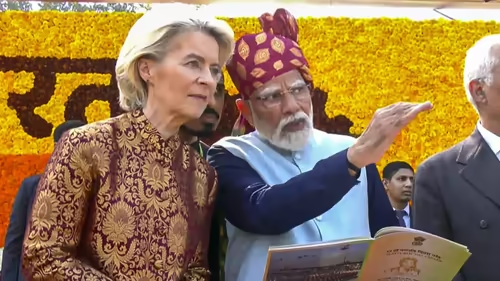
In a move that has sent shockwaves through global diplomatic and economic circles, the long-anticipated India-EU trade deal has finally been concluded, only to be met with fierce condemnation from the United States. The core of the controversy? A complex web of energy trade that the US Treasury Secretary claims is effectively allowing Europe to finance the very war it publicly opposes.
Table of Contents
- US Treasury Secretary’s Scathing Indictment
- The India-EU Trade Deal: A Landmark Pact
- The Russian Oil Nexus: How It All Connects
- The “Double Standard” Argument
- What This Means for Global Trade and Geopolitics
- Conclusion: A New World Order in the Making?
- Sources
US Treasury Secretary’s Scathing Indictment
US Treasury Secretary Scott Bessent has pulled no punches. He has directly targeted the newly minted India-EU trade deal, accusing European nations of a profound hypocrisy. His central argument is stark: by purchasing large quantities of refined oil products from India, which are processed from discounted Russian crude, Europe is indirectly providing Moscow with the financial lifeline it needs to sustain its war effort in Ukraine [[1]].
Bessent framed this as a critical issue of burden-sharing. He pointed out that while the US has imposed significant tariffs on India for its role in this trade flow, the EU appears to be rewarding the same behavior with a comprehensive trade pact. In his words, Europe is “financing war against themselves” [[4]]. This sharp criticism highlights a growing transatlantic rift over how to manage the economic dimensions of the conflict with Russia.
The India-EU Trade Deal: A Landmark Pact
After nearly two decades of negotiations, India and the European Union officially concluded their Free Trade Agreement (FTA) on January 27, 2026 [[14]]. This is not just any trade deal; it’s being hailed as the “mother of all trade deals” due to its potential to reshape economic ties between the world’s largest democracy and a major economic bloc [[15]].
The agreement aims for broad-based tariff reductions on a vast array of goods and services, promising to boost bilateral trade, create jobs, and deepen strategic cooperation. For India, it’s a gateway to a massive, high-value market. For the EU, it’s a crucial step in diversifying its supply chains away from China and forging a stronger partnership with a key Indo-Pacific player [INTERNAL_LINK:india-eu-strategic-partnership].
The Russian Oil Nexus: How It All Connects
To understand the US’s ire, one must follow the oil. Since the invasion of Ukraine, India has become the world’s second-largest buyer of Russian crude oil, snapping up heavily discounted barrels that many Western buyers have shunned [[19]]. Indian refineries, with their advanced capacity to process this specific type of crude, have turned it into diesel, naphtha, and other refined products.
A significant portion of these refined products is then exported to Europe. Data from late 2025 shows that six refineries in India and Turkey alone exported over €800 million worth of such products to the EU, among other destinations [[17]]. From the US perspective, this creates a circular and deeply problematic flow: Europe pays India for fuel, India pays Russia for crude, and Russia uses that revenue to fund its military. The US sees the new India-EU trade deal as an incentive that could further entrench this system.
The “Double Standard” Argument
Bessent’s critique hinges on what he perceives as a glaring double standard. The US has taken a hard line, imposing tariffs on Indian goods as a form of economic pressure to discourage this trade pattern [[6]]. Meanwhile, the EU is moving in the opposite direction by offering India unprecedented market access through the FTA. This, according to the US, undermines the collective West’s efforts to economically isolate Russia and creates an uneven playing field where the US bears a disproportionate share of the economic cost for its stance on the war [[7]].
What This Means for Global Trade and Geopolitics
This clash is about far more than just a single trade agreement. It’s a symptom of a rapidly fragmenting global order. The era of a unified Western front on economic policy is showing signs of strain. The EU, facing its own energy security challenges and economic pressures, is prioritizing its strategic relationship with India and its immediate energy needs.
For India, this situation presents both a challenge and an opportunity. It can leverage its position as a critical energy processor and a strategic counterweight to China to negotiate favorable terms with both the West and Russia. However, it also risks being caught in the crossfire of great power competition. The success of the India-EU trade deal will now be watched not just for its economic impact, but as a barometer of the health of the transatlantic alliance and the future of the rules-based international order.
Conclusion: A New World Order in the Making?
The controversy surrounding the India-EU trade deal is a powerful illustration of how geopolitics and global commerce are now inextricably linked. The US’s furious reaction underscores the deep anxieties in Washington about maintaining a united front against adversaries. At the same time, the EU’s decision to proceed with the deal signals its intent to pursue a more autonomous and pragmatic foreign policy, even if it means ruffling feathers in its most important alliance. As this high-stakes drama unfolds, the world is witnessing the messy, complex birth pangs of a new, multipolar world order.
Sources
- Times of India: ‘Europe financing war against themselves’: India-EU ‘mother of all trade deals’ draws US ire
- The Hindu: India-EU Summit LIVE: FTA concluded on Jan 27, 2026
- Energy & Clean Air Research Centre: November 2025 — Monthly analysis of Russian fossil fuel exports
- Al Jazeera: How India plans to continue buying Russian oil despite sanctions
- European Commission: EU Trade agreements – European Union