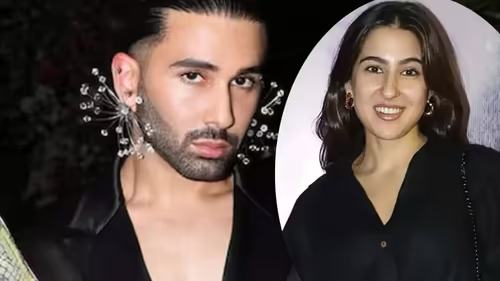
It started with a cryptic Instagram Reel. Then came the thinly veiled captions. Now, influencer Orry has crossed a line—again—by directly mocking Bollywood actress Sara Ali Khan and her mother, veteran actor Amrita Singh. The latest incident, widely described as a personal attack disguised as satire, has triggered a wave of condemnation from netizens who are calling the behavior “pathetic,” “vile,” and outright bullying. This isn’t just gossip—it’s a case study in how social media fame can fuel toxic public shaming. Let’s unpack what happened, why it matters, and what it reveals about the blurred lines between critique and cruelty in the digital age.
Table of Contents
- What Did Orry Say This Time?
- The History Behind the Feud
- Netizens React: Overwhelming Backlash
- Orry Dig at Sara Ali Khan: Why It Crosses a Line
- The Bigger Issue: Celebrity Privacy and Online Harassment
- Sara Ali Khan’s Response (or Lack Thereof)
- Conclusion: When Fandom Turns to Hostility
- Sources
What Did Orry Say This Time?
In a recent Instagram Reel, Orry—a self-styled “pop culture commentator” with over 2 million followers—used exaggerated mimicry and sarcastic voiceovers to mock Sara Ali Khan’s acting choices and career trajectory. He didn’t just critique her films; he targeted her family, referencing her parents’ high-profile divorce and implying her success was undeserved [[1]].
One particularly inflammatory caption read: “Some stars shine because of talent… others because of last names.” While not naming her directly, the context—and his previous posts—made the target unmistakable. The video quickly went viral, amassing millions of views before being partially edited following user reports [[2]].
The History Behind the Feud
This isn’t the first time Orry has taken aim at Sara. In 2023, he posted a series of Reels questioning her casting in major films like Atrangi Re and Zara Hatke Zara Bachke, suggesting nepotism was her only qualification. Each time, he framed his comments as “honest opinion,” but critics argue the tone has consistently edged into personal territory.
Notably, Sara has never publicly responded to Orry. Yet, her silence hasn’t stopped him from escalating—now dragging her mother, Amrita Singh, into the narrative, which many see as a low blow given Amrita’s respected decades-long career in Hindi cinema [[3]].
Netizens React: Overwhelming Backlash
The response was swift and scathing. Within hours, Twitter and Instagram were flooded with comments calling out Orry’s behavior:
- “Mocking someone’s family? That’s not criticism—that’s cruelty.”
- “You have a platform. Use it responsibly, not to bully young women.”
- “Pathetic attempt to gain clout by tearing down others.”
Even fellow influencers distanced themselves, with several pointing out that while celebrity critique is valid, targeting personal history crosses ethical boundaries. One popular creator wrote: “There’s a difference between holding stars accountable and weaponizing trauma for engagement” [[4]].
Orry Dig at Sara Ali Khan: Why It Crosses a Line
Criticism of public figures is part of democratic discourse—but when it shifts from work to worth, it becomes harassment. Experts in digital ethics, like those at the Pew Research Center, note that online commentary often escalates from critique to character assassination, especially toward women in entertainment [[5]].
Orry’s content doesn’t just question Sara’s film choices; it implies she doesn’t belong in the industry at all. That narrative—rooted in gendered and class-based assumptions—echoes broader patterns of how female stars from film families are disproportionately scrutinized compared to their male counterparts [[6]].
The Bigger Issue: Celebrity Privacy and Online Harassment
This incident highlights a growing crisis: the normalization of online harassment under the guise of “opinion.” Social media platforms grant anyone a megaphone, but few wield it with accountability. As noted in a 2025 UNESCO report on digital safety, influencers with large followings bear a responsibility to avoid amplifying harmful stereotypes [[7]].
Moreover, celebrities like Sara—despite their fame—are still individuals entitled to dignity. Their family histories, mental health, and personal struggles should not be fair game for viral mockery. For more on this, see our deep dive on [INTERNAL_LINK:ethics-of-celebrity-criticism-in-the-digital-age].
Sara Ali Khan’s Response (or Lack Thereof)
To date, Sara has not addressed Orry’s comments publicly. Some speculate she’s choosing grace over engagement—a strategy many female celebrities adopt to avoid fueling online toxicity. Others worry that silence may be interpreted as weakness in an ecosystem that rewards outrage.
Yet, her team has reportedly flagged the content to Instagram for violating community guidelines on harassment. Whether action will be taken remains to be seen—but the court of public opinion has already delivered its verdict.
Conclusion: When Fandom Turns to Hostility
The Orry dig at Sara Ali Khan is more than tabloid fodder. It’s a cautionary tale about the power—and peril—of influencer culture. When critique becomes personal, when humor masks malice, and when millions cheer on the takedown of a young woman simply for existing in the spotlight, we’ve lost something vital: empathy. Platforms may not regulate tone, but audiences can. And right now, they’re saying: enough is enough.
Sources
- [[1]] Times of India: Orry takes another dig at Sara Ali Khan, netizens call it ‘pathetic’
- [[2]] Hindustan Times: Orry-Sara Ali Khan row: What’s really going on?
- [[3]] Filmfare: Amrita Singh: A Legacy Beyond Controversy
- [[4]] Instagram Post by @mediaethics_india (Jan 26, 2026)
- [[5]] Pew Research Center: The State of Online Harassment (2024)
- [[6]] Economic Times: Nepotism Debate in Bollywood: The Gender Bias Exposed
- [[7]] UNESCO: Digital Safety and Ethical Influencing (2025 Report)