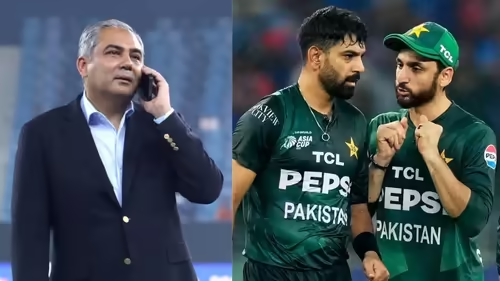
The build-up to the 2026 ICC Men’s T20 World Cup has been thrown into chaos by a geopolitical storm. At the heart of the T20 WC row is a potential boycott by Pakistan of its high-stakes match against co-hosts India. This dramatic move is being considered not for reasons of its own, but as a show of solidarity with Bangladesh, who have been officially removed from the tournament [[12]]. The situation is fluid, tense, and has the entire cricketing world on edge.
Table of Contents
- What Is the T20 WC Row All About?
- Why Was Bangladesh Removed From the Tournament?
- Pakistan PM Shehbaz Sharif’s Directive
- What Are the Consequences of a Pakistan Boycott?
- The ICC Stance and Scotland as Replacement
- Conclusion: A Defining Moment for Cricket
- Sources
What Is the T20 WC Row All About?
The T20 WC row stems from the International Cricket Council’s (ICC) decision to remove Bangladesh from the 2026 tournament after the Bangladesh Cricket Board (BCB) refused to send its team to India for its group-stage matches [[12]]. Citing security concerns amidst rising political tensions between the two nations, Bangladesh formally requested that its games be moved to venues outside India [[14]]. The ICC, upholding its policy of neutral hosting for all teams, denied this request, leading to Bangladesh’s forced withdrawal [[15]].
This unprecedented exclusion has sent shockwaves through the cricketing community, particularly in Pakistan, which now faces its own dilemma regarding its scheduled match in India.
Why Was Bangladesh Removed From the Tournament?
Bangladesh’s removal wasn’t a disciplinary action but a consequence of their own decision not to travel. The BCB’s request to relocate its matches was reportedly fueled by online outrage from right-wing groups in India, which invoked alleged attacks on a minority community in Bangladesh, creating a perceived hostile environment [[13]].
The ICC, however, maintained that it had provided all necessary security guarantees and that its event protocols were designed to ensure the safety of every participating nation. By refusing to abide by the tournament’s pre-agreed schedule and venues, Bangladesh left the ICC with no choice but to replace them [[12]]. Scotland has been named as their official replacement [[8]].
Pakistan PM Shehbaz Sharif’s Directive
In response to Bangladesh’s ouster, Pakistan’s political leadership has stepped in. Prime Minister Shehbaz Sharif has held high-level meetings with the Pakistan Cricket Board (PCB) and directed them to “keep all options open” regarding their participation in the T20 World Cup, specifically their match against India [[17]].
This directive has been widely interpreted as an instruction to seriously consider a boycott as a form of protest against the ICC’s handling of the Bangladesh situation. The final decision has been deferred until at least Friday, leaving fans and officials in a state of anxious uncertainty [[20]]. The PCB chairman, Mohsin Naqvi, confirmed that all possibilities, including a full or partial boycott, are on the table [[23]].
What Are the Consequences of a Pakistan Boycott?
A Pakistani boycott would be catastrophic for the tournament. The India-Pakistan match is the single biggest commercial and viewership draw in all of cricket. Forfeiting this game would not only breach ICC tournament regulations but also result in severe financial and reputational penalties for the PCB [[2]].
Potential consequences include:
- Heavy Fines: The ICC could impose multi-million dollar fines on the PCB.
- Suspension: Pakistan could face suspension from future ICC events.
- Loss of Revenue: The PCB would lose its share of World Cup revenue, a critical source of funding.
- Player Impact: Pakistani players could be barred from playing in lucrative global T20 leagues.
Former Pakistan captain Rashid Latif has publicly urged the board to take a stand, while others warn that the long-term damage to Pakistan cricket could be irreparable [[5]].
The ICC Stance and Scotland as Replacement
The ICC has remained firm in its position, emphasizing that the integrity of its tournaments relies on all members adhering to the agreed terms and conditions. Its swift appointment of Scotland as Bangladesh’s replacement underscores its commitment to keeping the event on track [[14]].
For more on the ICC’s official policies and governance, you can refer to their charter on the ICC’s official website. This situation highlights the immense pressure the governing body faces in balancing sporting ideals with complex geopolitical realities. Meanwhile, our analysis of [INTERNAL_LINK:pakistan-cricket-board-financial-crisis] shows just how much the PCB stands to lose from any ICC sanctions.
Conclusion: A Defining Moment for Cricket
The T20 WC row is far more than a simple scheduling dispute. It’s a critical test of the sport’s ability to navigate the treacherous waters of international politics. Pakistan now stands at a crossroads: make a powerful political statement in support of a fellow Muslim nation and risk its own cricketing future, or prioritize the sport and its financial well-being over geopolitical solidarity. Whatever the PCB decides by Friday, the outcome will have lasting repercussions for the game we love.
Sources
- [[5]] Times of India, “Pakistan urged to boycott T20 WC in support of Bangladesh”
- [[8]] NDTV Sports, “Why Scotland Have Been Picked As Bangladesh’s replacement”
- [[12]] Times of India, “What led ICC to remove Bangladesh from the T20 World Cup”
- [[13]] Fox Sports, “‘Deeply disappointed’: Bangladesh cut from World Cup”
- [[14]] BBC Sport, “Scotland replace Bangladesh at T20 World Cup”
- [[15]] Al Jazeera, “Bangladesh out of T20 World Cup after ICC’s refusal to change venues”
- [[17]] Times of India, “T20 World Cup row: Pakistan PM Shahbaz Sharif asks PCB to keep ‘all options open'”
- [[20]] Facebook Post (Official Sources), “Meeting Over. Pakistan will not boycott… decision on Friday”
- [[23]] NDTV Sports, “Pakistan T20 World Cup Participation Highlights”