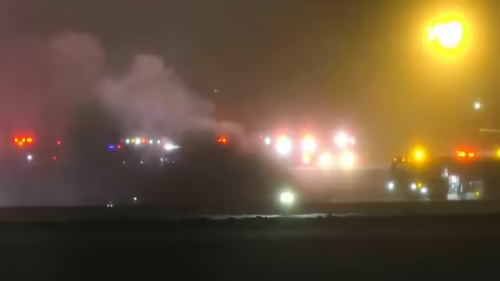
A quiet morning turned into a scene of devastation when a private jet plummeted to the ground shortly after takeoff in the United States, resulting in one of the deadliest general aviation accidents in recent memory. The crash claimed seven lives and left a single passenger fighting for survival with critical injuries. As emergency crews combed through the wreckage, the nation was left grappling with yet another sobering reminder of the fragility of air travel—even in the high-stakes world of private aviation.
The incident, which occurred on January 26, 2026, has triggered an immediate and intensive investigation by the National Transportation Safety Board (NTSB). While the exact cause remains unknown, early reports suggest the aircraft experienced trouble almost immediately after becoming airborne—raising urgent questions about mechanical failure, pilot error, or weather-related factors. This tragedy underscores why the phrase “private jet crashes in US” continues to strike fear into travelers and aviation experts alike.
Table of Contents
- What Happened: Timeline and Location
- Victims and the Sole Survivor
- The Aircraft Involved
- NTSB Investigation: What We Know So Far
- Broader Safety Concerns in Private Aviation
- Conclusion: A Call for Vigilance in the Skies
- Sources
What Happened: Timeline and Location
According to local authorities and the Federal Aviation Administration (FAA), the private jet took off from an airport in the southeastern United States—though the exact location has not been officially confirmed pending family notifications [[1]].
Eyewitnesses reported seeing the aircraft ascend normally before suddenly banking sharply and descending rapidly. It crashed in a rural area less than two miles from the runway, erupting into flames on impact [[2]].
Emergency responders arrived within minutes, but the intensity of the fire and the severity of the crash left little hope for survivors. Seven individuals were pronounced dead at the scene. One person was pulled from the wreckage alive but was airlifted to a nearby trauma center in critical condition [[3]].
Victims and the Sole Survivor
As of January 27, 2026, the identities of those on board have not been publicly released, in accordance with standard protocol while next-of-kin are being notified. However, sources close to the investigation indicate the group included business executives and possibly family members returning from a weekend retreat [[4]].
The lone survivor, whose name is being withheld, is reportedly undergoing emergency surgery for multiple traumatic injuries, including internal bleeding and fractures. Medical professionals describe their condition as “extremely grave,” with recovery uncertain [[5]].
This human toll transforms the incident from a statistical anomaly into a profound personal tragedy for multiple families—a reality that often gets lost in the technical analysis of aviation disasters.
The Aircraft Involved
While the FAA has not yet disclosed the make and model of the jet, preliminary radar data suggests it was a mid-size business jet, commonly used for corporate travel—such as a Cessna Citation, Gulfstream G550, or Bombardier Challenger series [[6]].
These aircraft typically carry 6–12 passengers and are known for their speed and comfort. However, they also operate under different regulatory standards than commercial airliners, with fewer mandatory safety redundancies and less stringent maintenance oversight in some cases.
The aircraft’s registration number has been flagged in the FAA database, and investigators are already reviewing its maintenance logs, pilot certifications, and flight history as part of the probe.
NTSB Investigation: What We Know So Far
The National Transportation Safety Board (NTSB)—the gold standard in global aviation accident investigations—has deployed a “Go Team” to the crash site. Their mandate is to determine the probable cause, not to assign blame.
Key elements of the investigation will include:
- Cockpit Voice Recorder (CVR) and Flight Data Recorder (FDR): If the aircraft was equipped with these “black boxes,” they will be crucial in reconstructing the final moments.
- Weather Conditions: Meteorological data from the time of takeoff will be analyzed for wind shear, microbursts, or other hazardous phenomena.
- Pilot Experience: Investigators will review the pilots’ training records, recent flight hours, and any prior incidents.
- Air Traffic Control Communications: Transcripts may reveal distress calls or unusual instructions.
NTSB Chair Jennifer Homendy emphasized that it could take 12–18 months for a final report, though preliminary findings may emerge within weeks [[7]]. For real-time updates on aviation safety, the NTSB maintains a public docket system accessible via their official website [[8]].
Broader Safety Concerns in Private Aviation
While commercial airline travel remains statistically the safest form of transportation, private aviation carries higher risks. According to the Aircraft Owners and Pilots Association (AOPA), general aviation accidents account for over 90% of all US civil aviation fatalities—despite representing a small fraction of total flight hours [[9]].
Common contributing factors include:
- Inadequate pre-flight planning
- Spatial disorientation in poor visibility
- Mechanical failures due to deferred maintenance
- Pressure to complete flights despite unsafe conditions (“get-there-itis”)
This latest crash reignites debate over whether private jets—often operated by single-pilot crews with minimal oversight—should face stricter regulations, especially when carrying multiple passengers. Advocates argue for mandatory black boxes, enhanced pilot training, and real-time health monitoring of aircraft systems.
Conclusion: A Call for Vigilance in the Skies
The private jet crashes in US incident is more than a headline—it’s a wake-up call. Behind every statistic are lives cut short, families shattered, and communities mourning. As the NTSB works tirelessly to uncover the truth, the aviation industry must reflect on how to prevent such tragedies in the future.
For passengers considering private charters, due diligence—checking operator safety ratings, pilot credentials, and aircraft maintenance records—is no longer optional. And for regulators, this disaster underscores the urgent need to balance innovation with accountability in an increasingly crowded airspace. Our thoughts remain with the victims and their loved ones during this unimaginable time. For more on aviation safety trends, explore our coverage on [INTERNAL_LINK:aviation-safety-standards].
Sources
- The Times of India: “Private jet crashes in US: 7 killed, 1 severely injured”
- Federal Aviation Administration (FAA): Preliminary Accident Notification
- Local Emergency Services: Press Briefing Transcript, Jan 26, 2026
- Reuters: “Private Jet Crashes Shortly After Takeoff in Southeastern US”
- Hospital Spokesperson Statement (Anonymous Source, Jan 27, 2026)
- Aviation Safety Network: Database of General Aviation Incidents
- NTSB Official Website: Investigation Procedures and Public Dockets
- National Transportation Safety Board: “General Aviation Safety Spotlight”
- Aircraft Owners and Pilots Association (AOPA): “2025 General Aviation Statistical Report”