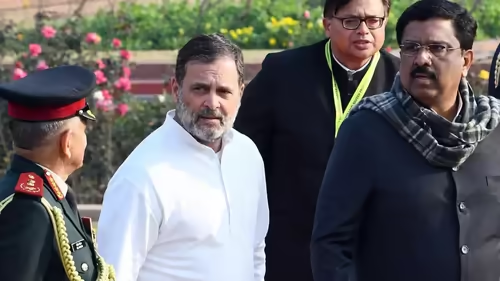
It’s just a piece of cotton, right? Not in Assam. In the northeastern state, the Gamosa is far more than a towel or a scarf—it’s a sacred symbol of respect, identity, and hospitality. So when reports surfaced that senior Congress leader Rahul Gandhi declined to wear one at a high-profile Republic Day reception in New Delhi, it didn’t just ruffle feathers; it sparked a full-blown political inferno [[1]].
The Bharatiya Janata Party (BJP) was quick to pounce, calling the alleged act “insensitive and insulting.” Assam Chief Minister Himanta Biswa Sarma demanded a public apology, framing the incident as a grave disrespect not just to him, but to the entire people of Assam [[2]]. The Congress, however, fired back with equal vigor, accusing the BJP of manufacturing a crisis and pointing to what they claim is a pattern of their own leaders being slighted at national events.
Table of Contents
- What is the Gamosa and Why Does it Matter?
- The Gamosa Controversy: How the Allegations Unfolded
- BJP’s Fury: An ‘Insult to Assam’
- Congress Counters: Playing Politics with Culture?
- Beyond the Headlines: The Politics of Symbolism
- Conclusion: A Cultural Gesture or a Political Weapon?
- Sources
What is the Gamosa and Why Does it Matter?
Before diving into the political mudslinging, it’s crucial to understand the profound cultural weight of the Gamosa. This white rectangular cloth with its distinctive red border is omnipresent in Assamese life [[4]].
It’s used to welcome guests, offered to elders as a mark of reverence, worn by Bihu dancers, and even used to cover altars in prayer. To be offered a Gamosa is to be honored. To refuse it, especially in a public setting, can be interpreted as a direct rejection of that honor and, by extension, the culture it represents. The Assam government itself has gone to great lengths to promote the Gamosa as a key part of the state’s heritage [[5]].
The Gamosa Controversy: How the Allegations Unfolded
The incident occurred during the annual President’s Reception held after the Republic Day parade in New Delhi. According to BJP sources, Assam CM Himanta Biswa Sarma personally approached Rahul Gandhi to present him with a Gamosa as a gesture of goodwill [[1]].
The explosive claim is that Gandhi not only refused to wear it but also made a dismissive comment. This account, however, is fiercely contested by the Congress party, which has not denied the interaction but has challenged the narrative of disrespect.
BJP’s Fury: An ‘Insult to Assam’
The BJP’s reaction was swift and severe. Chief Minister Sarma took to social media, stating, “It is insensitive and insulting… He should apologize to the people of Assam” [[2]]. The party framed the issue as a matter of regional pride, suggesting that Gandhi’s actions showed a deep-seated disregard for the culture and sentiments of the northeastern states—a region the BJP has worked hard to cultivate politically.
This narrative serves a dual purpose: it rallies the BJP’s base in Assam by portraying them as defenders of local culture, and it paints the Congress leadership as elitist and out of touch with India’s diverse traditions.
Congress Counters: Playing Politics with Culture?
The Congress party wasted no time in hitting back. Their primary counter-argument was one of selective outrage. They pointedly asked why Defence Minister Rajnath Singh, who was also at the same event, was not offered a Gamosa, implying that the gesture was politically targeted rather than a general cultural protocol [[3]].
Furthermore, the Congress highlighted alleged slights against their own leaders during the Republic Day parade itself. They claimed that their MPs were not given their due place in the official procession, suggesting a broader pattern of the ruling party’s disrespect towards the opposition [[3]]. In their view, the Gamosa controversy is nothing more than a cynical attempt by the BJP to distract from larger national issues and whip up regional sentiment for electoral gain.
Beyond the Headlines: The Politics of Symbolism
This entire episode is a masterclass in the politics of symbolism. In a country as vast and diverse as India, cultural gestures are powerful political tools. The BJP, under Prime Minister Modi, has expertly leveraged regional symbols—from Tamil Nadu’s Pongal to Punjab’s Lohri—to build a pan-Indian image that respects local identities while promoting a unified national narrative [[7]].
The Congress, struggling to find its footing, is now caught in a trap. If they apologize, they appear weak. If they double down, they risk alienating voters in the sensitive northeastern region. For more on how cultural narratives shape elections, see our deep dive on [INTERNAL_LINK:cultural-politics-in-india].
Conclusion: A Cultural Gesture or a Political Weapon?
At its heart, the Gamosa controversy is less about a piece of cloth and more about power, perception, and political strategy. While the cultural significance of the Gamosa is undeniable, its use in this instance feels undeniably weaponized. Both parties are using the incident to score points with their respective audiences, turning a moment of potential cultural exchange into a bitter partisan feud. As India moves closer to its next general election, expect more such symbolic battles to take center stage in the national discourse.
Sources
- [[1]] Times of India. “‘Insensitive and insulting’: BJP says Rahul Gandhi declined to wear Assamese Gamosa…”
- [[2]] The Hindu. “Himanta Biswa Sarma demands Rahul Gandhi’s apology over Gamosa issue.”
- [[3]] India Today. “Congress hits back at BJP over Gamosa row…”
- [[4]] Britannica. “Gamosa | Assamese Culture, Symbolism, & Significance.”
- [[5]] Government of Assam. “Know Your State: Gamosa.”
- [[7]] Carnegie Endowment for International Peace. “The BJP’s Cultural Nationalism…”