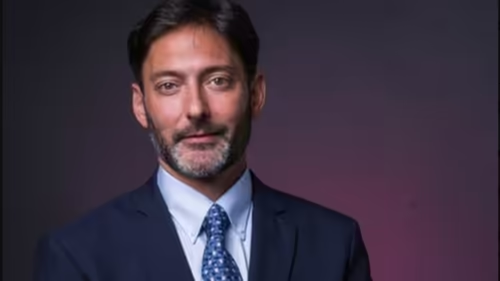
A high-stakes diplomatic agreement has ignited a firestorm on social media, and at its center is Dr. Francis Vijay Narasimhan Rangarajan, a top British civil servant of Indian origin. The source of the controversy? The landmark Chagos deal—a complex agreement between the UK and Mauritius that will see the sovereignty of the Chagos Archipelago finally transferred after decades of dispute [[1]].
Rangarajan, who led the negotiations for the UK government, has become the public face of a policy that many view as a necessary step towards historical justice, while others condemn as a dangerous concession that undermines national security and betrays the exiled Chagossian people. The backlash has been swift and severe, with critics demanding answers and accountability.
Table of Contents
- Who is Dr. Francis Vijay Narasimhan Rangarajan?
- The Chagos Deal: What Does the Agreement Actually Say?
- A History of Injustice: The Chagossian Exile
- Why the Backlash Against Rangarajan and the UK Government?
- The Path Forward for Chagossians and Diego Garcia
- Conclusion: A Complex Legacy in the Making
- Sources
Who is Dr. Francis Vijay Narasimhan Rangarajan?
Dr. Rangarajan is no ordinary bureaucrat. Born in Delhi, he was educated at the University of Cambridge, where he earned a master’s in mathematics and a PhD [[1]]. His distinguished career in the UK Foreign Office has seen him hold several key posts, including Director of Multilateral Policy and Europe Director [[3]]. He is currently the Chief Executive of the UK Electoral Commission [[2]]. His deep expertise in international law and diplomacy made him a natural choice to lead the sensitive Chagos negotiations, a role that has now thrust him into an unexpected and unwelcome spotlight.
The Chagos Deal: What Does the Agreement Actually Say?
The core of the Chagos deal, announced in October 2024 and formalized in May 2025, is a two-part arrangement designed to resolve a long-standing international legal and moral dispute [[14], [13]].
First, the United Kingdom will formally cede sovereignty of the entire Chagos Archipelago to Mauritius, a move that aligns with a series of rulings from the International Court of Justice and the UN General Assembly [[14]].
Second, to protect its strategic interests, the UK (on behalf of the US) has secured a 99-year lease for the critical military base on Diego Garcia [[12]]. The UK will pay Mauritius an average of £101 million per year for this lease [[13]]. This arrangement aims to maintain the vital Western military presence in the Indian Ocean while finally acknowledging Mauritius’s claim to its territory.
A History of Injustice: The Chagossian Exile
To understand the intensity of the current debate, one must look back to the 1960s and 70s. Between 1967 and 1973, the UK government, at the request of the United States, forcibly removed the entire indigenous population—the Chagossians—from their homeland [[18], [21]]. These people, descendants of African slaves and Indian indentured laborers, were deported to Mauritius and the Seychelles to make way for the construction of the Diego Garcia base [[19], [20]].
This act of mass displacement, widely condemned as a crime against humanity, created a stateless diaspora that has been fighting for their right to return for over 50 years. Their struggle is the painful backdrop against which the new Chagos deal is being judged.
Why the Backlash Against Rangarajan and the UK Government?
The criticism stems from multiple angles:
- Betrayal of the Chagossians: Many argue that the deal is a transaction between two governments that completely ignores the wishes and rights of the Chagossian people themselves. They fear that by handing sovereignty to Mauritius without ironclad guarantees for their return and resettlement, their dream of going home is being sacrificed once again [[1]].
- National Security Concerns: Critics, including some former politicians, believe that relinquishing sovereignty, even with a lease, weakens the UK’s and US’s long-term strategic position in the region. They worry about future political instability in Mauritius potentially jeopardizing access to the base [[11]].
- Scapegoating the Negotiator: As the lead negotiator, Dr. Rangarajan has become a convenient target for all this frustration. His Indian heritage has, unfortunately, been weaponized by some online, adding a layer of xenophobia to the political critique [[1]].
The Path Forward for Chagossians and Diego Garcia
The success of the Chagos deal hinges entirely on its implementation. The UK and Mauritius have pledged to work together on a framework for the potential resettlement of Chagossians on the islands, excluding Diego Garcia itself due to its military status [[17]]. This is a monumental task that involves addressing complex issues of infrastructure, sustainability, and compensation.
For the UK, the deal represents an attempt to shed a colonial legacy that has been a persistent source of international embarrassment. For Mauritius, it is the culmination of a decades-long campaign to reclaim its territory. And for the Chagossians, it is a moment of both hope and profound anxiety. Their future, and the true legacy of this agreement, remains unwritten.
For more on the geopolitical implications of such deals, see our analysis on [INTERNAL_LINK:post-colonial-diplomacy].
Conclusion: A Complex Legacy in the Making
Dr. Francis Vijay Narasimhan Rangarajan is now inextricably linked to one of the most significant acts of post-colonial diplomacy in recent British history. While the Chagos deal may resolve a major international dispute, it has opened a domestic and ethical can of worms. The fierce backlash is a reminder that historical injustices cast long shadows, and any solution that doesn’t center the voices of the most affected—the Chagossians—is destined to be met with skepticism and anger. The world will be watching to see if this agreement can finally deliver justice, or if it merely creates a new chapter in an old tragedy.
Sources
- [[1]] Times of India. “PIO civil servant gets flak on X for negotiating Chagos deal.”
- [[2]] Wikipedia. “Vijay Rangarajan.”
- [[3]] MercoPress. “New UK ambassador to Brazil…”
- [[11]] AA.com.tr. “Trump rips UK over Chagos Islands deal…”
- [[12]] Sky News. “What is in the Chagos Islands deal and why is it controversial?”
- [[13]] BBC News. “UK signs deal to hand over Chagos Islands…”
- [[14]] Taylor & Francis Online. “The change in sovereignty for the Chagos Archipelago…”
- [[17]] Mongabay. “A deal signals a new chapter for Chagossians…”
- [[18]] Britannica. “Chagos Archipelago | Geography, History, Map, & Facts.”
- [[19]] ResearchGate. “Imperial mobilities, errantry, and the displacement of the Chagos Islanders.”
- [[20]] UK Parliament. “BRIEFING: The Chagossians…”
- [[21]] Wikipedia. “Expulsion of the Chagossians.”