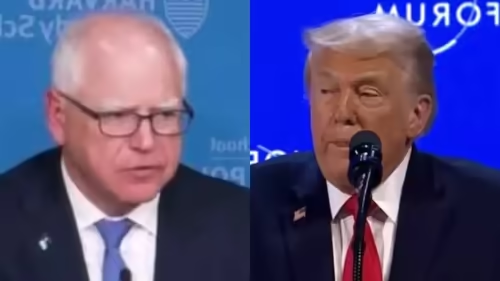
In a stunning turn of events that has left political analysts scrambling, President Donald Trump and Minnesota Governor Tim Walz have held what both sides described as a “productive” phone call. This unexpected dialogue comes on the heels of massive civil unrest and national outrage over the fatal shooting of Alex Pretti, a 37-year-old ICU nurse, by a U.S. Border Patrol agent in Minneapolis [[6]].
The incident, which marks the second time this month a U.S. citizen has been killed by federal forces in the state, has ignited fierce protests demanding the removal of federal immigration agents from Minnesota cities [[8]]. Now, with this high-stakes conversation, we may be witnessing a critical shift in the federal government’s hardline stance.
Table of Contents
- The Alex Pretti Incident: A Catalyst for Crisis
- From Confrontation to Cooperation: The Trump-Walz Call
- Why the Minnesota BCA Investigation is a Major Win
- What Does This Mean for Federal Presence in Minnesota?
- Conclusion: A Fragile Truce with High Stakes
- Sources
The Alex Pretti Incident: A Catalyst for Crisis
On January 24, 2026, the city of Minneapolis was once again thrust into the national spotlight under tragic circumstances. Alex Pretti, a dedicated healthcare worker, was shot and killed during an encounter with federal law enforcement officers who were conducting operations in the city [[6]].
Pretti’s death wasn’t just another statistic; it was a flashpoint. Coming so soon after another fatal shooting involving federal agents, it crystallized public fears about the unchecked power and presence of these forces in local communities. Governor Walz had been unequivocal in his response, publicly demanding that President Trump remove all federal immigration agents from the state [[3]]. The situation was a powder keg, threatening to explode into a full-blown constitutional crisis over states’ rights versus federal authority.
From Confrontation to Cooperation: The Trump-Walz Call
Against this backdrop of tension, the phone call between the Republican president and the Democratic governor was nothing short of remarkable. According to official statements, the conversation was direct and, surprisingly, yielded concrete results [[2]].
President Trump, known for his combative style, agreed to two key requests from Governor Walz:
- State-Led Investigation: Trump consented to allow the Minnesota Bureau of Criminal Apprehension (BCA) to take the lead in investigating the circumstances surrounding the Alex Pretti shooting.
- Review of Federal Agent Numbers: He also agreed to a review of the number of federal agents currently operating within Minnesota, a direct response to the governor’s demands to scale back their presence [[1]].
This move represents a significant de-escalation from the White House, which has typically doubled down on its enforcement policies in the face of criticism.
Why the Minnesota BCA Investigation is a Major Win
The concession to let the Minnesota BCA investigate is perhaps the most critical outcome of the call. Historically, incidents involving federal agents are investigated internally by their own agencies or by the Department of Justice, which can lead to perceptions of a lack of impartiality.
The Minnesota Bureau of Criminal Apprehension, however, is a highly respected state-level agency known for its forensic expertise and independent investigations, particularly in officer-involved shootings [[17]]. By handing the reins to the BCA, the federal government is acknowledging the need for transparency and public trust. This decision empowers a local entity to seek answers for a local community, a powerful symbolic and practical victory for Governor Walz and the protesters.
What Does This Mean for Federal Presence in Minnesota?
While the agreement to “review” the number of federal agents is vaguer, it’s still a notable crack in the administration’s previously unyielding position. It opens the door for a potential reduction in the visible and often aggressive tactics that have fueled the protests in the first place.
For residents of Minneapolis and other Minnesota cities, this could mean a return to a sense of normalcy, where local law enforcement—not federal troops—are the primary point of contact. However, it’s crucial to remain cautious. A “review” is not a promise of withdrawal. The ultimate decision will likely hinge on political calculations and the ongoing pressure from the public and state officials.
This development also sets a precedent. If a successful model of cooperation can be forged in Minnesota, it could become a blueprint for other states grappling with similar tensions between federal immigration enforcement and local governance—a topic we’ve explored in our guide on [INTERNAL_LINK:state-vs-federal-law].
Conclusion: A Fragile Truce with High Stakes
The “productive” call between Trump and Walz is a welcome sign of political pragmatism in a deeply polarized climate. For the family of Alex Pretti and the citizens of Minnesota, the state-led BCA investigation offers a real chance for accountability and justice. The review of federal agent numbers provides a glimmer of hope for de-escalation.
However, this truce is fragile. The true test will be in the follow-through. Will the BCA be given full, unfettered access to evidence and personnel? Will the “review” lead to tangible changes on the ground? The nation will be watching closely, as the outcome in Minnesota could reshape the relationship between federal power and state sovereignty for years to come.
Sources
- [[1]] Voto Latino. “Minnesota Governor Tim Walz addressed the killing of 37-year-old Alex Pretti…”
- [[2]] FOX 9. “Trump, Walz have ‘productive call’ over ICE operations in Minnesota.”
- [[3]] Al Jazeera. “Minnesota Gov Walz demands Trump remove border agents after Pretti killed.”
- [[6]] FOX 2 Detroit. “Minneapolis shooting: What we know about Alex Pretti…”
- [[8]] PBS NewsHour. “A second U.S. citizen was killed by federal forces in Minneapolis…”
- [[17]] Minnesota Department of Public Safety. “About BCA.”