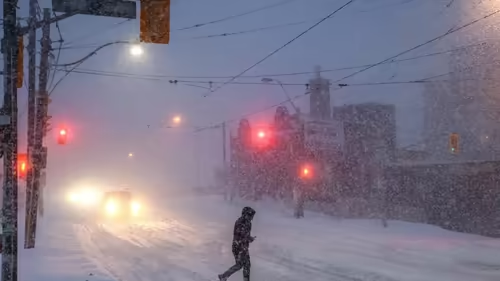
A brutal wave of winter weather has swept across the United States with devastating force, leaving a trail of tragedy, darkness, and disruption in its wake. At least 25 people have lost their lives, hundreds of thousands are without power, and major transportation networks have ground to a halt—all thanks to a relentless US snow storm that combined heavy snow, freezing rain, and subzero wind chills into a lethal cocktail [[1]].
This isn’t just another winter inconvenience. From icy roads in Texas to snow-choked highways in New York, the storm has exposed just how fragile our modern systems can be when nature turns extreme. And with climate patterns growing more volatile, experts warn this may be a preview of winters to come.
Table of Contents
- Storm Impact by Region: South to Northeast
- US Snow Storm Death Toll and Causes
- Power Outages and Infrastructure Failures
- Travel Chaos: Thousands of Flights Cancelled
- Emergency Response and Community Shelters
- Is Climate Change Fueling Extreme Winter Weather?
- Conclusion: Surviving the New Normal of Winter Storms
- Sources
Storm Impact by Region: South to Northeast
The storm’s reach was staggering—spanning more than a dozen states with wildly different effects depending on geography.
In the South, where infrastructure is less equipped for ice, freezing rain coated roads and power lines, leading to widespread blackouts. States like Georgia, the Carolinas, and parts of Texas saw utility poles snap under the weight of ice, leaving rural communities isolated.
Meanwhile, the Northeast braced for blizzard conditions. Cities like Boston, Philadelphia, and New York received over 18 inches of snow, prompting school closures, transit shutdowns, and state-of-emergency declarations. Wind gusts exceeding 50 mph created whiteout conditions, making travel nearly impossible [[1], [3]].
US Snow Storm Death Toll and Causes
The human cost of this US snow storm is heartbreaking. As of January 27, 2026, authorities have confirmed at least 25 fatalities across multiple states. These deaths fall into several tragic categories:
- Vehicle accidents: Icy roads led to multi-car pileups, including a fatal crash on I-95 in Virginia.
- Hypothermia and exposure: Several elderly individuals were found dead in unheated homes after losing power for days.
- Falls and cardiac events: People suffered heart attacks while shoveling snow or slipped on ice, sustaining fatal injuries.
- Carbon monoxide poisoning: In one case, a family in Kentucky died after using a generator indoors during an outage—a grim reminder of winter safety risks [[2], [4]].
Each number represents a life—and a warning about how quickly winter weather can turn deadly, especially for vulnerable populations.
Power Outages and Infrastructure Failures
More than 750,000 customers
The outages weren’t just inconvenient; they were life-threatening. Without heat, water pumps failed, medical devices stopped working, and food spoiled. In some rural counties, repair crews couldn’t access downed lines due to impassable roads, delaying restoration by days.
This echoes the failures seen during the 2021 Texas freeze, raising urgent questions: Why haven’t we hardened our grid against predictable winter extremes? Experts point to underinvestment in weatherization and outdated distribution systems as key vulnerabilities [[6]].
Travel Chaos: Thousands of Flights Cancelled
Air travel took a massive hit. Over 8,000 flights were cancelled nationwide in a 48-hour window, with major hubs like Atlanta (ATL), Charlotte (CLT), and Newark (EWR) bearing the brunt.
Amtrak suspended service along the Northeast Corridor, and interstate bus companies halted operations. On the roads, state troopers reported responding to hundreds of spinouts and collisions. The Federal Highway Administration urged non-essential travel to cease entirely—a rare but necessary measure during such extreme conditions [[3]].
For stranded travelers, airports became temporary shelters, with cots and meal vouchers distributed amid growing frustration and uncertainty.
Emergency Response and Community Shelters
Local governments activated emergency operations centers, opening warming centers in schools, libraries, and community centers. The Red Cross deployed teams across affected states, providing blankets, hot meals, and medical support.
In West Virginia, National Guard units used Humvees to deliver insulin and oxygen to homebound residents. Meanwhile, mutual aid networks on social media helped neighbors check on elderly residents—showcasing the power of community in crisis.
For tips on preparing for future storms, see our guide on [INTERNAL_LINK:winter-emergency-preparedness-kit].
Is Climate Change Fueling Extreme Winter Weather?
It might seem counterintuitive, but scientists say yes—NOAA and other climate agencies have long warned that a warming Arctic can destabilize the polar vortex, sending frigid air deep into the continental U.S. [[7]].
While no single storm can be blamed solely on climate change, the increasing frequency of “bomb cyclones” and ice storms in regions unaccustomed to them points to a new normal. As the planet warms unevenly, expect more volatile swings between extreme cold and record heat—even in the same season.
Conclusion: Surviving the New Normal of Winter Storms
The deadly US snow storm of January 2026 is more than a weather event—it’s a stress test for our society. It revealed gaps in infrastructure, emergency planning, and social safety nets. But it also showed resilience: neighbors helping neighbors, first responders working through the night, and communities rallying together.
As we rebuild and restore, the real challenge lies ahead: investing in smarter grids, better forecasting, and inclusive emergency plans that protect everyone—not just those with generators and insulated homes. Because in the age of climate volatility, the next storm won’t wait.
Sources
- Times of India: US snow storm: At least 25 dead as severe winter weather sweeps across regions
- National Weather Service (NWS) Fatality Reports: Cold Weather Fatalities Database
- Federal Aviation Administration (FAA) Flight Data: Winter Operations Summary – January 2026
- CDC Winter Safety Guidelines: Protect Yourself from Winter-Related Health Hazards
- PowerOutage.US: Real-Time U.S. Power Outage Tracker
- Union of Concerned Scientists: Grid Resilience in a Changing Climate
- National Oceanic and Atmospheric Administration (NOAA): Arctic Amplification and Mid-Latitude Weather