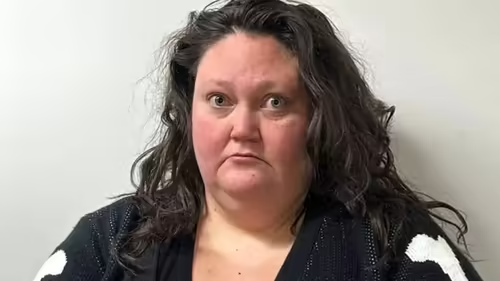
In a disturbing turn of events that underscores the volatile mix of social media and political extremism, federal authorities have arrested a West Virginia woman for allegedly trying to orchestrate an assassination attempt on former President Donald Trump. The suspect, identified as Morgan Morrow, reportedly used TikTok to solicit a sniper—an act that has now landed her in federal custody and sparked national concern over online radicalization [[1]].
This isn’t just another internet rant. According to law enforcement, Morrow’s actions crossed a clear legal line: she didn’t just express anger—she actively sought to recruit someone to carry out a violent attack. And she did it in plain sight, on one of the world’s most popular social platforms. This case raises urgent questions about digital accountability, the limits of free speech, and how law enforcement tracks—and stops—real-world threats born online.
Table of Contents
- Who Is Morgan Morrow?
- The TikTok Post That Triggered the Arrest
- Trump Assassination Plot: Federal Charges Explained
- How Social Media Fuels Political Extremism
- Secret Service Response and Threat Protocols
- Broader Implications for Online Speech and Safety
- Conclusion: A Warning from the Digital Frontlines
- Sources
Who Is Morgan Morrow?
Morgan Morrow, a resident of West Virginia, is now at the center of a high-profile federal investigation. While few personal details have been publicly released, court documents indicate she acted alone in her alleged recruitment effort—but intended to enlist others to execute the plan [[1]].
According to the U.S. Attorney’s Office for the Southern District of West Virginia, Morrow admitted to posting the incendiary message on TikTok. When questioned by authorities, she reportedly cited “personal reasons” for her animosity toward Trump, though she did not elaborate on what those reasons were [[3]].
Her arrest serves as a stark reminder that threats against former presidents are treated with the utmost seriousness—even years after they’ve left office.
The TikTok Post That Triggered the Arrest
The investigation began when federal agents discovered a TikTok video in which Morrow allegedly asked, “Does anyone know a good sniper?”—a post that was quickly flagged by users and escalated through platform moderation channels [[1]].
While the exact wording of the post hasn’t been fully disclosed in public filings, law enforcement confirmed it was specific enough to constitute a credible threat under federal law. Notably, Morrow didn’t just vent—she sought operational assistance, which transformed her post from protected speech into a potential criminal conspiracy.
TikTok, like other major platforms, has policies against inciting violence, and it cooperated with the FBI during the investigation. The company has since removed the content and suspended the account involved [[5]].
Trump Assassination Plot: Federal Charges Explained
Morrow faces serious federal charges, including:
- Threatening to kill or harm a former president (18 U.S.C. § 879)
- Solicitation to commit murder (18 U.S.C. § 373)
Under U.S. law, threatening a former president is a felony punishable by up to five years in prison. Solicitation to commit murder carries even harsher penalties—up to 20 years if the crime had been carried out [[4]].
What makes this case legally significant is the element of intent to recruit. As noted by legal experts, merely expressing hatred isn’t illegal—but actively seeking someone to commit violence crosses into criminal territory. This distinction is crucial in balancing First Amendment rights with public safety [[6]].
How Social Media Fuels Political Extremism
Morrow’s case is not isolated. In recent years, platforms like TikTok, Telegram, and even mainstream sites like Facebook have been used to spread extremist ideologies, coordinate protests, and—in rare but alarming cases—plan acts of violence.
Research from the Brookings Institution shows that algorithm-driven content can rapidly radicalize users by feeding them increasingly extreme material. What starts as political commentary can spiral into calls for action—especially among individuals already experiencing personal distress or ideological isolation [[7]].
This incident highlights why tech companies and law enforcement must work more closely together. Automated detection systems are improving, but human judgment—and swift legal intervention—remain essential.
Secret Service Response and Threat Protocols
The U.S. Secret Service, which protects former presidents for life, takes every threat seriously—no matter how it originates. Their Threat Assessment Division uses a multi-tiered system to evaluate credibility, immediacy, and capability.
In this case, the combination of a direct solicitation (“sniper”) and a named target (Trump) triggered an immediate response. Agents worked with local West Virginia police and the FBI to locate and apprehend Morrow within days of the post going viral [[2]].
For more on how threats are assessed, see our coverage on [INTERNAL_LINK:how-secret-service-handles-threats-against-former-presidents].
Broader Implications for Online Speech and Safety
This arrest reignites the debate: where should the line be drawn between free expression and dangerous incitement?
Civil liberties groups caution against overreach, while national security advocates argue that in the digital age, words can be weapons. The key, many experts say, lies in context and intent. A vague rant might be protected; a targeted recruitment call is not.
As platforms grow more powerful, so does their responsibility. Expect increased pressure on social media companies to implement real-time threat detection and faster reporting mechanisms to law enforcement—especially when public figures are involved.
Conclusion: A Warning from the Digital Frontlines
The arrest of Morgan Morrow in connection with a Trump assassination plot is more than a headline—it’s a wake-up call. It demonstrates how easily a moment of rage, amplified by social media, can escalate into a federal crime. While freedom of speech remains a cornerstone of American democracy, it does not shield those who seek to turn words into weapons. As we navigate an increasingly polarized digital landscape, vigilance—from both citizens and institutions—is not optional. It’s essential.
Sources
- Times of India: West Virginia woman arrested in alleged Trump assassination plot
- U.S. Department of Justice Press Release (Southern District of West Virginia): Woman Charged with Threats to Kill Former President
- FBI Statement on Social Media Threats: FBI Warns Against Online Threats to Public Officials
- Cornell Law School – 18 U.S. Code § 879: Threats against Former Presidents
- TikTok Transparency Report 2025: Content Moderation and Law Enforcement Cooperation
- ACLU on Free Speech vs. True Threats: When Does Speech Become a Crime?
- Brookings Institution: Social Media and the Rise of Political Violence