Introduction: A Party at a Crossroads
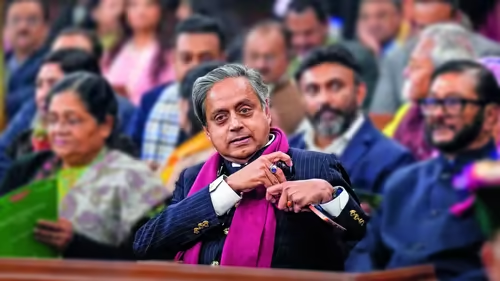
The calm before the storm is often the most telling. As the Indian National Congress gears up for the high-stakes 2026 Kerala state elections, a quiet but significant rift has emerged—one that could jeopardize its entire campaign. The absence of senior MP and intellectual heavyweight Shashi Tharoor from a pivotal election strategy meeting has sent shockwaves through the party’s corridors. Now, with whispers of discontent and personal grievances, Congress leadership is reportedly planning an urgent meeting with Tharoor to patch things up. For a party that desperately needs a united front in a state it hasn’t governed since 2011, this internal drama couldn’t come at a worse time. The central question on everyone’s mind: can the Kerala elections Congress alliance hold together?
Table of Contents
- The Missing Piece: Shashi Tharoor’s Absence
- Why Tharoor Matters in Kerala Politics
- Sources of Discontent: What Went Wrong?
- The Unity Mission: Congress Leadership’s Response
- Historical Context: Congress in Kerala – A Turbulent Ride
- Conclusion: Can Congress Pull Together in Time?
- Sources
The Missing Piece: Shashi Tharoor’s Absence
The recent all-important Congress strategy conclave for the upcoming Kerala elections Congress was meant to be a show of strength and cohesion. Instead, it became a glaring display of internal strain. Shashi Tharoor, the sitting MP from Thiruvananthapuram and a key figure in the party’s Kerala unit, was conspicuously absent. His office cited “personal reasons” for his non-attendance, but party insiders and political observers suggest a deeper issue: growing unhappiness with the party’s internal dynamics and decision-making processes [[1]]. This absence wasn’t just a scheduling conflict; it was a political signal that cannot be ignored.
Why Tharoor Matters in Kerala Politics
To understand the gravity of this situation, one must grasp Tharoor’s unique position in Kerala’s political landscape:
- Electoral Asset: Tharoor commands a loyal voter base in Thiruvananthapuram, a constituency he has won twice, defying anti-incumbency trends.
- National Profile: His international reputation as a former UN diplomat and author gives the Congress a credibility boost beyond state borders.
- Youth Appeal: He is one of the few Congress leaders who resonates strongly with younger, urban, and educated voters—a demographic the party struggles to retain.
- Ideological Anchor: In a party often accused of lacking a clear narrative, Tharoor provides a coherent, progressive voice.
Losing his active support or, worse, facing public dissent from him, would be a massive blow to the Congress’s already uphill battle against the ruling LDF and the surging BJP.
Sources of Discontent: What Went Wrong?
While Tharoor has not publicly aired his grievances, multiple reports point to a combination of factors fueling his frustration:
- Lack of Consultation: Feeling sidelined in key decisions regarding Kerala’s election strategy and candidate selection.
- Internal Rivalries: Long-standing tensions with other powerful factions within the Kerala Pradesh Congress Committee (KPCC).
- Strategic Differences: Potential disagreements over the party’s alliance choices and campaign messaging.
- Personal Ambition: Unfulfilled expectations regarding his role in shaping the party’s future in the state.
This cocktail of professional and personal dissatisfaction has created a volatile situation that the national leadership can no longer afford to ignore.
The Unity Mission: Congress Leadership’s Response
In damage control mode, senior Congress leaders are now reportedly preparing to meet Shashi Tharoor in the coming days. The goal is clear: to listen to his concerns, address his issues, and bring him back into the fold as a committed and enthusiastic campaigner. This isn’t just about appeasing one leader; it’s about sending a message to the entire party rank-and-file that unity is non-negotiable. The success of this “Unity Mission” will be a critical test of the leadership’s ability to manage internal dissent and project a cohesive image ahead of the polls [[2]].
Historical Context: Congress in Kerala – A Turbulent Ride
The Congress’s struggle in Kerala is not new. Despite being a founding member of the United Democratic Front (UDF), the party has faced consistent challenges:
- It last formed the government in 2011 under Oommen Chandy.
- Since then, the UDF has lost two consecutive assembly elections to the LDF.
- Internal factionalism, particularly between the ‘A’ and ‘I’ groups, has long plagued the KPCC, weakening its electoral machinery [[3]].
The current Tharoor episode is merely the latest manifestation of these deep-seated structural issues. For more on the history of coalition politics in the state, see our analysis on [INTERNAL_LINK:kerala_political_alliances].
Conclusion: Can Congress Pull Together in Time?
The upcoming meeting between Congress leadership and Shashi Tharoor is more than a private chat—it’s a pivotal moment for the party’s future in Kerala. The Kerala elections Congress strategy hinges on presenting a united, energetic, and credible alternative to the incumbent LDF. If Tharoor’s concerns are genuinely addressed and he returns as a full-throated supporter, it could energize the base and attract undecided voters. But if the talks fail or result in only a superficial truce, the party risks entering the 2026 elections with a visible crack in its foundation. In the high-stakes game of Kerala politics, unity isn’t just a virtue—it’s a necessity for survival.
Sources
- Times of India: Congress brass may meet Shashi Tharoor to settle issues
- The Hindu: Congress in Kerala faces internal challenges ahead of 2026 polls
- Election Commission of India: Past Election Results – Kerala