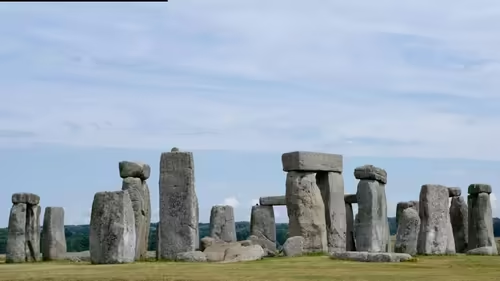
Introduction: The Enduring Enigma of Stonehenge
For over 4,500 years, the towering stones of Stonehenge have stood as silent sentinels on Salisbury Plain, guarding one of humanity’s greatest architectural secrets. How did Neolithic builders—without wheels, metal tools, or beasts of burden—manage to haul 25-tonne sarsen blocks from distant quarries and erect them with such precision? This question has fueled countless theories, from alien intervention to lost super-civilizations. But now, a landmark scientific study is offering the most compelling answer yet: the Stonehenge mystery solved through meticulous geology, archaeology, and digital mapping.
Table of Contents
- The Breakthrough: New Evidence from the Field
- Where Did the Stones Really Come From?
- The Proposed Route: How 25-Tonne Stones Were Moved
- Neolithic Engineering: Smarter Than We Thought
- Why This Changes Our Understanding of Ancient Britain
- Conclusion: A Milestone in Archaeological Science
- Sources
The Breakthrough: New Evidence from the Field
The latest research, led by a team of scientists from the University of Brighton and other UK institutions, combines geochemical fingerprinting with landscape archaeology to trace the exact source of Stonehenge’s giant sarsen stones. By analyzing a returned core sample—originally drilled during 1950s restoration work and only recently recovered—the team matched the chemical composition of the monument’s stones to a specific outcrop just 25 kilometers (about 15 miles) away near Marlborough, Wiltshire [[1]]. This discovery is pivotal because it confirms a local—but still impressively distant—origin for the megaliths, ruling out far-flung theories involving Wales or Scotland for the sarsens.
Where Did the Stones Really Come From?
It’s important to distinguish between two types of stone at Stonehenge:
- Bluestones: Smaller stones (2–5 tonnes) from the Preseli Hills in Wales—over 200 km away. Their transport method remains debated but may have involved human effort or glacial movement.
- Sarsen stones: The massive uprights and lintels forming the iconic trilithons, each weighing up to 25 tonnes. These are the focus of the new study.
The sarsens, researchers now confirm, came from West Woods in the Marlborough Downs—a site rich in high-quality silcrete rock that matches Stonehenge’s geochemistry almost perfectly [[2]]. This area was likely a known quarry for Neolithic communities, used not just for Stonehenge but for other monuments across southern England.
The Proposed Route: How 25-Tonne Stones Were Moved
Knowing the origin is only half the puzzle. The real marvel is how they got the stones to the site. The study proposes a plausible overland route stretching approximately 25 km from West Woods to Salisbury Plain. This path follows natural ridgelines and avoids steep valleys or dense forests, making it feasible for large groups of people using simple technology.
Archaeologists believe the builders used a combination of techniques:
- Log rollers: Wooden logs placed beneath the stone to reduce friction.
- Sledges or timber cradles: The stone would be secured on a wooden frame pulled by ropes.
- Human power: Estimates suggest 150–200 people could move a single 25-tonne block at a slow but steady pace—roughly 1–2 km per day [[3]].
This method, while labor-intensive, aligns with evidence from other Neolithic sites and experimental archaeology projects that have successfully replicated such feats.
Neolithic Engineering: Smarter Than We Thought
This discovery underscores a crucial truth: Neolithic people were not primitive. They possessed sophisticated knowledge of their environment, logistics, and social organization. Moving a 25-tonne stone required planning, coordination, and communal effort—hallmarks of a complex society. The fact that they selected stones from a specific geological source shows intentionality and technical discernment. Far from being mystical or supernatural, the construction of Stonehenge was a triumph of human ingenuity and cooperation—a testament to what organized communities can achieve long before the invention of writing or the wheel.
Why This Changes Our Understanding of Ancient Britain
The implications go beyond just solving a logistical puzzle. Pinpointing the sarsen source allows archaeologists to investigate the quarry site itself for tool marks, campsites, or ritual deposits—clues that could reveal more about the builders’ lives and beliefs. It also suggests that the Marlborough Downs were a cultural and ceremonial hub during the Neolithic period, possibly even more significant than previously assumed. Furthermore, this finding strengthens the argument that Stonehenge was part of a much larger sacred landscape, connected by processional routes and shared cosmological ideas [[4]].
Conclusion: A Milestone in Archaeological Science
While mysteries still linger—such as the precise purpose of Stonehenge or the full story behind the bluestones—the question of how the massive sarsen stones arrived may finally have a scientifically grounded answer. The Stonehenge mystery solved narrative isn’t about a single “eureka” moment, but the culmination of decades of interdisciplinary research. This breakthrough reminds us that ancient peoples were capable of extraordinary feats through collaboration and deep environmental knowledge. For anyone visiting the site today, the stones are no longer just relics of the unknown—they’re monuments to human resilience and collective will. To explore more about ancient wonders, check out our feature on [INTERNAL_LINK:megalithic_sites_europe].
Sources
- Times of India: Stonehenge mystery solved? Study reveals how 25-tonne stones reached the site
- Nature Scientific Reports: Origins of the sarsen megaliths at Stonehenge
- English Heritage: Stonehenge History and Stories
- University of Brighton: Stones at Stonehenge came from just 15 miles away