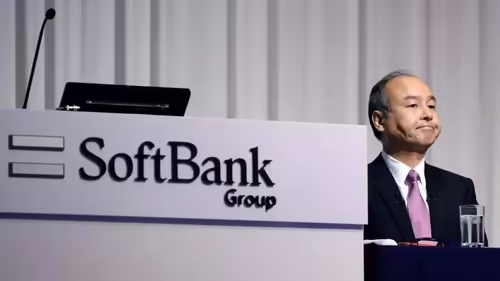
Just when the tech world was bracing for one of the largest acquisitions of the decade, a stunning reversal has sent shockwaves through the AI and data center industries. Masayoshi Son, the visionary and often volatile CEO of SoftBank Group, has reportedly pulled the plug on his audacious $50 billion plan to acquire U.S. data center firm Switch Inc. [[1]]. This decision, coming after months of dedicated pursuit, marks a critical juncture for SoftBank’s colossal Stargate AI infrastructure project, a venture designed to be the backbone for OpenAI’s next generation of artificial intelligence.
Table of Contents
- The $50 Billion Dream: Why Son Wanted Switch
- The Sudden Halt: What Went Wrong with the Masayoshi Son Switch Deal?
- Stargate AI Project: Is SoftBank’s AI Vision in Jeopardy?
- Who is Switch Inc.? The Data Center Giant at the Center of It All
- What’s Next for SoftBank? A Strategic Pivot, Not a Retreat
- Conclusion: The Evolving Landscape of AI Infrastructure
- Sources
The $50 Billion Dream: Why Son Wanted Switch
Masayoshi Son’s interest in Switch Inc. wasn’t a casual flirtation; it was a core strategic play for his AI-centric future. For months, Son was convinced that direct control over Switch’s network of energy-efficient, high-capacity data centers was essential [[3]]. His grand vision, the Stargate AI project—a $500 billion initiative backed by SoftBank, OpenAI, and Oracle—requires an unprecedented scale of computing power and physical infrastructure [[11]]. Acquiring Switch would have given SoftBank immediate, massive capacity to fuel this ambition, particularly to support OpenAI’s voracious need for computational resources [[17]].
The Sudden Halt: What Went Wrong with the Masayoshi Son Switch Deal?
So why did the Masayoshi Son Switch deal collapse? While the exact reasons remain private, several factors likely contributed to this dramatic shift. The sheer size of the $50 billion price tag, which included debt, may have become a significant financial burden in an increasingly cautious market [[6]]. Concerns over integration, regulatory hurdles, or even a reassessment of the Stargate project’s immediate needs could have played a role [[7]]. The owners of Switch were reportedly holding firm on their valuation, which may have ultimately been a bridge too far for SoftBank’s current risk appetite [[6]].
Stargate AI Project: Is SoftBank’s AI Vision in Jeopardy?
The immediate reaction might be to assume that the Stargate project is now in trouble. However, the reality appears more nuanced. While a full takeover of Switch is off the table, reports indicate that discussions for a partial investment or a strategic partnership are still very much alive [[1]]. This suggests a tactical adjustment rather than a complete abandonment of the goal. SoftBank can still secure the necessary data center capacity through other means, such as its existing partnership with Oracle, which has already announced five new U.S. AI data center sites under the Stargate umbrella [[15]].
Who is Switch Inc.? The Data Center Giant at the Center of It All
To understand the magnitude of this missed opportunity, it’s crucial to know the target. Switch Inc., headquartered in Las Vegas, Nevada, is a leader in designing and operating advanced, exascale data center ecosystems known as SUPERNAP facilities [[21]]. As a subsidiary of DigitalBridge Group, Switch provides colocation, connectivity, and cloud computing solutions to a wide range of clients, making it a highly attractive asset in the AI gold rush [[19]]. Its reputation for energy efficiency and cutting-edge design was precisely what made it so appealing to Son’s vision [[3]].
What’s Next for SoftBank? A Strategic Pivot, Not a Retreat
This move should be seen as Masayoshi Son doubling down on AI, but with a more flexible and potentially less capital-intensive approach. Instead of betting the farm on a single, massive acquisition, SoftBank is likely to pursue a diversified strategy. This could include:
- Strategic Partnerships: Deepening ties with existing partners like Oracle and potentially forming new alliances with other data center operators.
- Targeted Investments: Making smaller, more agile investments in multiple data center projects or startups to build out its AI infrastructure portfolio.
- Global Expansion: Focusing on international Stargate sites, such as the potential UK location that has been under consideration [[13]].
This approach mitigates risk while still allowing SoftBank to capture a significant share of the exploding AI infrastructure market.
Conclusion: The Evolving Landscape of AI Infrastructure
The collapse of the Masayoshi Son Switch deal is a powerful reminder of the high-stakes, fast-moving nature of the AI race. While the dream of a single, monolithic acquisition has faded, SoftBank’s commitment to building the foundational infrastructure for the AI future remains unwavering. The Stargate project is far from dead; it’s simply evolving. For investors and industry watchers, this pivot signals a more pragmatic, albeit no less ambitious, path forward for one of the world’s most influential tech conglomerates. To stay ahead of the curve on global AI trends, explore our deep dive on [INTERNAL_LINK:global-ai-investment-trends]. You can also learn more about the official Stargate project from its co-founders on the [OpenAI website][[12]].
Sources
- Times of India: Japan’s second-richest man drops $50 billion plan to buy US company
- Bloomberg: SoftBank Halts Talks to Buy Data Center Firm Switch
- Finviz: SoftBank’s $50 Billion Data Center Bid To Power OpenAI Falls Apart
- SoftBank Group Corp.: Announcing The Stargate Project
- OpenAI: Announcing The Stargate Project
- Wikipedia: Switch (company)
- Data Center Dynamics: SoftBank ends talks over $50bn purchase of data center firm Switch