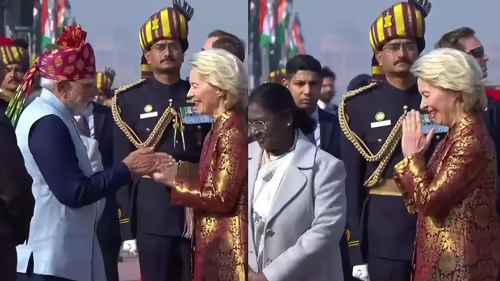
It’s official. The long, winding road of diplomacy has finally reached its destination. On Tuesday, January 27, 2026, India and the European Union announced the successful conclusion of their India-EU FTA, a landmark agreement that has been in the works for a staggering 18 years [[1]]. Dubbed by some as the “mother of all trade deals,” this pact is poised to send shockwaves through global markets, opening up new avenues for businesses and consumers alike [[8]]. But after nearly two decades of starts, stops, and complex negotiations, what’s actually in this deal, and who stands to win?
Table of Contents
- What is the India-EU FTA?
- A Journey of 18 Years: Why Did It Take So Long?
- Key Sectors and Tariff Concessions: Who Wins?
- The Strategic Impact: Beyond Just Trade
- What Comes Next? Implementation Timeline
- Conclusion: A New Chapter in Global Trade
- Sources
What is the India-EU FTA?
The India-EU Free Trade Agreement (FTA) is a comprehensive pact designed to eliminate or significantly reduce tariffs on a vast majority of goods traded between the two economic powerhouses. It goes beyond simple trade in goods, also covering areas like services, investment, intellectual property, and even a mobility chapter for professionals [[4]]. The core objective is to create a more predictable and stable business environment, fostering deeper economic integration and mutual growth.
A Journey of 18 Years: Why Did It Take So Long?
The story of this deal is one of persistence. Formal negotiations began way back in 2007, only to stall in 2013 due to significant gaps on key issues like market access for automobiles, wines, and geographical indications (GIs) [[16]]. The talks were revived in 2022 with renewed political will from both sides, recognizing the strategic importance of a strong partnership in an increasingly fragmented world. The final stretch involved painstakingly detailed negotiations to balance the interests of diverse industries across 27 EU member states and a rapidly growing Indian economy.
Key Sectors and Tariff Concessions: Who Wins?
This deal is built on a foundation of mutual concession. Here’s a breakdown of the key winners and the compromises made:
Indian Exports Set for a Boost
Indian labour-intensive industries are expected to be major beneficiaries. The EU has agreed to provide significant duty-free or low-duty access for a wide range of products, including:
- Textiles and Footwear: A massive win for India’s manufacturing sector, which has long sought better access to the lucrative European market [[13]].
- Leather Goods: Another key export category that will see reduced barriers [[9]].
- Marine Products and Toys: These sectors are also eyeing substantial tariff elimination [[9]].
EU Gains in Key Markets
In return, India has made notable concessions in sectors that have historically been protected by high tariffs:
- Automobiles: India is set to slash its import duty on cars from the EU from a peak of 110% down to 40%, a significant opening of its market [[12]].
- Wines and Spirits: The EU’s famed wine industry will gain much better access to Indian consumers, with India offering quota-based tariff concessions similar to its recent UK deal [[7]].
It’s worth noting that sensitive agricultural products like dairy and certain fruits may still face some protections, reflecting the need to safeguard domestic producers [[14]].
The Strategic Impact: Beyond Just Trade
This agreement is far more than just a commercial contract. It’s a powerful geopolitical signal. In a world where supply chains are being reconfigured, the India-EU FTA cements a strategic partnership between the world’s largest democracy and a major Western bloc. This move is seen as a counterbalance to other global economic forces and strengthens their collective voice on issues like climate change and digital governance. The deal also includes a Security and Defence Partnership, signed on the same day, highlighting the depth of this new relationship [[3]].
What Comes Next? Implementation Timeline
While the political agreement is a monumental step, the work isn’t over. The text now enters a “legal scrubbing” phase, where lawyers from both sides will meticulously review every word to ensure clarity and legal robustness. This process is expected to continue through the spring of 2026, with a formal signing ceremony anticipated before India’s fiscal year-end on March 31, 2026 [[4]]. Full implementation of the agreement is projected for early 2027, giving businesses time to adapt to the new rules of the road.
Conclusion: A New Chapter in Global Trade
The finalization of the India-EU FTA marks the end of an 18-year odyssey and the beginning of a transformative era for trade between these two giants. By slashing tariffs and creating a more stable business environment, the deal promises to unlock billions in new trade and investment. For businesses in sectors like textiles, leather, autos, and wine, the opportunities are immense. While challenges in implementation remain, this agreement stands as a testament to what can be achieved through sustained diplomatic engagement and a shared vision for a more connected global economy. Keep an eye on [INTERNAL_LINK:global-trade-news] for ongoing updates on how this deal unfolds.
Sources
- [[1]] The Statesman: “The official announcement of the long-awaited free trade agreement between India and the European Union will be made on Tuesday, 27 January 2026”
- [[3]] News On AIR: “India & EU conclude official-level negotiations for proposed FTA; India-EU Security & Defence Partnership to be signed today.”
- [[4]] VisaHQ: “Legal scrubbing will continue through the spring, with formal signing expected before India’s fiscal year-end (31 March 2026).”
- [[7]] Daily Pioneer: “Duty cuts on textiles, cars, wines likely in India-EU FTA”
- [[8]] Times of India: “India-EU ‘mother of all trade deals’ draws US ire”
- [[9]] Times of India: “Key sectors eye zero-duty EU access”
- [[12]] RTE: “India to cut tariffs on cars to 40% in EU trade deal”
- [[13]] Mint: “India-EU trade deal to cut import duties on textiles, footwear, cars, wines and more”
- [[14]] Dairy Dimension: “India–EU FTA may allow duty-free access for 90% of Indian goods while safeguarding sensitive sectors like dairy”
- [[16]] NDTV: “From Defence To Worker Mobility, India-EU Free Trade Deal To Create History”