Let’s be honest: city driving in India is a special kind of hell. Stop-and-go traffic, unpredictable auto-rickshaws, and the constant dance of the clutch pedal can turn your daily commute into a workout for your left leg. If you’ve ever found yourself dreaming of a car that just… drives itself, you’re not alone. This is where automatic cars and their budget-friendly cousins, AMTs (Automated Manual Transmissions), come in.
But with so much conflicting advice online, how do you know which is the right choice for you? Is an AMT just a cheap knock-off of a ‘real’ automatic, or is it the smart, efficient solution for the modern Indian driver? Let’s cut through the noise and get to the heart of the matter.
Table of Contents
- What Are Automatic Cars and AMTs?
- Why Automatic Cars Are a Game-Changer for City Driving
- The Rise of AMTs: The Best of Both Worlds?
- Automatic vs. AMT: A Detailed Comparison
- The Verdict: Which Should You Buy?
- Sources
What Are Automatic Cars and AMTs?
First, let’s clear up the confusion. The term “automatic cars” is often used as a broad umbrella, but it actually covers several different technologies:
- Traditional Automatic (AT): Uses a torque converter and a complex hydraulic system to change gears seamlessly. It’s smooth, refined, and requires zero input from the driver beyond the accelerator and brake.
- Continuously Variable Transmission (CVT): Uses a belt and pulley system to provide an infinite number of gear ratios, resulting in incredibly smooth acceleration and excellent fuel efficiency.
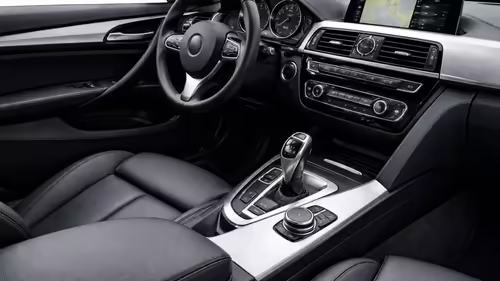
- Automated Manual Transmission (AMT): This is essentially a manual gearbox with a robot doing the clutch and gear-shifting work for you. You’ll find buttons or paddles on the steering wheel or gear lever to shift manually if you wish [[3]].
So, while all AMTs are a type of automatic, not all automatics are AMTs. Understanding this distinction is key to making the right decision.
Why Automatic Cars Are a Game-Changer for City Driving
If your life is a series of traffic jams, a traditional automatic or CVT is your new best friend. Here’s why:
- Zero Clutch Fatigue: Your left leg will thank you. No more riding the clutch on inclines or in bumper-to-bumper traffic [[16]].
- Reduced Stress: You can focus entirely on the road and the chaotic environment around you, rather than managing your gear stick. This leads to a calmer, safer driving experience [[12]].
- Smooth Operation: Modern automatics, especially CVTs, offer buttery-smooth acceleration without any jerks or lurches, making for a far more comfortable ride [[11]].
For many city dwellers, the sheer convenience and reduction in daily driving stress make the higher price tag of a full automatic worth every rupee.
The Rise of AMTs: The Best of Both Worlds?
Enter the AMT. Born out of the need to offer automatic convenience at a manual-car price point, AMTs have become wildly popular in the Indian market, especially in budget hatchbacks and compact SUVs [[4]]. They promise the core benefit of an automatic—no clutch pedal—while retaining the mechanical simplicity and fuel efficiency of a manual gearbox [[20]].
Manufacturers like Maruti Suzuki have championed this technology, making automatic-like driving accessible to a much wider audience. An AMT car typically costs only a fraction more than its manual counterpart, whereas a traditional automatic can add a significant Rs 1-2 lakhs to the price [[1]].
Automatic vs. AMT: A Detailed Comparison
Now, let’s get down to brass tacks. How do they really stack up against each other?
| Feature | Traditional Automatic / CVT | AMT |
|---|---|---|
| Driving Smoothness | Very smooth, seamless gear changes. | Can feel jerky or hesitant, especially at low speeds. The robot isn’t as skilled as a human driver [[2]]. |
| Fuel Efficiency | Generally offers fuel efficiency very close to, and sometimes even better than, a manual transmission because it’s based on the same mechanical layout [[27]]. | |
| Cost | Significantly more expensive upfront (Rs 1-2 lakhs+ premium) [[1]]. | Much more affordable, with a small premium over the manual version. |
| City Driving Comfort | The gold standard for relaxed, effortless driving in traffic [[15]]. | Eliminates the clutch, which is a huge plus, but the jerky shifts can be annoying in slow-moving traffic. |
The Verdict: Which Should You Buy?
There’s no one-size-fits-all answer, but here’s a simple guide:
- Choose a Traditional Automatic or CVT if: Your budget allows for it, and your top priority is a smooth, relaxed, and completely stress-free driving experience, especially in heavy city traffic. You value refinement over everything else.
- Choose an AMT if: You’re on a tighter budget but desperately want to ditch the clutch. You’re willing to trade a bit of smoothness for significant cost savings and excellent fuel efficiency. It’s the pragmatic, value-for-money choice for millions of Indian drivers [[3]].
Ultimately, both automatic cars and AMTs represent a massive leap forward in driving comfort for urban India. The choice isn’t about which is objectively “better,” but which is better for your specific needs, budget, and tolerance for a little mechanical quirkiness. Whichever you choose, your left leg will be forever grateful.
Sources
- [[1]] Garware Hi-Tech Films. (2025). Manual vs Automatic Car: Which One Should You Buy in India?
- [[2]] Shriram General Insurance. (2025). Automatic vs Manual: Best Car Transmission for India.
- [[3]] Hizuno. (2025). Understanding AMT cars in India.
- [[4]] Fourwheelz. (2025). AMT vs CVT: Which Automatic Transmission is Right for You?
- [[11]] Maruti Suzuki Arena. (2025). What are the benefits of Automatic Transmission?
- [[12]] Volvo Baar. (2025). The advantages and disadvantages of an automatic car.
- [[15]] ATC Auto Center. (2025). The Pros and Cons of Automatic Transmissions.
- [[16]] Windsor Motor Group. (2025). Why Go Automatic?
- [[20]] Gartz Lube. (2025). Automated Manual Transmission (AMT) And Its Difference from Automatic Transmission (AT).
- [[27]] Oreate AI. (2025). Understanding Automated Manual Transmission: The Best of Both Worlds.