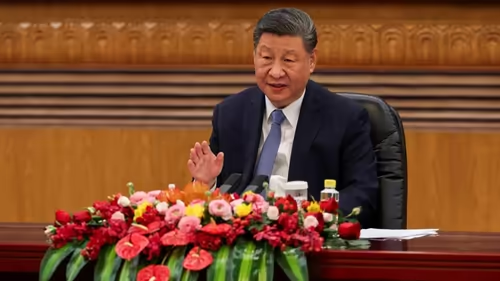
On a day when India celebrates its democratic spirit and constitutional values, a message from Beijing offered a surprisingly warm note of optimism. Chinese President Xi Jinping, in his congratulatory message to President Droupadi Murmu on India’s 77th Republic Day, didn’t just offer standard diplomatic pleasantries. He invoked a powerful and now-familiar metaphor: the “dragon and elephant dance together.”
This poetic imagery, while beautiful, carries immense weight in the context of one of the world’s most complex and volatile bilateral relationships. After years of border standoffs, economic decoupling, and deep-seated mistrust, is this a genuine signal of a new chapter in India-China relations, or merely a carefully crafted piece of political theater?
Table of Contents
- The Message and Its Meaning
- History of the “Dragon and Elephant” Metaphor
- Current State of India-China Relations
- Why This Timing Matters
- Challenges Ahead for a Genuine Reset
- Conclusion: Is the Dance On?
- Sources
The Message and Its Meaning
President Xi’s message was more than just a greeting; it was a strategic communication. He described China and India as “good neighbours, friends and partners,” a phrase that stands in stark contrast to the tense rhetoric of recent years [[6]]. The core of his message centered on the idea that the two Asian giants, represented by the dragon and the elephant, can and should “dance together” in a harmonious partnership [[1]].
This isn’t just about friendship; it’s a call for cooperation on the global stage. In an increasingly multipolar world, both nations have a vested interest in shaping a new international order. By framing their relationship as a collaborative dance, Xi is suggesting that their combined influence can be a force for stability and mutual benefit, rather than a source of conflict.
History of the “Dragon and Elephant” Metaphor
The “dragon and elephant” metaphor isn’t new, but its repeated use by President Xi signals its importance in his vision for bilateral ties. He first popularized this imagery to describe the potential for a harmonious and powerful partnership between the two ancient civilizations [[21]]. The dragon, a symbol of China’s strength and ambition, and the elephant, representing India’s wisdom and resilience, are not meant to clash but to move in a coordinated, powerful tango [[25]].
For a long time, this metaphor felt aspirational, even ironic, given the reality on the ground. However, its re-emergence in such a high-profile message on a significant Indian national day suggests that Beijing is serious about pushing this narrative into the realm of policy.
Current State of India-China Relations
To understand the significance of Xi’s message, we must look at the current state of play. After the deadly Galwan Valley clash in 2020, India-China relations plummeted to a historic low. The border remained a major flashpoint, trade was scrutinized, and strategic distrust was at an all-time high.
However, since 2023, a slow and cautious process of re-engagement has been underway. Multiple rounds of military commander-level talks have led to disengagement at several friction points along the Line of Actual Control (LAC) [[15]]. While a complete resolution is far off, the de-escalation has created a more stable environment for dialogue.
Experts describe the current phase as one of “cautious and fragile re-engagement” [[9]]. Both sides are testing the waters, balancing a desire for stability with a deep-seated wariness of the other’s intentions. Xi’s Republic Day message appears to be a public affirmation of this tentative thaw, aimed at building momentum for further dialogue.
Why This Timing Matters
The timing of this message is crucial for several reasons:
- Domestic Audiences: In India, the message comes at a time of strong nationalist sentiment. A conciliatory gesture from China can be used by the Indian government to show its diplomatic success in managing a difficult neighbor.
- Global Stage: With India playing a key role in forums like the G20 and set to host BRICS events in 2026, a stable relationship with China is geopolitically advantageous for both [[13]]. It projects an image of responsible regional leadership.
- US-China Rivalry: As the US-China strategic competition intensifies, Beijing may see value in preventing a full-fledged alliance between Washington and New Delhi. A friendly overture to India serves to complicate that dynamic [[11]].
Challenges Ahead for a Genuine Reset
Despite the hopeful rhetoric, the path to a genuine reset in India-China relations is fraught with challenges. Trust, once broken, is incredibly hard to rebuild. Key issues remain unresolved:
- The Border Dispute: The core issue of the LAC remains unsettled. Any future flare-up could instantly derail the current positive momentum.
- Trade Imbalance: India’s massive trade deficit with China is a persistent source of economic concern and political friction.
- Strategic Distrust: India’s growing closeness with the US, Japan, and Australia through the Quad is viewed with deep suspicion in Beijing, while China’s infrastructure projects in Pakistan and its presence in the Indian Ocean are major security concerns for New Delhi.
As one analysis notes, India is currently “balancing diplomacy and vigilance with China,” a clear sign that New Delhi is not taking Beijing’s friendly words at face value [[10]].
Conclusion: Is the Dance On?
President Xi Jinping’s Republic Day message is a significant and welcome development. It moves beyond mere protocol and offers a clear, positive vision for the future of India-China relations. The “dragon and elephant dance” is a compelling metaphor for what is possible.
However, for this dance to become a reality, it will require more than just elegant words. It demands concrete actions, sustained dialogue, and a genuine willingness from both sides to address the deep-rooted issues that have plagued their relationship for decades. The music has started, but whether the two giants can find a rhythm that leads to lasting harmony remains the central question for Asia and the world.
Sources
- [[1]] Asianews Network. (2026, January 27). ‘Dragon and Elephant can dance together’: President Xi Jinping calls for India-China partnership in Republic Day message.
- [[6]] Al Jazeera. (2026, January 26). President Xi says India, China ‘friends, partners’ in Republic Day message.
- [[9]] ISEAS Perspective. (2026). Between Rivalry and Rapprochement: The Trials and Trajectory of India-China Relations.
- [[10]] Think China. (2026). As India heads into 2026, it balances diplomacy and vigilance with China.
- [[11]] China Global South. (2026). In 2026 China–India Ties Will Primarily Be Shaped at Home, Not by the U.S.
- [[13]] Ministry of Foreign Affairs of the PRC. (2025, August 19). List of Outcomes of the Meeting between the Foreign Ministers of China and India.
- [[15]] Vajiram and Ravi. (2025, December 23). India China Relations, History, Timeline, UPSC Notes.
- [[21]] NDTV. (2025, September 5). Xi Coined “Elephant-Dragon” For India-China Ties, “Bear” for Russia.
- [[25]] CGTN. (2025, April 3). Why realizing Dragon-Elephant Tango is right choice for China-India.