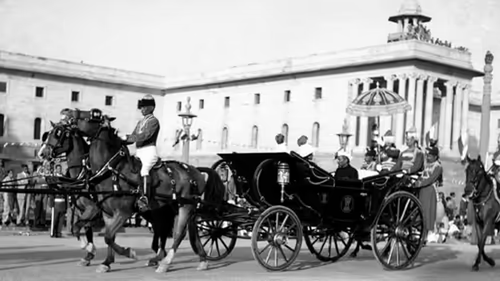
Seventy-six years ago, on a crisp January morning, a nation of over 320 million people stood at the threshold of a new era. It wasn’t just another day of celebration; it was the birth of a sovereign, democratic republic. While today’s Republic Day parade on Kartavya Path is a spectacle of military might and cultural grandeur, its humble beginnings in 1950 tell a profoundly different, yet equally powerful, story.
Table of Contents
- The Birth of a Republic
- The Historic Parade Route and Venue
- Indonesia’s Presidential Guest of Honor
- The Military Display: A Modest Beginning
- President Prasad’s Inaugural Vision
- From 1950 to Today: The Evolution of a Tradition
- Conclusion: The Enduring Legacy of January 26, 1950
- Sources
The Birth of a Republic
January 26, 1950, was not chosen at random. It was a date etched in the Indian freedom struggle, originally celebrated as ‘Purna Swaraj’ (Complete Independence) Day in 1930. On this historic day in 1950, the Constitution of India came into full effect, officially transforming the Dominion of India into the Republic of India. Dr. Rajendra Prasad was sworn in as the nation’s first President, marking the final step in India’s journey from a British colony to a self-governing democracy [[40]].
The Historic Parade Route and Venue
Contrary to popular belief, the iconic parade did not start on what is now Kartavya Path. The very first Republic Day parade 1950 had a much more intimate setting. The main event was held at the Irwin Stadium (now known as the National Stadium) in New Delhi [[3]]. The parade itself followed an 8-kilometer route from the Government House (now Rashtrapati Bhavan) to the stadium [[18]]. From 1950 to 1954, the venue rotated between several locations in Delhi before finally settling on Rajpath (now Kartavya Path) in 1955 [[22]].
Indonesia’s Presidential Guest of Honor
In a powerful symbol of solidarity among newly independent nations, the chief guest for India’s first Republic Day was none other than Dr. Sukarno, the first President of Indonesia [[9]]. His presence was a deliberate diplomatic gesture, reflecting the shared anti-colonial struggles and a vision for a new world order. This set a precedent for the international dimension of the Republic Day celebrations that continues to this day [[17]].
The Military Display: A Modest Beginning
The scale of the first parade was a far cry from today’s massive displays. It was a solemn and relatively simple affair, focused on the ceremonial rather than the spectacular. All three branches of the armed forces—Army, Navy, and Air Force—participated, but the display was limited largely to infantry marching contingents [[18]]. There were no complex fly-pasts or missile displays; the emphasis was on the dignity of the occasion and the formal presentation of the new republic’s armed forces to its first President [[30]].
President Prasad’s Inaugural Vision
Addressing the nation on this momentous day, President Dr. Rajendra Prasad delivered a speech that would become a cornerstone of the Indian republic’s ethos. He spoke of the core principles enshrined in the new Constitution: justice, liberty, equality, and fraternity. “There will be no prosecution of opinion or faith,” he declared, emphasizing the secular and democratic foundations of the new state [[41]]. His words were not just a statement of policy but a promise to a diverse and hopeful nation [[42]].
From 1950 to Today: The Evolution of a Tradition
The journey from that modest parade at Irwin Stadium to the grand spectacle on Kartavya Path is a mirror to India’s own evolution. Over the decades, the parade has grown to include elaborate cultural tableaux from every state and union territory, showcasing the nation’s incredible diversity. The military display has become a showcase of indigenous defence technology and strategic prowess. The inclusion of foreign army contingents, like the European Union’s in 2026, is a testament to India’s growing global stature—a stark contrast to its post-independence infancy in 1950 [[34]].
This evolution reflects a deeper truth: the Republic Day parade is more than just a ceremony. It is a living, breathing narrative of India’s journey as a nation.
Conclusion: The Enduring Legacy of January 26, 1950
While the scale and grandeur of the Republic Day celebrations have changed dramatically, the spirit of January 26, 1950, remains its unwavering core. That first parade was not about showing off power; it was about affirming a commitment to a democratic ideal. It was a promise made by a young nation to its people—a promise of justice, liberty, and equality. As we watch the modern parade unfold, it’s worth remembering the quiet dignity of that first event, which laid the foundation for everything that followed. For a deeper dive into the constitutional journey, explore our guide on [INTERNAL_LINK:indian-constitution-history].
Sources
- Moneycontrol. “What India’s first Republic Day parade in 1950 looked like.” https://www.moneycontrol.com/lifestyle/what-india-s-first-republic-day-parade-in-1950-looked-like-article-13788439.html
- Vedantu. “List of All Chief Guests on Indian Republic Day Parades.” https://www.vedantu.com/general-knowledge/list-of-all-chief-guests-on-indian-republic-day-parades
- Scroll.in. “January 26, 1950: How India’s first Republic Day unfolded.” https://amp.scroll.in/article/1090189/january-26-1950-how-indias-first-republic-day-unfolded
- The Better India. “5 Pre-Republic Day Speeches by Presidents That Told Us…” https://thebetterindia.com/247811/republic-day-president-address-to-the-nation-speech-constitution-ram-nath-kovind-abdul-kalam-india-nor41/
- National Herald. “Dr Rajendra Prasad on January 26, 1950: There will be no…” https://www.nationalheraldindia.com/india/dr-rajendra-prasad-on-january-26-1950-there-will-be-no-prosecution-of-opinion-or-faith
- Sunday Guardian. “Republic Day 2026: From 1950 to 2026 — Celebrating 77 years…” https://sundayguardianlive.com/india/republic-day-2026-from-1950-to-2026-celebrating-77-years-with-77-fascinating-facts-on-india-how-many-did-you-know-166500/
- Festivals of India. “26 january 1950,first republic day speech.” https://www.festivalsofindia.in/republicday/26-january-1950