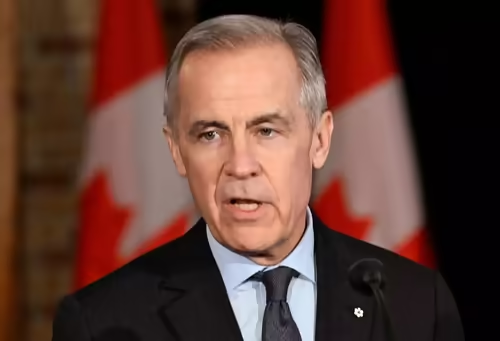
In a move that signals a major realignment in global diplomacy, Canadian Prime Minister Mark Carney is poised to make his first official trip to India in early March 2026. The Mark Carney India visit isn’t just another diplomatic stop—it’s a calculated strategic reset, driven by fraying ties with the United States, growing wariness of China, and a shared vision for a multipolar world order [[1]].
Coming just weeks after Canada’s high-profile “China pivot” review, this visit underscores Ottawa’s urgent push to diversify its economic and security partnerships. And India, with its booming tech sector, vast consumer market, and democratic credentials, is emerging as the ideal counterweight.
Table of Contents
- Why Now? The Geopolitical Backdrop
- Key Agendas for the Mark Carney India Visit
- The Uranium Deal: A Game-Changer
- CEPA Negotiations Finally Take Off
- Beyond Trade: Strategic and People-to-People Ties
- Challenges and Opportunities Ahead
- Conclusion: A New Era in India-Canada Relations?
- Sources
Why Now? The Geopolitical Backdrop
Canada’s foreign policy is at a crossroads. Relations with the U.S.—its largest trading partner—have soured under recent protectionist measures and tariff threats targeting Canadian energy and auto exports [[2]]. Simultaneously, Ottawa’s attempts to engage China have been met with diplomatic frostiness and security concerns over critical infrastructure [[3]].
In this volatile climate, India presents a rare opportunity: a stable democracy with a $4 trillion economy, a young workforce, and a shared interest in reducing dependence on adversarial powers. As one Canadian foreign policy advisor noted, “India is no longer Plan B—it’s Plan A for our Indo-Pacific strategy” [[4]].
Key Agendas for the Mark Carney India Visit
The March trip will be packed with high-stakes discussions. Confirmed agenda items include:
- Uranium supply agreement to support India’s civilian nuclear energy program.
- Critical minerals partnership covering lithium, cobalt, and graphite for EV and battery manufacturing.
- AI and quantum computing collaboration between Canadian research hubs and Indian tech firms.
- Education and cultural exchange programs to boost student mobility and academic ties.
- Formal launch of CEPA negotiations (Comprehensive Economic Partnership Agreement) after years of delay [[5]].
The Uranium Deal: A Game-Changer
Perhaps the most significant outcome will be the finalization of a long-pending uranium trade pact. Canada, one of the world’s top uranium producers, has been a key supplier to India since the 2010 civil nuclear deal. The new agreement is expected to secure long-term, low-enriched uranium shipments to fuel India’s expanding fleet of nuclear reactors—critical for meeting its 2070 net-zero target [[6]].
For Canada, it’s not just about revenue; it’s about positioning itself as a reliable, rules-based alternative to Russian or Chinese nuclear suppliers—a stance that aligns perfectly with India’s own strategic autonomy goals.
CEPA Negotiations Finally Take Off
After more than a decade of talks, the Comprehensive Economic Partnership Agreement (CEPA) between India and Canada is finally set to enter formal negotiation mode during Carney’s visit. The deal aims to eliminate tariffs on thousands of goods, ease services trade, and protect investments [[7]].
Key sectors expected to benefit include:
- Pharmaceuticals: Indian generic drug makers gaining better access to Canadian markets.
- IT & Software: Streamlined visa pathways for Indian tech professionals.
- Agriculture: Canadian pulses, lentils, and canola oil entering India with reduced duties.
While sensitive areas like dairy and labor mobility may face hurdles, both sides are signaling unprecedented political will to conclude a deal within 18–24 months [[8]].
Beyond Trade: Strategic and People-to-People Ties
The relationship goes beyond commerce. With over 1.8 million people of Indian origin in Canada—making up nearly 5% of its population—the diaspora is a powerful bridge [[9]]. The visit will also explore joint initiatives in climate tech, space cooperation (leveraging ISRO and CSA), and defense dialogues on maritime security in the Indo-Pacific.
Moreover, both nations see eye-to-eye on issues like multilateral reform, counter-terrorism, and upholding democratic values—foundations for a deeper strategic alignment [[INTERNAL_LINK:india-canada-diaspora-impact]].
Challenges and Opportunities Ahead
Despite the optimism, obstacles remain. Past tensions—such as the 2023 diplomatic row over alleged Indian involvement in a Sikh separatist killing on Canadian soil—still cast a shadow [[10]]. Trust-building will be essential.
Additionally, bureaucratic delays, differing regulatory standards, and competition from other trade blocs (like the EU-India FTA) could slow progress. Yet, the mutual urgency to reduce reliance on volatile partners may override these hurdles.
Conclusion: A New Era in India-Canada Relations?
The Mark Carney India visit marks more than a diplomatic handshake—it’s the opening chapter of a reimagined partnership. In an era defined by fragmentation, India and Canada are betting that shared values, complementary economies, and strategic necessity can forge a resilient alliance. If successful, this reset could become a blueprint for how middle powers navigate an increasingly bipolar world.
Sources
- Times of India: Canada PM Mark Carney likely to visit India in March
- Reuters: U.S.-Canada trade tensions escalate over auto tariffs
- Global Affairs Canada: Canada-India Relations: A Strategic Partnership
- Ministry of External Affairs, India: Joint Statement on India-Canada CEPA Framework
- International Energy Agency: Uranium 2025: Resources, Production and Demand
- Statistics Canada: Population and Demographics of Indian Origin in Canada